
Registration, Evaluation, Authorisation and Restriction of Chemicals (REACH)
REACH is the EU regulation that manages chemical safety by requiring companies to register substances, assess risks, and follow evaluation, authorisation and restriction procedures to protect health and the environment.
Overview
REACH — Registration, Evaluation, Authorisation and Restriction of Chemicals — is the principal European Union regulatory framework governing the manufacture, placement on the market and use of chemical substances. Adopted in the mid‑2000s and in force since 2007, it places primary responsibility for demonstrating safe use on industry rather than regulators. Companies that manufacture or import substances for use in the European Union must gather and submit information about hazards, uses and risk management measures.
Image gallery
1 Image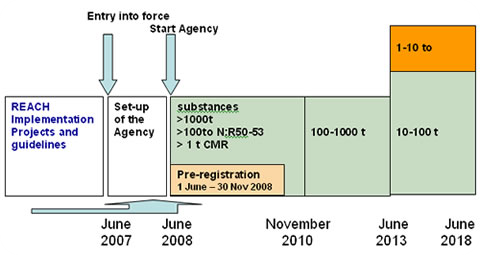
Who must comply and what is covered
REACH applies to substances on their own, in mixtures and in manufactured articles, with specific exemptions (for example for radioactive materials, certain medicines and foodstuffs). Generally, manufacturers and importers handling one tonne or more per year of a substance must register that substance with the European Chemicals Agency (ECHA). The scope includes industrial chemicals, intermediates and many consumer chemicals supplied in the market.
Core processes
The regulation is organised around four interlocking processes:
- Registration — Submission of dossiers describing substance identity, intrinsic properties, uses and proposed risk management. For higher tonnages, dossiers include a Chemical Safety Assessment and exposure scenarios.
- Evaluation — ECHA and Member State authorities review dossiers and test proposals to check data quality, adequacy and whether further information or testing is needed.
- Authorisation — Substances identified as of very high concern (SVHCs) may require authorisation for specific uses, listed in Annex XIV; authorisation aims to ensure their risks are properly controlled or that suitable alternatives are used.
- Restriction — Where necessary to protect health or the environment, manufacture and use of a substance can be limited or prohibited under Annex XVII, across the internal market.
Roles and governance
ECHA, based in Helsinki, manages technical and administrative processes: it receives registrations, maintains public lists such as the Candidate List of SVHCs and provides guidance for compliance. National authorities in Member States enforce the rules, perform inspections and carry out some evaluations. The regulatory process emphasises transparency and information sharing within supply chains to support safe use.
Practical implications and impact
REACH has encouraged manufacturers and downstream users to generate safety data, improve labelling and communicate exposure scenarios in Safety Data Sheets. It seeks to reduce unnecessary animal testing by promoting data sharing and alternative methods. The system has increased regulatory burdens and compliance costs for some businesses, notably for complex supply chains and smaller enterprises, but it has also driven substitution of hazardous substances, improved product stewardship and influenced chemical management beyond the EU. For official guidance and detailed obligations see the REACH information maintained by the European Commission and ECHA (REACH information).
Challenges and ongoing developments
Implementing REACH requires balancing protection of human health and the environment with technical feasibility and economic considerations. Prioritisation of substances for review, scientific assessment of complex hazards, and international trade impacts are recurring topics. The framework is periodically updated through amendments to annexes and procedural guidance to reflect new science, policy goals and court decisions.
Related articles
Author
AlegsaOnline.com Registration, Evaluation, Authorisation and Restriction of Chemicals (REACH) Leandro Alegsa
URL: https://en.alegsaonline.com/art/81907