
Blaise Pascal (1623–1662)
French mathematician, physicist, inventor and writer whose contributions include probability theory, Pascal's triangle, experiments on pressure and the mechanical calculator, and influential religious writings.
Overview
Blaise Pascal was a 17th-century French thinker notable for contributions across mathematics, physical science, engineering and religious literature. Born in Clermont-Ferrand, France in 1623, he displayed early talent in mathematics and was educated by his father Étienne. He died in Paris in 1662 after a life of intense intellectual activity and recurring ill health. Pascal combined rigorous scientific investigation with a deep interest in theology and moral reasoning, bridging technical and humanistic fields.
Image gallery
10 Images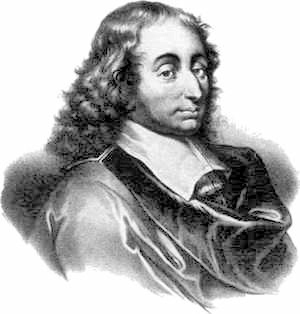


Scientific and mathematical work
Pascal established his reputation as a young mathematician and geometer. His work on the arithmetical triangle—commonly known as Pascal's triangle—clarified properties of binomial coefficients and combinatorial patterns. In correspondence with other mathematicians he helped lay foundations of probability theory, addressing problems of gambling and expectation that later became central to statistics and decision theory. He also made early contributions to projective geometry; one famous result from his teens is a theorem about a hexagon inscribed in a conic.
Experiments, inventions and practical science
Pascal carried out careful physical experiments and argued for the use of experiment in understanding nature, endorsing the emerging scientific method. He investigated the properties of fluids and atmospheric pressure, producing observations that reinforced the reality of a vacuum and helped establish principles later summarized as Pascal's law on transmission of pressure in liquids. Around 1642 he built a mechanical adding device, the pascaline, an early calculating machine designed to reduce errors in accounting.
Philosophy, theology and writings
In addition to technical works, Pascal wrote influential religious and philosophical texts. He became associated with the Jansenist movement and addressed contemporary theological controversies in the Lettres provinciales. His unfinished manuscript collection, published posthumously as the Pensées, contains famous reflections on faith, reason and what is often called "Pascal's wager," a pragmatic argument about belief that continues to be discussed in philosophy of religion. He is also remembered as a Catholic theologian who sought to reconcile rigorous thought with spiritual concerns.
Notable facts and legacy
Pascal's interdisciplinary work left a diverse legacy. The SI unit of pressure, the pascal, honors his contributions to hydrostatics. His investigations into probability and expectation influenced later mathematics and economics. His experiments on barometric pressure and support for empirical testing helped shape experimental physics. He remains a figure who linked mathematical precision with practical invention and reflective religious writing.
- Early life and training under his father in Clermont-Ferrand and later activity in Paris.
- Mathematical achievements: Pascal's triangle, probability (correspondence), and projective geometry.
- Physical science: experiments on the vacuum and fluids supporting the law of pressure transmission.
- Inventions: the mechanical calculator (pascaline) for practical arithmetic.
- Writings: polemical letters and the spiritual Pensées, reflecting his role as a theologian and public intellectual.
For readers seeking more detail about his life and works, consult general surveys of 17th‑century science and philosophy or specialized studies of the history of probability, hydraulics and early computing; primary editions and modern translations of Pascal's letters and Pensées also provide direct access to his thought. Additional online resources or library catalogues led by reputable institutions give reliable overviews of his biography and lasting influence in mathematics and physics.
Although his health remained fragile for much of his life and the precise cause of his early death is uncertain, Pascal's short career produced enduring ideas and inventions whose names—such as the triangle and the pascal unit—continue to appear across science and culture.
Related articles
Author
AlegsaOnline.com Blaise Pascal (1623–1662) Leandro Alegsa
URL: https://en.alegsaonline.com/art/12073