
2nd century BC (200–101 BC)
Overview of major political, military, cultural and economic developments in the 2nd century BC, including Roman expansion, Hellenistic transformations, Han China and the growth of long‑distance exchange.
Overview
The 2nd century BC began on 200 BC and ended on 101 BC. Historians commonly place it within the broader Classical period, a time when large territorial states, intensified diplomacy and expanding networks of trade reshaped political life across Eurasia. The century is marked by Roman ascendancy in the west, important transformations among the Hellenistic successor states in the Near East, and the consolidation and outward expansion of the Han dynasty in East Asia.
Image gallery
10 Images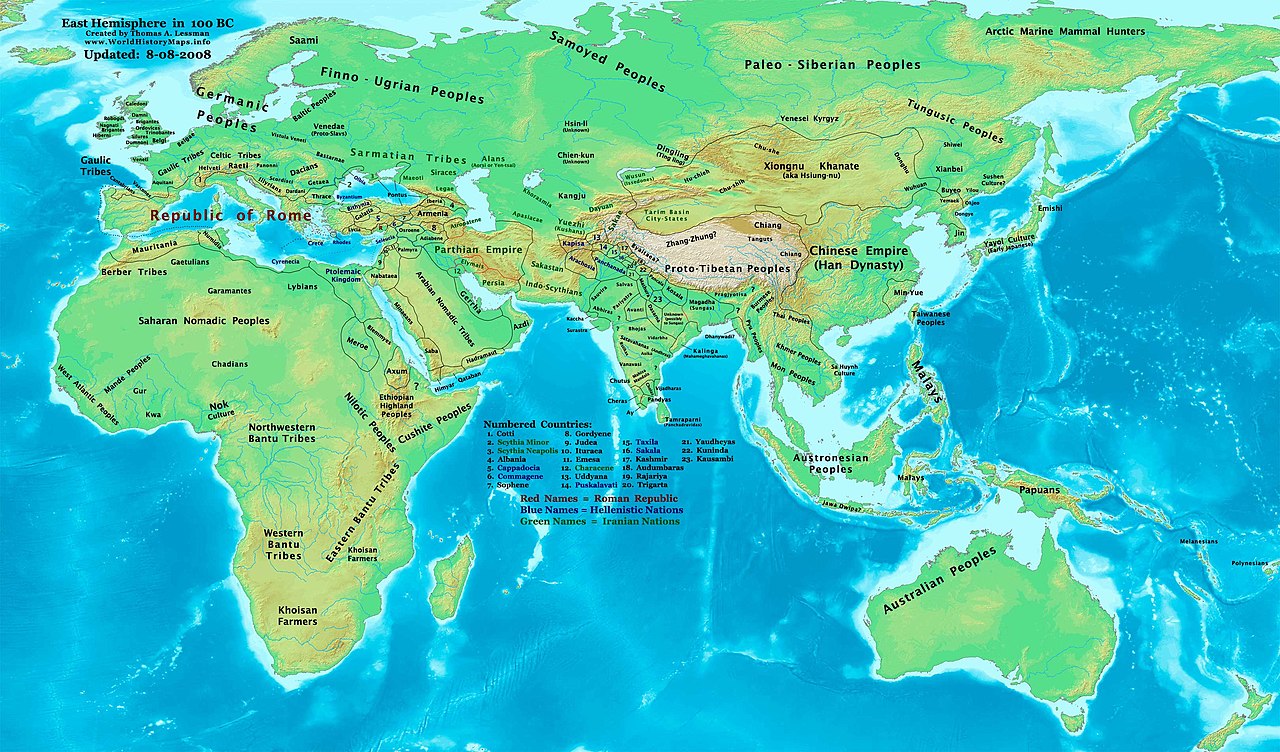




Rome and the western Mediterranean
After its victory in the Second Punic War, Rome consolidated control across the Italian peninsula and projected power into the Hellenistic world. The Roman Republic intervened repeatedly in Greek affairs, and through a combination of military action and diplomatic settlement effectively absorbed much of Greece by mid‑century. In North Africa Rome eliminated its principal rival when it destroyed Carthage at the end of the Third Punic War, acquiring coastal territories in North Africa and gaining unchallenged naval supremacy in the Mediterranean Sea.
Institutions, military change and social pressures
Growing frontier commitments and internal strains prompted changes in Roman society and armed forces. Recruitment practices and the composition of the army evolved as the Republic moved away from older systems of citizen conscription based on property toward arrangements that encouraged longer service and greater professionalism. Political tensions surfaced in reform efforts and popular movements, including prominent challenges to elite privilege and land distribution that foreshadowed deeper conflicts of the following century.
Hellenistic and Near Eastern transformations
The states formed after Alexander the Great continued to fragment. The Seleucid Empire experienced territorial losses and internal unrest as local rulers, Parthian expansion, and Roman influence eroded its authority. Other Hellenistic realms—Pergamon, Egypt and Macedonia—were drawn into Roman diplomacy and war, altering the balance of power in the eastern Mediterranean. These shifts increased movement of peoples and goods across Asia Minor and the Fertile Crescent.
Han China and contacts to the west
In East Asia the Han dynasty consolidated imperial institutions and expanded beyond the Yellow River basin. Under assertive rulers the Han projected influence into regions that touched the Korean peninsula (Korea), northern parts of what is today Vietnam, and territories approaching modern Kazakhstan. Diplomatic missions and military campaigns engaged nomadic confederations such as the Xiongnu, and exploratory journeys by envoys opened early routes that would later be called the Silk Road. The period also saw advances in administrative record keeping and writing materials; early developments in the manufacture and use of paper and other supports contributed to more extensive bureaucratic documentation.
Trade, culture and legacy
Across the century there was an intensification of long‑distance exchange. Mediterranean maritime trade, caravan routes across the Near East and new connections between Central Asia and East Asia carried luxury goods, technologies and ideas. Urban centres and port cities prospered, while artistic and intellectual life reflected blends of local traditions and Hellenistic forms. Legal, fiscal and military innovations during this century set conditions that led to the major political realignments and imperial formations of the 1st century BC.
Key themes and events
- Roman consolidation after the Second Punic War and expansion into Greece and North Africa.
- The fall of Carthage following the Third Punic War, and Roman control of the Mediterranean Sea.
- Evolving military recruitment and organisation in Rome, with changes in the army and the practice of conscription.
- Hellenistic political fragmentation and pressure on the Seleucid Empire.
- Han imperial consolidation, diplomacy with the Xiongnu, and contacts reaching Korea, Vietnam and regions near Kazakhstan.
- Emerging long‑distance routes and technological advances, including early stages in the use of paper, which aided administration and transmission of knowledge.
Related articles
Author
AlegsaOnline.com 2nd century BC (200–101 BC) Leandro Alegsa
URL: https://en.alegsaonline.com/art/112778