
White matter: structure, function, development, and clinical importance
White matter is the myelinated nerve fiber tissue of the central nervous system that connects regions of grey matter; crucial for signal transmission, development, and many neurological disorders.
Overview
White matter is one of the principal tissue types of the central nervous system, alongside grey matter. It is composed mainly of bundles of myelinated axons that interconnect neuronal cell bodies and processing centers. These long-range connections allow rapid and coordinated transmission of electrical signals across the brain and spinal cord. For a general description of the larger system, see central nervous system.
Image gallery
3 Images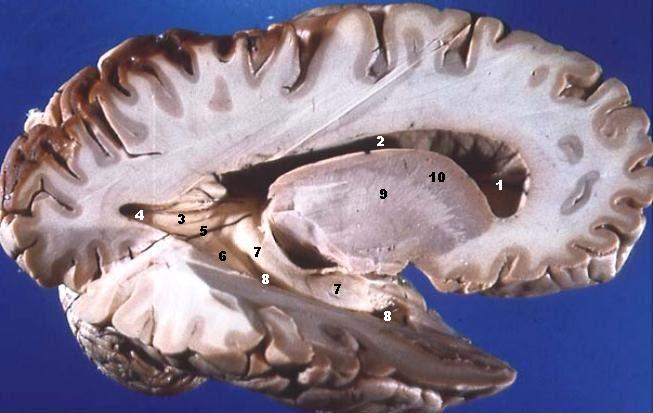


Composition and appearance
The defining component of white matter is myelin, a lipid-rich insulating sheath that surrounds axons. Myelin is produced by specialized glial cells and increases conduction speed and efficiency. In microscopic sections myelin and axons dominate, while small blood vessels such as capillaries supply nutrients. Fresh tissue may show a faint pink tint, but when fixed with agents like formaldehyde the myelinated regions appear pale or white because of their high lipid content. For terms related to insulation of axons, see myelinated and axons.
Organization and regional differences
In the cerebral hemispheres white matter usually lies beneath the outer layer of grey matter, forming tracts that link cortical areas and subcortical nuclei. In the spinal cord this arrangement is reversed: white matter forms the outer columns while grey matter occupies the interior. The bulk of myelin is made of lipid components and proteins. The brain proper is often discussed as a whole; see brain resources for context. Separate, darker regions such as the substantia nigra are distinct in composition and function from white matter.
Functions and importance
White matter tracts transmit signals that underlie sensation, movement, cognition and coordination. They include projection pathways (between cortex and lower centers), association fibers (within a hemisphere) and commissural fibers (between hemispheres). Key roles include:
- Speeding and coordinating neural signaling across distances.
- Integrating distributed processing carried out by grey matter regions.
- Enabling plastic changes and rerouting after injury, though recovery capacity varies.
Some brain areas associated with reward and movement, and processes such as pleasure, addiction and movement, interact extensively with white matter pathways.
Development, aging and plasticity
White matter undergoes prolonged maturation during childhood and adolescence as myelination progresses; this contributes to improvements in processing speed and executive function. In later life myelin integrity can decline, and small vessel changes or degeneration may reduce conduction efficiency. The brain can sometimes establish alternative pathways after damage, reflecting limited but meaningful plasticity of white matter connections.
Clinical relevance and imaging
Damage to white matter underlies a range of neurological conditions. Demyelinating diseases (for example, multiple sclerosis), traumatic injury, ischemic small-vessel disease, and genetic leukoencephalopathies affect white matter structure and function. On magnetic resonance imaging (MRI), many white matter abnormalities are visible as signal changes commonly reported as lesions or hyperintensities; such findings are interpreted alongside clinical context. Preservation of white matter is therefore important for mobility, cognition and everyday functioning.
Further reading
To learn more about related topics, consult introductory resources on grey matter, the spinal cord, and general guides to brain anatomy and pathology. Specialized reviews discuss the roles of myelination and vascular support in white matter health.
Related articles
Author
AlegsaOnline.com White matter: structure, function, development, and clinical importance Leandro Alegsa
URL: https://en.alegsaonline.com/art/107829