
Van de Graaff generator — electrostatic high-voltage generator
Electrostatic device that uses a moving insulating belt to concentrate charge on a hollow metal sphere, producing very high voltages for research, accelerators, industry and classroom demonstrations.
Overview
The Van de Graaff generator is a class of electrostatic machine that accumulates electric charge on a smooth, hollow conductor to produce very high potentials. Small tabletop units are widely used in classrooms to demonstrate static electricity, while larger laboratory machines reach potentials of several megavolts and serve as components in particle accelerators and high-voltage research. The device stores charge on an external terminal so that the terminal behaves as a high-voltage reservoir, and it is valued for a simple mechanical principle that yields large voltages with relatively low current.
Image gallery
10 Images
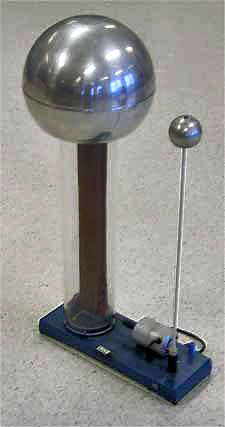


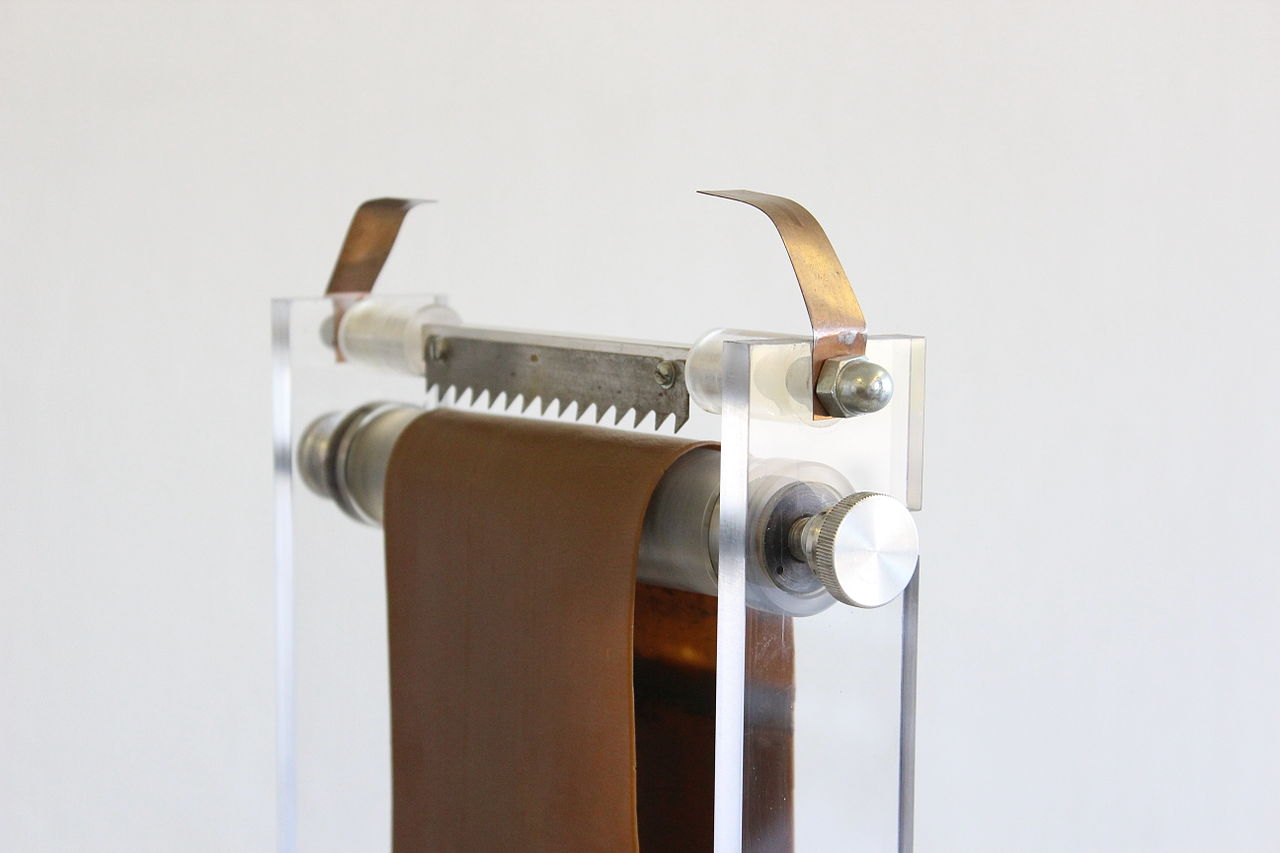


Principle of operation
Central to the design is a moving insulating belt that carries charge between two electrodes. A charge generator near the lower roller deposits charge onto the belt; the belt transports that charge to the upper terminal, where a complementary electrode transfers it to the outer conductor. Because like charges concentrate on the outside of a conductor, the terminal accumulates charge and its potential rises. In circuit terms the machine acts approximately like a steady current source charging a capacitor: an electrical model treats the terminal as a capacitor in parallel with a very large resistance that represents inevitable resistive leakage paths to ground. The terminal voltage increases until losses from leakage, corona discharge, or dielectric breakdown balance the charging current.
Construction and components
Typical components include an insulating belt made from a nonmetallic belt material, upper and lower rollers (often of differing materials to favor charge transfer), and a large smooth hollow metal sphere or terminal that stores charge. Small machines use simple brushes or needles to effect charge transfer; larger devices may use optimized electrodes, environmental control (dry gas or vacuum), and motor drives to maintain steady operation. Mechanical design seeks to minimize sharp points and surface irregularities on the terminal to reduce unwanted corona and premature leakage.
Variants and accelerator use
Variants include tandem and cascade arrangements in which ions are accelerated through the potential multiple times to achieve higher particle energies. In a tandem machine, negative ions are accelerated toward the high-voltage terminal, stripped of electrons there, and then accelerated again away, effectively doubling the energy gain. Van de Graaff generators or their modern descendants are one class among high-voltage generators used to drive beams for research. They have been used to supply voltages to specialized X-ray tubes and to accelerate particles for experiments in nuclear physics and related fields.
Applications
- Educational demonstrations of electrostatics: sparks, charge repulsion, and the effect of geometry on field strength.
- Particle acceleration for nuclear and atomic physics experiments and isotope production.
- Industrial electron-beam processes such as sterilization, materials modification, and polymer cross-linking where energetic electrons are required.
- Generation of high voltages for specialized imaging or electrical testing systems, including some X-ray applications.
Performance, limits and safety
Terminal potentials of modern Van de Graaff machines can reach several megavolts under controlled conditions, but practical limits are set by surface geometry, humidity, air pressure or vacuum conditions, and the onset of corona or breakdown. Although the available current at the terminal is typically small, voltages at megavolt scale can cause serious injury or equipment damage, especially where stored energy or secondary discharges are present. Proper insulation, interlocks, grounding procedures, and environmental control are essential in laboratory and industrial installations.
History and significance
The concept is named for the American physicist Robert J. Van de Graaff, who built the first practical generators of this type in the late 1920s. His invention provided a compact, scalable method to reach high voltages and helped expand experimental study of high-energy phenomena. Over time, refinements in materials, electrode design and environmental control extended the usefulness of the design and led to larger accelerator facilities and industrial applications.
Further reading: Introductory texts on electrostatics and high-voltage engineering describe the underlying physics and practical design considerations; reviews of accelerator technology place Van de Graaff machines in the context of other high-voltage sources and modern particle accelerators.
Related articles
Author
AlegsaOnline.com Van de Graaff generator — electrostatic high-voltage generator Leandro Alegsa
URL: https://en.alegsaonline.com/art/104140