
Prunus mume (Ume): the East Asian plum or Japanese apricot
Prunus mume, known as ume, is an East Asian deciduous tree valued for fragrant winter blossoms and a tart fruit used in cuisine, drinks, preserves and cultural symbolism across China, Japan and Korea.
Prunus mume, commonly called ume in Japanese and mei in Chinese, is a small deciduous tree of the rose family (Rosaceae) grown across East Asia for its early, fragrant blossoms and its strongly flavored fruit. Although often translated as "Japanese apricot" or "Japanese plum," it is distinct from the true apricot and the common plum; its botanical placement is within the genus Prunus and it is related to other stone-fruit species. Ume is highly valued both as an ornamental for winter flowers and as an agricultural crop for preserves, beverages and condiments.

Image gallery
10 Images


Characteristics
Prunus mume typically grows as a small tree or large shrub. It produces five-petaled flowers in late winter or very early spring, often before the leaves open. Flower colors range from pure white to pale pink and deeper rose, and forms vary from single to double blooms. The flowers are notably fragrant and have been cultivated for their scent and appearance for centuries.
The fruit is a drupe with a single stone; it is initially green and becomes yellowish when ripe. The fresh fruit is sour and astringent, which led to a long tradition of processing—pickling, fermenting, candying and macerating—to make it palatable and long-lasting. Trees are hardy to cool climates, prefer well-drained soil and a sunny site, and are often propagated by grafting to preserve desired cultivars.
History and cultural significance
Prunus mume is native to parts of China from where it spread to neighboring regions of Korea and Japan at an early date. In East Asian cultures the blossom has deep symbolic meaning: it represents endurance and renewal because it flowers in winter, and it appears frequently in poetry, painting and ceremonial practice. In Chinese art the plum blossom is one of the "Four Gentlemen" (along with orchid, bamboo and chrysanthemum) used to express refined qualities. Various festivals celebrate the ume bloom each year in parks and temple gardens.
Uses and importance
- Culinary: In Japan, the fruit is widely used to make umeboshi (salted pickles) and umeshu (plum liqueur); in Korea it becomes maesil-cheong (a syrup) and maesil-ju (plum wine); in China there are preserved plums and sour plum beverages. The tart, aromatic fruit is rarely eaten raw in quantity.
- Ornamental: Cultivated for early-season blossoms, many gardens and public spaces plant ume varieties to enjoy their color and fragrance when few other trees are in flower.
- Traditional medicine and condiments: Processed ume products have long-standing roles as flavoring agents and folk remedies in East Asian cuisines and remedies, though modern medical claims should be treated with caution.
Varieties and cultivation
There are hundreds of cultivars, especially in Japan, selected for either flower form, fragrance or fruit quality. Cultivars differ in bloom time, flower color, fruit size and taste; some are prized specifically for making umeboshi, while others are grown primarily as ornamental flowering trees. Growers manage soil, pruning and winter protection to balance flowering and fruit production and to reduce susceptibility to fungal and bacterial diseases common to stone fruits.
Notable distinctions and facts
Although common English names like "Japanese apricot" suggest a close relationship to the apricot, Prunus mume occupies a distinct position and should not be confused with Prunus salicina (the Japanese plum) or true apricots. Its cultural prominence in East Asia rivals that of the cherry blossom in some contexts, but the ume blooms earlier and carries different symbolic associations related to fortitude and the coming of spring.
Because of its dual roles—ornamental and utilitarian—Prunus mume remains a significant plant in horticulture, cuisine and cultural tradition across China, Japan and Korea.
Etymology
The scientific name (Prunus mume) preserves another old Japanese pronunciation, possibly the original mme (んめ), which was historically written as "mume" (むめ), as there was no special kana for the single nasal sound used at that time. All three names (chin. méi, jap. ume and kor. maesil) derive from the country-specific pronunciation of the same character 梅.
Features
The Ume is a deciduous tree with a round crown that reaches growth heights of 1 to 15 metres, or a tall shrub. The thin bark is grey-green.
The simple, alternate, fresh green, paler underneath, slightly leathery leaves are 4 to 10 centimetres long, ovate to elliptical and with serrated margins. When young they are hairy on both sides, later glabrous on top, hairy on the underside only on the veins and often have a pointed, crooked tip.
The flowers are solitary or in pairs, single or double. They are white to dark pink in colour, almost stalkless, appear before the leaves and have a strong fragrance, especially in the evening. The flower cup is broadly cup-shaped, it is a winter bloomer and the flowers appear before the leaves.
The small drupe has a diameter of 2 to 3 centimeters and is yellow or green, somewhat hairy, spherical and sour to bitter. The stone core is pitted and adheres well to the flesh. Individual specimens can live for over a thousand years.
The chromosome number is 2n = 16, rarely 32.
· 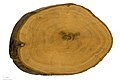
Cross section through a trunk of an ume
· 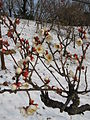
White flowers of Prunus mume in the snow
· 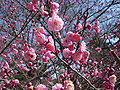
Pink flowers of Prunus mume at the Imperial Palace in Kyōto
· 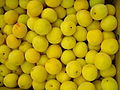
Fruits of Prunus mume
· 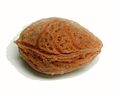
Stone core of Prunus mume
Related articles
Author
AlegsaOnline.com Prunus mume (Ume): the East Asian plum or Japanese apricot Leandro Alegsa
URL: https://en.alegsaonline.com/art/102742
Sources
- wdl.org : "The Plum Blossom"
- commons.wikimedia.org : Prunus mume