
Vanda (orchid): description, distribution, cultivation and significance
Vanda is a genus of mainly epiphytic orchids prized for showy, long‑lasting flowers. This article summarizes appearance, natural range, cultivation, propagation and conservation considerations.
Vanda is a genus of orchids in the family Orchidaceae and is treated by growers and botanists as one of the most important groups in floriculture. The name appears in botanical literature as the genus Vanda, often abbreviated to "V." in trade. Species are valued for large, colorful, frequently fragrant flowers and for their use in hybrid breeding programs.
Image gallery
10 Images
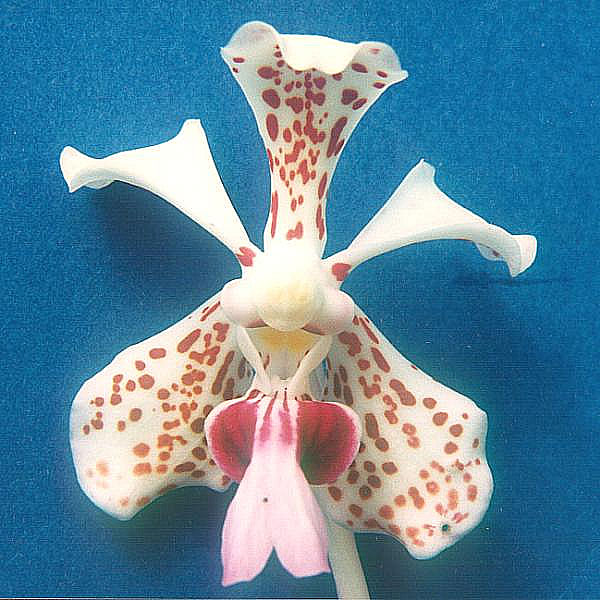


Description
Plants in this genus are typically monopodial, producing a single upright stem with leaves arranged along it, and many are epiphytic or lithophytic, growing on trees or rocks rather than in soil. Vanda orchids have thick, aerial roots that absorb moisture and nutrients directly from the air and from rainfall. Leaves are usually long and strap-like. Flowers arise on racemes or panicles and can be long-lived; colors and patterns are diverse, which contributes to their popularity in displays and hybridization.
Distribution
Wild Vanda species occur across a broad portion of Asia and Australasia. Natural populations are found in parts of East Asia, throughout much of Southeast Asia, and across New Guinea. A few species extend into northern Australia, notably in Queensland, and to some islands of the western Pacific. Because taxonomy continues to be revised, the commonly cited count is about fifty species, though that number may vary among authorities.
Horticulture and cultivation
Vandas are highly prized in horticulture and are commonly grown for exhibition and cut flowers. They require bright light, good air movement and high humidity to thrive. Many growers mount Vandas on bark or cork or place them in open baskets so their aerial roots receive free air circulation. Watering is frequent in warm conditions, and regular, balanced fertilization during the growing season supports strong root growth and flowering.
Propagation and care
Propagation of Vanda orchids in cultivation is achieved by seed under sterile conditions and by vegetative methods such as stem cuttings, keiki production or tissue culture for mass propagation. Because many wild plants are slow to reproduce in situ, nursery propagation supplies the horticultural trade while reducing pressure on native populations. Proper care includes seasonal adjustment of water, light and fertilizer to encourage spike initiation and blossom longevity.
Taxonomy and conservation
Vanda belongs to a group of orchids often placed in the subtribe Aeridinae within the orchid family; taxonomic placement can vary as research advances. Several wild species face threats from habitat loss, fragmentation and collection for trade. Many orchid species, including some Vandas, are subject to regulations or trade controls to discourage wild collection and support conservation. Conservation measures include habitat protection, cultivation in botanical gardens, ex situ propagation programs and public education to promote sustainable practices.
For further reading on classification, cultivation techniques and conservation recommendations, see specialized botanical references and regional floras; horticultural societies and botanical gardens also provide guidance for growers and conservationists. Additional resources and supplier information are often cited in horticultural guides and academic treatments of the group, where more detailed species-level accounts are available via specialist sources such as monographs and orchid societies (reference, regional accounts, conservation lists, distribution maps, Australian records, East Asian studies, horticulture manuals, taxonomic databases, and family-level treatments).
Related articles
Author
AlegsaOnline.com Vanda (orchid): description, distribution, cultivation and significance Leandro Alegsa
URL: https://en.alegsaonline.com/art/104180
Sources
- apps.kew.org : Kew World Checklist of selected plant families