
Valonia ventricosa — bubble algae, a giant single-celled green alga
Valonia ventricosa is a marine green alga known as bubble algae or sailors’ eyeballs; notable as one of the largest single cells, found in tropical and subtropical seas and studied for its unique cell biology.
Overview
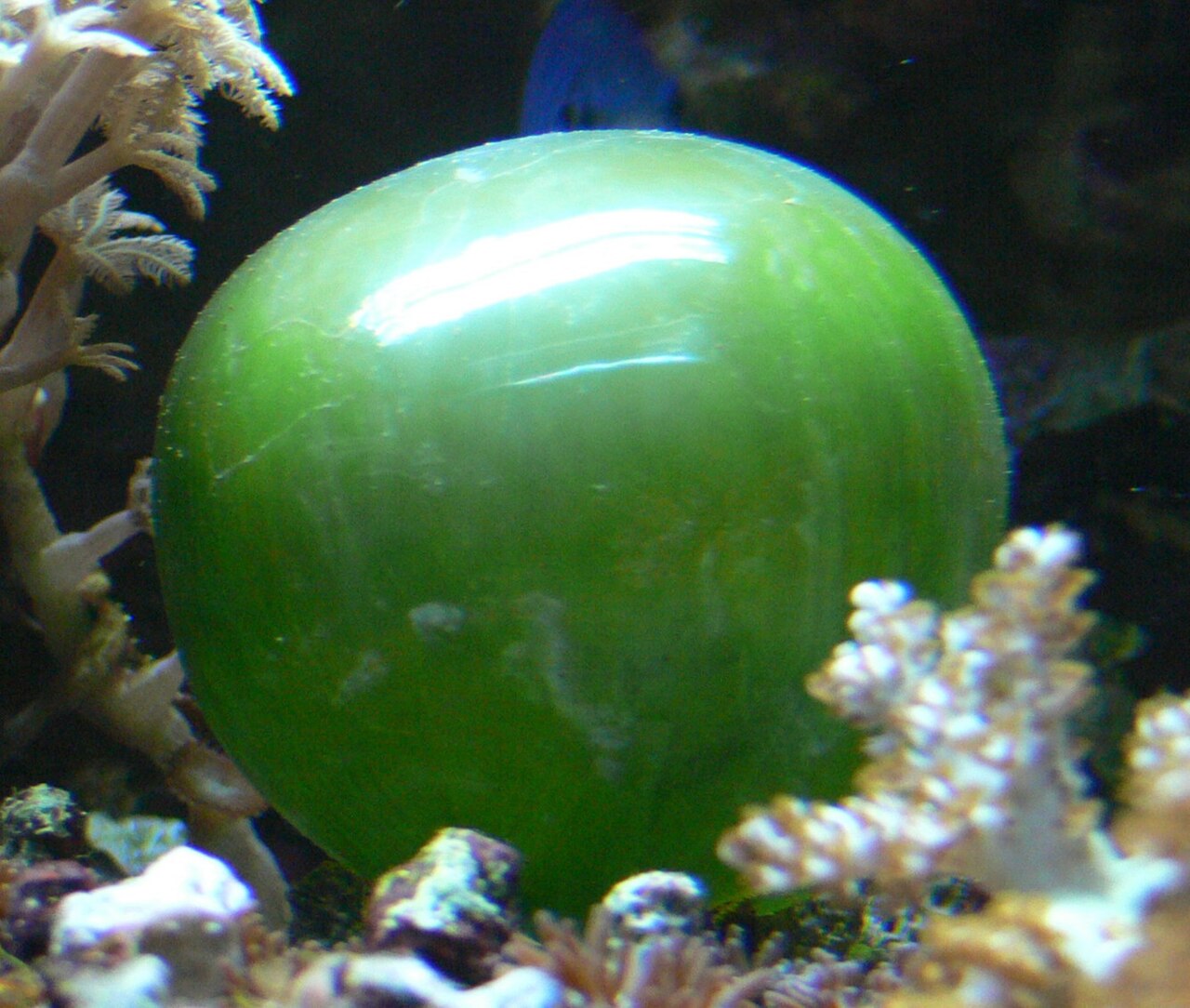
Valonia ventricosa, commonly called bubble algae or sailors’ eyeballs, is a marine green alga notable for forming glossy, spherical thalli that are in fact single cells. It occurs in warm coastal waters worldwide and attracts scientific attention because of its unusual size and internal organization: one cell can reach a few centimetres across and contain many nuclei.
Image gallery
3 Images

Structure and characteristics
The organism is siphonous (coenocytic), meaning its body is a multinucleate cell without cross-walls. Externally it appears as a smooth, translucent green bladder attached to rock, seagrass or other substrates by a short stalk. Internally the cell typically contains a large central vacuole with a thin peripheral layer of cytoplasm that houses chloroplasts, nuclei and organelles responsible for photosynthesis and metabolism. The thick cell wall and shiny surface make the spheres conspicuous in shallow water.
Habitat and ecology
Valonia ventricosa inhabits intertidal to shallow subtidal zones in tropical and subtropical regions. It grows on hard substrates such as stones, shells, algae and man-made structures and is often found in seagrass beds and reef flats. As a photosynthetic alga it contributes to primary production and provides microhabitats for small invertebrates, though in confined systems such as aquaria it is sometimes regarded as a pest because it can propagate and spread.
Reproduction and lifecycle
Like many siphonous algae, V. ventricosa reproduces by a combination of vegetative fragmentation and sexual or asexual spore formation, depending on environmental conditions. Fragments of the cell or specialized reproductive cells can give rise to new individuals. Because whole thalli are single multinucleate cells, damage that releases cytoplasm may enable rapid colonization if fragments settle and regenerate.
Scientific and practical significance
Valonia ventricosa has been used as a model in cell biology and physiology because its large cell size permits direct experimental access to membranes, vacuoles and cytoplasm. Researchers have studied ion transport, membrane permeability and cytoplasmic organization using this species. In marine aquaria and reef tanks it is well known to hobbyists for its persistent, balloon-like appearance and ability to spread under favorable conditions.
Notable distinctions
- Size: One of the largest single-celled organisms; despite macroscopic appearance it remains one continuous cell.
- Organization: Coenocytic structure with many nuclei rather than multiple distinct cells.
- Similarity to other algae: Bubble-like thalli are produced by several related species, but V. ventricosa is characteristic for its spherical, glossy bladders and broad tropical distribution.
For further details and taxonomic information follow specialist sources or the linked reference above. The species continues to interest both marine biologists and aquarium enthusiasts because it combines a simple outward form with complex cellular biology.
Questions and answers
Q: What is Valonia ventricosa?
A: Valonia ventricosa is a species of algae found in oceans throughout the world in tropical and subtropical regions.
Q: What are some other names for Valonia ventricosa?
A: Valonia ventricosa is also known as "bubble algae" and "sailors’ eyeballs".
Q: How large is Valonia ventricosa?
A: Valonia ventricosa is one of the largest single-celled organisms.
Q: Is Valonia ventricosa truly a single cell?
A: Yes, Valonia ventricosa is genuinely a single cell.
Q: Does Valonia ventricosa have more than one nucleus?
A: Yes, Valonia ventricosa has more than one nucleus.
Q: Where in the world can Valonia ventricosa be found?
A: Valonia ventricosa can be found in oceans throughout the world in tropical and subtropical regions.
Q: What type of organism is Valonia ventricosa?
A: Valonia ventricosa is a species of algae.
Related articles
Author
AlegsaOnline.com Valonia ventricosa — bubble algae, a giant single-celled green alga Leandro Alegsa
URL: https://en.alegsaonline.com/art/104088
Sources
- itis.gov : "Valonia ventricosa. J. Agardh"
- allatsea.net : "Gazing Balls in the Sea"
- books.google.com : Coral reefs of the southern Gulf of Mexico
- data.gbif.org : Overview occurrence, Valonia ventricosa
- books.google.com : Phycology
- books.google.com : Échanges ioniques transmembranaires chez les végétaux
- sciencemag.org : "Membranes of Valonia ventricosa: Apparent Absence of Water-Filled Pores"
- jstor.org : "X-Ray analysis of the structure of the wall of Valonia ventricosa. I"
- doi.org : 10.1098/rspb.1932.0005