
Umar ibn al-Khattab: Second Rashidun Caliph and Statesman
Umar ibn al-Khattab (c. 583–644) was the second Rashidun caliph, a close companion of Muhammad, a jurist and administrator whose reign saw rapid territorial expansion and administrative reforms.
Overview
Umar ibn al-Khaṭšāb (Arabic: عمر بن الخطاب) was a leading companion of the Islamic prophet Muhammad and the second caliph of the Rashidun period. Born around 583–584 CE, he converted to Islam after originally opposing the new faith. He succeeded Abu Bakr to the caliphate in 634 and ruled until his assassination in 644. Revered for his stern piety and reputation for justice, he acquired the honorific al-Farooq — "the one who distinguishes between right and wrong."
Image gallery
8 Images




Administration and reforms
Umar is remembered less for personal wealth than for creating institutions that shaped early Islamic governance. He organized a centralized treasury, established the public register (diwan) to record soldiers and stipends, and set administrative divisions for the rapidly expanding state. He is credited with initiating the Islamic lunar calendar for official use and strengthening judicial and provincial rule by appointing qualified governors and judges.
His practical measures included public works, road improvements, and measures intended to protect the poor and veterans. Umar emphasized accountability: governors could be removed for misconduct, and he sought to keep central authority responsive to local conditions. These reforms helped convert military successes into lasting territorial and administrative control.
Military expansion and territories
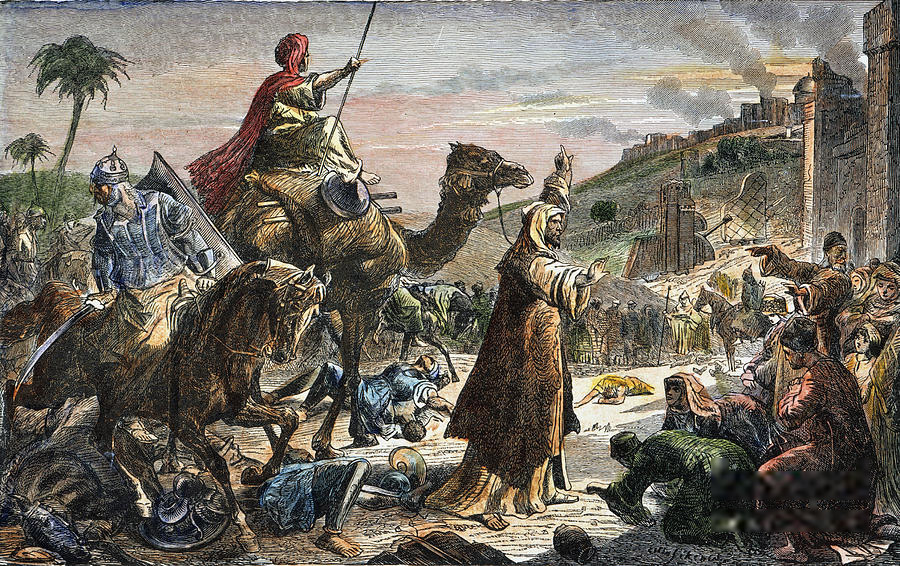
During Umar's decade-long rule the caliphate extended dramatically. Muslim forces pressed into Sasanian Persia and large portions of Byzantine-held territories, gaining control over key provinces and cities. Contemporary and later sources describe rapid conquests that reshaped the map of the Near East. His military leadership combined delegating command to capable generals with strategic consolidation of conquered lands.
- Campaigns against the Sasanian state brought much of Persia under Muslim rule within a few years.
- Byzantine provinces in the Levant and Egypt were also taken, altering the balance of power.
Religious and social policies
Umar's approach to religious minorities was governed by pragmatic policies that recognized Jews and Christians as "People of the Book." Jewish and Christian communities were generally allowed to practice their faiths in return for a tax and recognition of Muslim authority; some traditions also say he allowed Jewish entry into Jerusalem after Byzantine expulsions. Sources record attempts to integrate diverse populations while maintaining order and revenue for the state.
Death and legacy
In 644 Umar was fatally wounded by a Persian slave, often identified in later sources as Abu Lu'lu'a (Abu Lu'lu'a Firuz), and he died shortly afterward. His death marked the end of a formative period in Islamic history. Sunni tradition (see) generally honors him as one of the foremost companions and jurists; some hadith collections rank him closely behind Abu Bakr (hadith). In contrast, Twelver Shia narratives (see) are critical of his role in early succession disputes. Jewish and Christian traditions offer varied perspectives on his treatment of their communities (Jewish, Christian), and some sources recount his actions regarding Jerusalem (Jerusalem).
Umar's life touches on many themes: conversion and personal transformation; military conquest; institutional state-building; legal and social oversight; and contested memories across religious communities. Modern studies of his caliphate examine both the administrative achievements of his reign and the controversies that shaped later Islamic political and sectarian thought. For more on his biography and historical context, see references to primary and secondary studies (early rituals, Byzantine encounters, Persian context, and broader surveys of the Rashidun period).
Related articles
Author
AlegsaOnline.com Umar ibn al-Khattab: Second Rashidun Caliph and Statesman Leandro Alegsa
URL: https://en.alegsaonline.com/art/102722