
Kaaba: The Sacred Cuboid of Mecca
The Kaaba is Islam’s most sacred structure, a cuboid shrine at the center of Masjid al‑Haram in Makkah. It defines Muslim prayer direction and is central to Hajj and Umrah rituals.
Overview
The Kaaba is a simple, cuboid stone building located at the center of the Grand Mosque, al‑Masjid al‑Haram, in the city of Makkah. For Muslims worldwide it is the qibla, the fixed direction toward which they pray. Tradition holds that the Kaaba’s original foundation was established under divine guidance and associated with the patriarch Abraham (Ibrāhīm) and his son Ismāʿīl; it has been cared for and rebuilt at various times in history. Scholars and visitors alike note its austere, cubical form and the long continuity of its role in Islamic worship.
Image gallery
10 Images




Structure and notable features
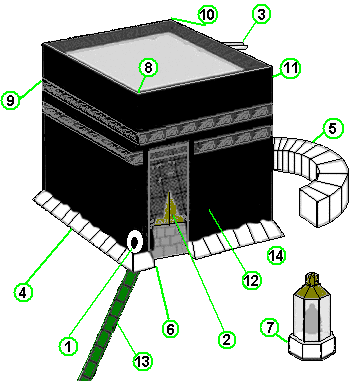
The building’s exterior is draped in the kiswah, a black cloth embroidered with gold calligraphy that is replaced annually. A distinctive element is the Black Stone (al‑Hajar al‑Aswad) set into one corner, which pilgrims attempt to touch or point toward during tawaf (circumambulation). Other recognisable features include the raised door of the Kaaba, the interior chamber with few fittings, and the adjacent low semicircular wall called the Hijr or Hatīm, which marks an area considered part of the sacred enclosure.
Parts and layout
- Exterior cladding: the kiswah and its embroidered bands.
- Black Stone: revered relic set into the eastern corner.
- Maqam Ibrāhīm: a small structure near the Kaaba associated with Abraham.
- Hijr/Ḥatim: the low curved boundary adjoining the building.
History and development
The Kaaba predates Islam as a religious site in the Arabian Peninsula and functioned as a regional sanctuary. Islamic sources describe the monument as restored and purified by the Prophet Muḥammad after the conquest of Mecca in the early 7th century CE. Since then, the structure has undergone multiple reconstructions and repairs prompted by natural damage, floods, and routine maintenance. While its basic cuboid form has been preserved, successive generations have altered materials, coverings, and surrounding mosque architecture to accommodate growing numbers of worshippers.
Religious role and rituals
The Kaaba is central to the rites of Hajj and Umrah. Pilgrims perform tawaf by walking seven counterclockwise circuits around the building and may attempt to approach the Black Stone. Orientation toward the Kaaba unifies daily prayer across diverse Muslim communities. Officials of the Grand Mosque manage crowd flow, ritual timings, and conservation of the structure, balancing devotional access with preservation.
Distinctions and preservation
Although compact in form, the Kaaba is one of the most recognizable religious monuments in the world. Its simplicity contrasts with the vast mosque complex that surrounds it, which has expanded repeatedly to serve increasing numbers of pilgrims. The building’s appearance and the annual renewal of the kiswah attract international attention; its maintenance combines religious stewardship with modern engineering. For architectural context, see accounts of its construction and restoration approaches in studies of Kaaba architecture.
Questions and answers
Q: What is the Kaaba?
A: The Kaaba is a large cuboid-shaped building inside the al-Masjid al-Haram mosque in Makkah, Saudi Arabia.
Q: Who is believed to have built the Kaaba?
A: Muslims believe that the Kaaba was built by the command of Allah.
Q: What is the significance of the Kaaba in Islam?
A: The Kaaba is considered one of the holiest sites in Islam and is the direction towards which Muslims face when praying.
Q: Has the architecture of the Kaaba changed over time?
A: No, the Kaaba's original architecture has remained the same for centuries.
Q: What is the shape of the Kaaba?
A: The Kaaba is cuboid-shaped.
Q: Where is the Kaaba located?
A: The Kaaba is located inside the al-Masjid al-Haram mosque in Makkah, Saudi Arabia.
Q: What is al-Masjid al-Haram mosque?
A: Al-Masjid al-Haram mosque is a mosque located in Makkah, Saudi Arabia and is one of the holiest sites in Islam, as it houses the Kaaba.
Related articles
Author
AlegsaOnline.com Kaaba: The Sacred Cuboid of Mecca Leandro Alegsa
URL: https://en.alegsaonline.com/art/51834
Sources
- quran.com : Quran 3/96
- quran.com : Quran 22/26
- britannica.com : "Ka'bah"
- sunnah.com : Sahih Muslim 1397
- sunnah.com : Sunan an-Nasa'i 2898
- bbc.co.uk : "BBC - Schools - Religion - Islam - Eid-ul-Adha"
- youtube.com : youtube.com/watch?v=oviQ-L9Kv9Q
- youtube.com : youtube.com/watch?v=fQVwlyUCjRw
- arabnews.com : arabnews.com/node/1359431/saudi-arabia