
Turbojet: principles, components, history and uses
A turbojet is a type of gas turbine jet engine that compresses air, mixes it with fuel, burns the mixture and expels hot gases to produce thrust. This article explains its parts, operation, history, and typical uses.
Overview
A turbojet is a form of gas-turbine engine designed to produce thrust by accelerating a continuous flow of air through combustion and a high‑velocity exhaust. Unlike propeller engines, a turbojet generates propulsion by ejecting mass rearward; its compact design made it the first practical jet propulsion for aircraft. For a general introduction to jet engine types see jet engine overview.
Image gallery
10 Images




Operation and main parts
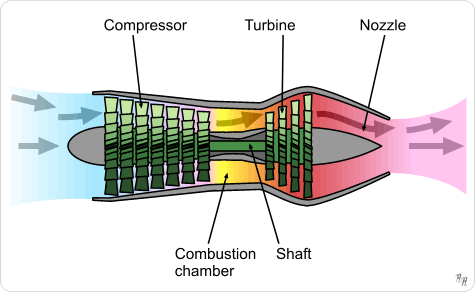
The turbojet converts incoming air into a stream of hot gases that leave the engine at high speed. Its principal sections are the intake, compressor, combustion chamber, turbine and nozzle. Air is drawn in, compressed, mixed with fuel and ignited; the expanding gases turn the turbine and are expelled through the nozzle to produce thrust.
- Intake: shapes and guides air into the compressor.
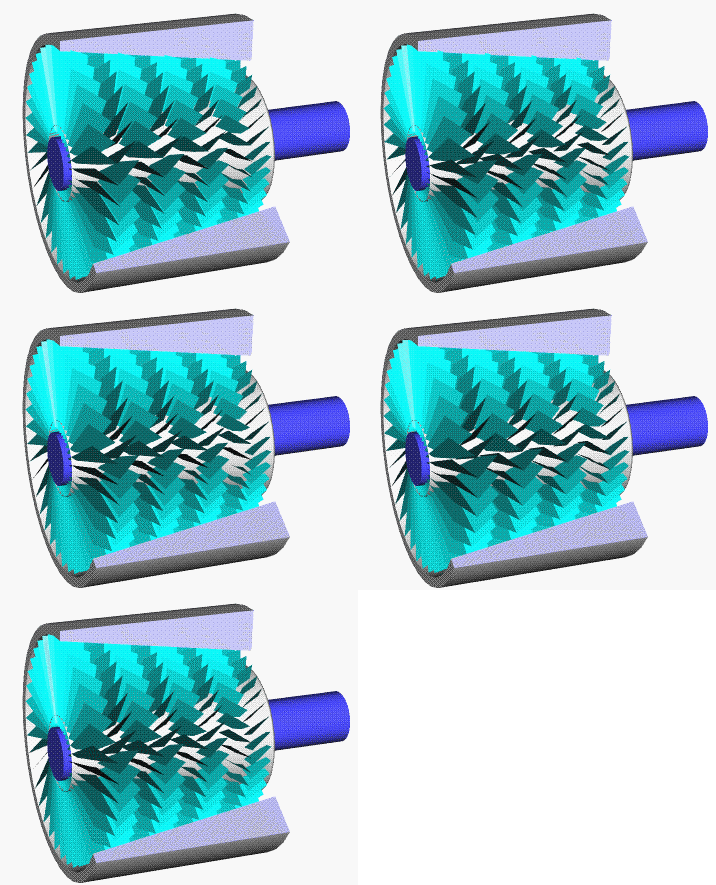
- Compressor: a series of rotating and stationary blades that raise air pressure before combustion. See compressor.
- Combustor: where fuel is injected and burned efficiently.
- Turbine: extracts energy from hot gases to drive the compressor; more on turbine designs at turbine.
- Nozzle: accelerates exhaust to create thrust.
Performance, variants and notable features
Turbojets produce high exhaust velocity and are relatively simple compared with later engine families. They perform well at high speed and high altitude but are less fuel efficient at subsonic cruise when compared with engines that use a bypass flow. Many modern designs add an afterburner for short bursts of extra thrust, commonly used on military supersonic aircraft.
History and development
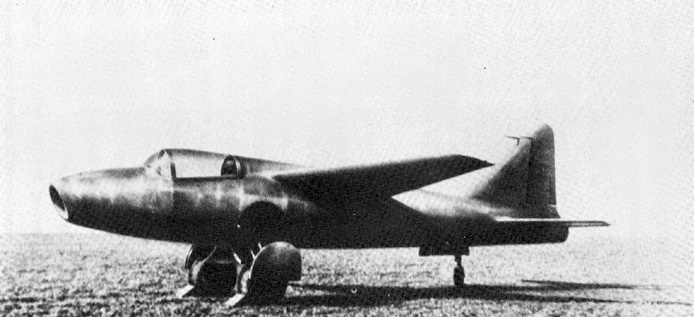
Concepts for jet propulsion appeared in the early 20th century and practical turbojets were developed in the 1930s. Early pioneers independently produced operational prototypes shortly before and during the Second World War; the technology matured rapidly and revolutionized military and then civil aviation in the decades that followed. For broader historical context see resources on power and efficiency advances in aero engines.
Uses, comparisons and current role
Today turbojets have largely been superseded in airliners by turbofan engines that incorporate a bypass stream to improve fuel economy and reduce noise; a comparison of the two can be found at turbofan vs turbojet. Turbojets remain in service where very high exhaust speed is required—for example in some supersonic platforms, certain missiles and specialized research aircraft. Supersonic applications and military aircraft design considerations are discussed at supersonic propulsion.
In summary, the turbojet is a fundamental jet engine type whose straightforward cycle—intake, compression, combustion, expansion and exhaust—laid the groundwork for later, more efficient engine families. For technical introductions and component diagrams consult introductory materials at fuel and combustion basics and compressor technology.
Related articles
Author
AlegsaOnline.com Turbojet: principles, components, history and uses Leandro Alegsa
URL: https://en.alegsaonline.com/art/102061
Sources
- commons.wikimedia.org : Turbojet