
Supersonic (speeds faster than the speed of sound)
Supersonic describes motion faster than the local speed of sound (Mach > 1). Covers physics of shock waves, history, aircraft design, examples, and distinctions with transonic and hypersonic regimes.
Supersonic refers to motion at speeds greater than the local speed of sound. The ratio of an object's speed to the speed of sound is its Mach number: Mach 1 means equal to sound speed and values above 1 are supersonic. The local sound speed depends on air temperature; at typical sea‑level conditions near 20–21 °C the speed of sound is roughly 343–344 m/s. For convenience this is often given in other units as about 1,235–1,238 km/h or roughly 767–770 mph.
Image gallery
4 Images


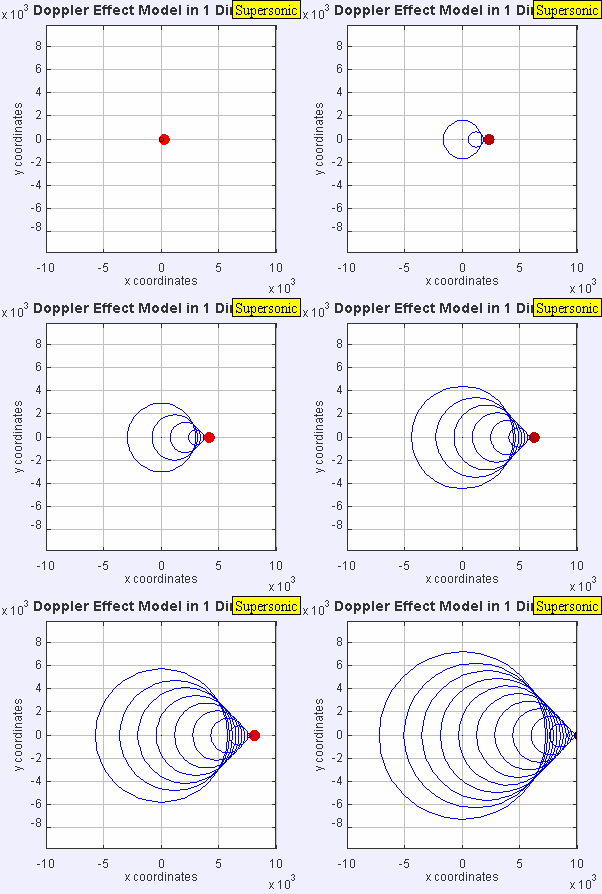
Key physical characteristics
When an object travels faster than sound several distinctive aerodynamic phenomena appear. A supersonic object generates shock waves — thin, nearly discontinuous pressure fronts — that change pressure, temperature and density across the wave. The sudden change in pressure produces the familiar sonic boom heard on the ground when those shock waves reach an observer. Aerodynamic drag rises sharply near the transonic speed range, which historically made controlled supersonic flight difficult until specific design and propulsion advances were introduced.
- Mach number: a dimensionless measure of speed relative to sound (Mach).
- Shock waves and sonic boom: abrupt pressure changes radiating from the vehicle.
- Drag increase: wave drag becomes important and designers must compensate (drag).
- Temperature dependence: sound speed varies with temperature, so local conditions matter (21.1 °C as a familiar reference).
Regimes and distinctions
Speeds are commonly classified into regimes. Subsonic is below Mach 1, transonic covers the region where parts of the flow become supersonic while others remain subsonic (often near Mach 0.8–1.2), supersonic is consistently above Mach 1, and hypersonic is typically reserved for speeds above about Mach 5. The transition through transonic speeds is particularly challenging because the flow fields change rapidly and control surfaces can behave unpredictably.
History and examples
Simple objects have reached local supersonic speeds long before powered aircraft: the cracking tip of a fast-moving whip produces a small supersonic shock, and projectiles such as rifle bullets and artillery shells became supersonic in the 19th century. Piston and early jet aircraft first encountered the so‑called "sound barrier" — a collection of aerodynamic and control problems — in the first half of the 20th century. Breaking the barrier in controlled flight required advances in jet propulsion, airframe design and materials.
- Early examples of supersonic motion in everyday devices include the whip.
- Military ordnance and some firearms and artillery have operated supersonically since the 1800s.
- Jet propulsion (jet engines) and design refinements enabled practical supersonic aircraft.
Design and propulsion
To fly efficiently and safely at supersonic speeds engineers adopt specific shapes and technologies: sharp, thin airfoils or highly swept wings, fuselage shaping to control pressure distribution (area ruling), strong materials to tolerate higher heating, and propulsion systems suited to high speeds such as turbojets, ramjets and scramjets. Afterburners and variable-geometry inlets were used on many early and military supersonic aircraft to provide sufficient thrust across a wide speed range.
Uses, limitations and notable facts
Supersonic flight is common in military aircraft and some experimental vehicles. Civilian supersonic transport has been demonstrated by aircraft like Concorde and others, but widespread commercial supersonic travel has been limited by economic, environmental and regulatory concerns — notably sonic booms over populated areas. Research into quieter supersonic designs and very high‑speed propulsion (including hypersonic research) continues for both civilian and defense applications.
Because the exact speed that marks "supersonic" depends on local atmospheric conditions (speed of sound) the same vehicle may be subsonic at one altitude or temperature and supersonic at another. Common numeric references include speeds expressed in metres per second (m/s), feet per second, miles per hour (mph) and kilometres per hour. The range where components of the flow begin to reach supersonic values is often called transonic and requires careful design tradeoffs.
Supersonic flight remains a specialized field within aerodynamics and aerospace engineering, balancing performance with noise, cost and safety considerations. Advances in materials, computational design and propulsion continue to expand what is feasible at speeds above the speed of sound.
Related articles
Author
AlegsaOnline.com Supersonic (speeds faster than the speed of sound) Leandro Alegsa
URL: https://en.alegsaonline.com/art/95083