
Turing test (imitation game)
A description of the Turing test, its original imitation-game formulation, typical formats and variants, historical background, uses in AI evaluation, and common criticisms.
The Turing test is an influential thought experiment and practical proposal for assessing whether a machine can exhibit behaviour that is indistinguishable from that of a person. First described in a widely read paper by Alan Turing, the test shifts attention from defining intelligence to observing interactions: if observers cannot reliably tell a machine from a human, the machine is said to have demonstrated intelligent behaviour.
Image gallery
3 Images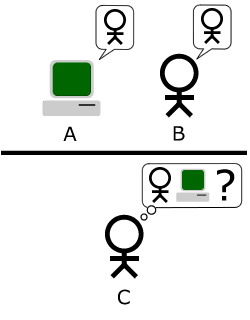

Overview
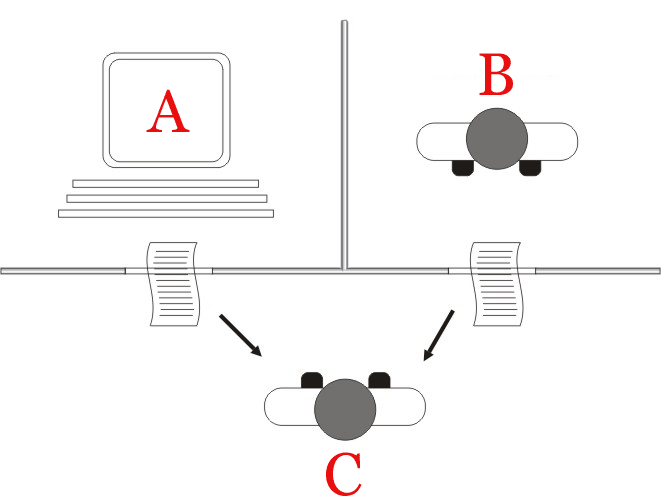
In the simplest formulation, a human judge carries out a conversation with two unseen interlocutors through written messages. One interlocutor is a person and the other is a machine (a computer). The judge's task is to decide which is which. The test focuses on the machine's ability to imitate the conversational responses and behaviour of a human, rather than on internal processes or how the responses are produced.
Format and common variations
Researchers and hobbyists have adapted the original imitation game in several ways, including time-limited contests, text-only chat, and more complex interactive setups. Typical elements include:
- Text-only exchanges to avoid revealing identity through voice or appearance.
- Blind judging panels where multiple evaluators assess transcripts.
- Restricted domains (specific topics) versus open-domain conversation.
- Measures of success ranging from fooling a majority of judges to achieving indistinguishability for set time spans.
History and context
Turing proposed the imitation game in a 1950 essay as a practical alternative to attempting a formal definition of "thinking." The idea grew from earlier philosophical debates about whether machines could think, reframing the discussion around observable performance. Over decades the Turing test inspired both research into natural language systems and public debate about machine intelligence.
Uses, examples, and limitations
The test has been used informally to stimulate development of chatbots and conversational agents and has become a cultural shorthand for machine intelligence. However, it is not a comprehensive scientific benchmark: passing the test demonstrates convincing human-like responses in restricted exchanges but does not prove understanding, consciousness or general reasoning abilities.
Criticisms and legacy
Critics argue the test emphasises imitation over underlying capability, can be gamed by clever tricks, and depends on judges' expectations and the nature of questions asked. Philosophers and AI researchers have proposed alternative assessments that target learning, reasoning, and problem-solving. Despite these criticisms, the Turing test remains a historically important and widely recognized milestone in discussions about artificial intelligence.
For further reading about the original essay and contemporary perspectives, follow introductory resources and scholarly discussions that reprint or analyze Turing's proposal and its aftermath.
Related articles
Author
AlegsaOnline.com Turing test (imitation game) Leandro Alegsa
URL: https://en.alegsaonline.com/art/102080