
Gas compressor: function, types, and applications
A gas compressor raises the pressure of a gas by reducing its volume. This article explains how compressors work, major types, common uses, differences from pumps, and safety/maintenance considerations.
Overview
A gas compressor is a machine that increases the pressure of a gas by decreasing its volume. Compressing a gas also raises its temperature, a fact that influences design choices such as cooling and staging. When the working medium is atmospheric air, the device is commonly called an air compressor. Compressors are essential components in many industrial, commercial and scientific systems.
Image gallery
10 Images




How compressors work
At a basic level, compressors convert mechanical energy into the internal energy of a gas. They draw in gas at low pressure, reduce its volume through mechanical action, and discharge it at higher pressure. Because gases are compressible, the process changes density and temperature. To manage heat and efficiency, many compressors use intercooling, multiple stages, and throttling or control valves.
Major types
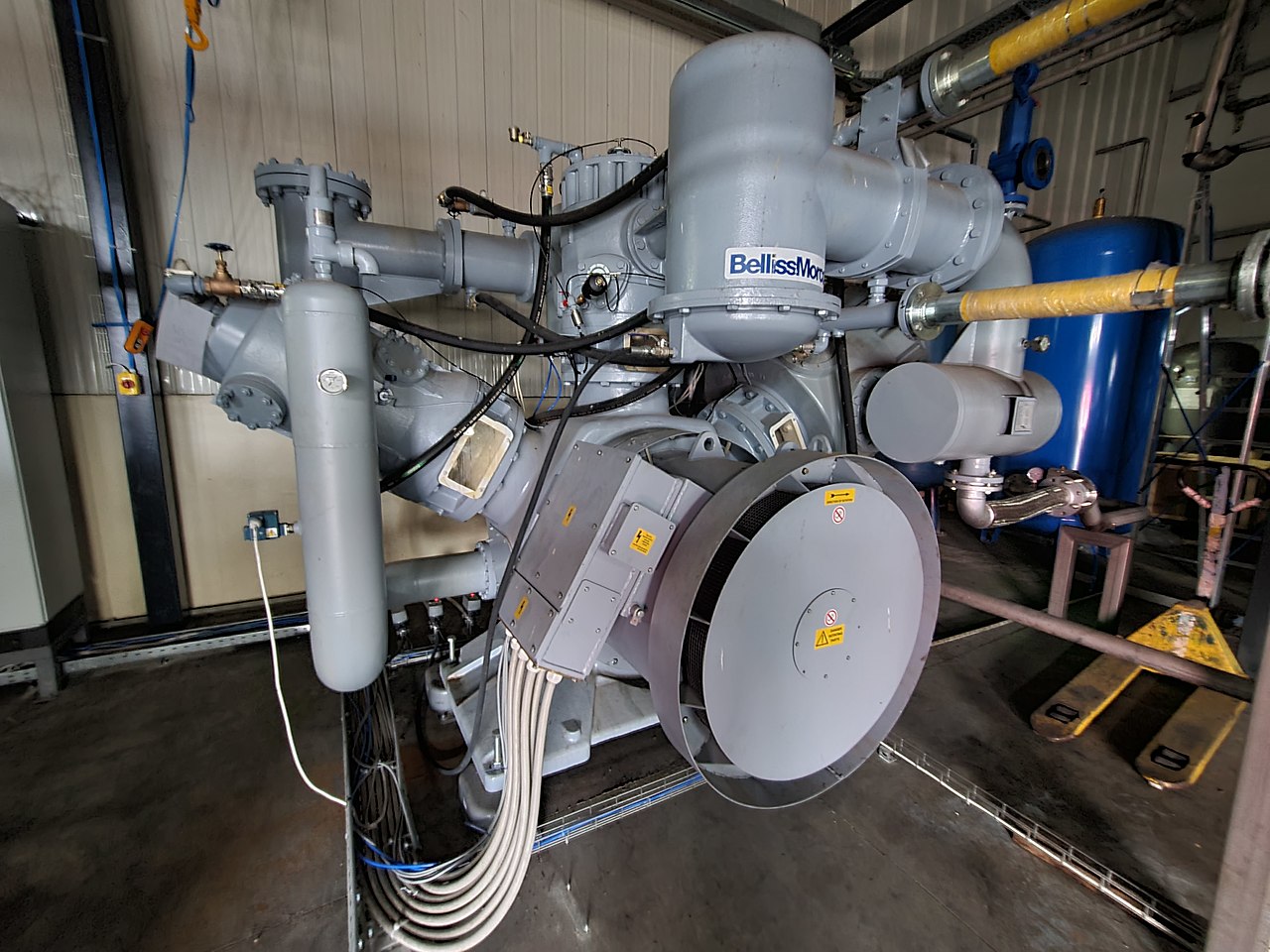
- Reciprocating (piston): Uses pistons in cylinders to compress gas; common for high-pressure and low-flow applications.
- Rotary screw: Positive-displacement device with meshing helical rotors, suited to continuous duty and moderate pressures.
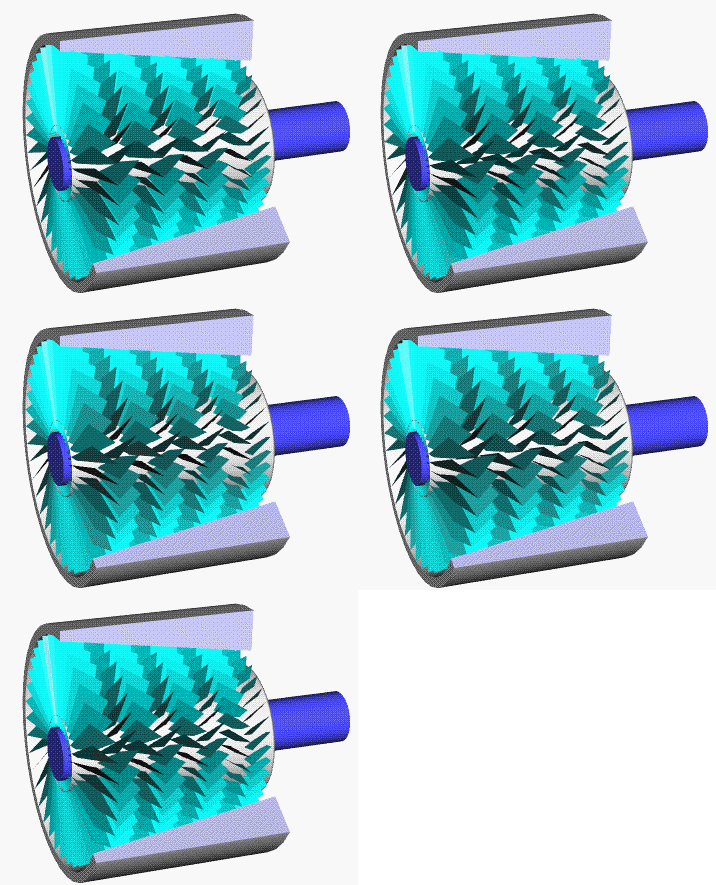
- Centrifugal (dynamic): Uses high-speed rotating impellers to accelerate and decelerate gas, converting kinetic energy to pressure; favored for large-volume, lower-pressure services.
- Axial: Handles very large flows at relatively small pressure rises per stage, often used in gas turbines and large processing plants.
- Diaphragm and vane: Specialized designs for clean or leak-free compression.
Uses and importance
Compressors serve a wide range of roles: powering pneumatic tools, refrigerant circulation in HVAC systems, natural gas transport and storage, chemical processing, and supplying breathing air in medical and diving applications. They are also integral to refrigeration cycles and many manufacturing processes that require controlled pressure or vacuum.
Distinctions and practical considerations
Compressors are often compared with pumps, since both increase pressure on a fluid and move it through a pipe. The key difference is compressibility: pumps primarily move nearly incompressible liquids without changing volume significantly, while compressors reduce gas volume as part of their function. Efficiency, lubrication, cooling, and materials selection vary with gas type, temperature, and required pressure.
Maintenance and safety
Regular maintenance—filter changes, lubrication checks, leak detection and vibration monitoring—keeps compressors reliable and efficient. Safety concerns include high-pressure hazards, hot surfaces from compression heating, and proper handling of the specific gases in use. In many installations, safety relief valves, pressure sensors, and appropriate ventilation are standard precautions.
The evolution of compressor technology spans simple hand-operated pumps to sophisticated multi-stage rotary and centrifugal machines used in modern industry. Selection depends on required flow rate, discharge pressure, duty cycle, gas composition and efficiency priorities. For further technical references and product specifics consult manufacturers and technical standards organizations.
Questions and answers
Q: What is a gas compressor?
A: A gas compressor is a mechanical device that increases the pressure of a gas by reducing its volume.
Q: What happens to the temperature of a gas when it is compressed?
A: Compression of a gas naturally increases its temperature.
Q: What is an air compressor?
A: When the gas is air, the machine is called an air compressor.
Q: How are compressors and pumps similar?
A: Compressors are similar to pumps: both increase the pressure on a fluid and both can transport the fluid through a pipe.
Q: What is the main action of a pump?
A: Liquids are relatively incompressible, so the main action of a pump is to transport liquids.
Q: What does the compressor do to the volume of a gas?
A: As gases are compressible, the compressor also reduces the volume of a gas.
Q: Can pumps compress gases?
A: Pumps are not designed to compress gases as gases are highly compressible. Pumps are designed to transport liquids that are relatively incompressible.
Related articles
Author
AlegsaOnline.com Gas compressor: function, types, and applications Leandro Alegsa
URL: https://en.alegsaonline.com/art/37659
Sources
- thomasnet.com : Introduction to Industrial Compressed Air Systems