
UDFj-39546284: candidate for one of the earliest observed galaxies
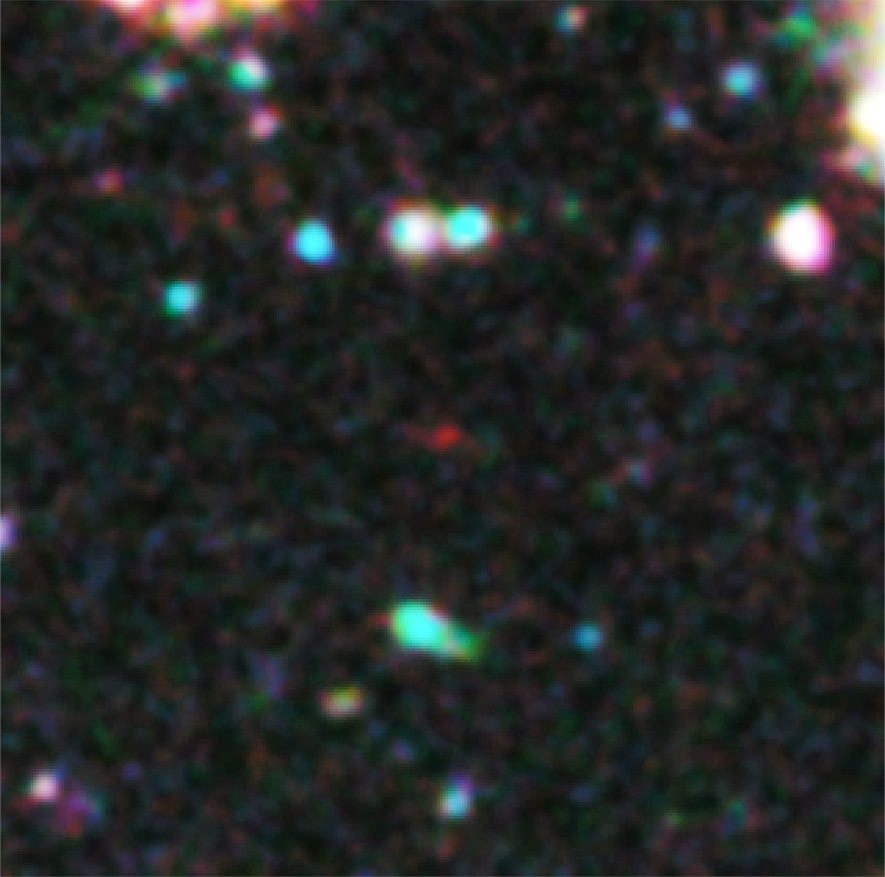
UDFj-39546284 is a faint infrared source identified in Hubble deep-field imaging and interpreted as a candidate galaxy from about 380 million years after the Big Bang (photometric, not yet spectroscopic).
Overview
UDFj-39546284 is a faint, compact astronomical source discovered in deep infrared images of the Hubble Ultra-Deep Field. It was reported as a candidate very high-redshift galaxy after analysis of images taken with the Hubble Space Telescope and later with supporting data from the Spitzer Space Telescope. Early reports described it as among the most distant objects then known and referred to it as potentially the oldest object observed in terms of light-travel time.
Image gallery
8 Images



Detection and distance estimates
The source was recognized through deep infrared imaging and color-selection techniques designed to pick out very distant galaxies whose ultraviolet light has been shifted into the infrared by cosmic expansion. Such selection relies on the Lyman-break method: a sharp drop in flux shortward of the redshifted hydrogen Lyman limit causes the object to "drop out" of bluer filters and appear only in redder infrared bands. Photometric analyses combining Hubble's infrared filters and longer-wavelength Spitzer data led to a photometric redshift estimate of roughly z ≈ 11.9, implying that the light we see left the object when the universe was only a few hundred million years old (commonly stated as roughly 380 million years after the Big Bang), corresponding to a light-travel time of about 13.4 billion years.
Physical nature and significance
If the photometric redshift is correct, UDFj-39546284 represents a very small, compact system of young, massive, blue stars — a mini-galaxy in the early stages of assembly. Such objects are important because they probe the epoch when the first generations of galaxies formed and when starlight began to reionize the neutral intergalactic medium. Studies of candidates like UDFj-39546284 help constrain models of early star formation, the growth of structure, and the timeline of cosmic reionization.
Uncertainties and confirmation
The redshift for UDFj-39546284 rests on photometric measurements rather than a spectroscopic detection of spectral lines. Photometric techniques can be powerful but are also subject to ambiguity from low-redshift interlopers with unusual dust or emission-line properties. Unlike some other early candidates such as UDFy-38135539, UDFj-39546284 has not been robustly spectroscopically confirmed, so its exact distance remains uncertain. Definitive confirmation requires sensitive spectroscopy in the near- and mid-infrared to detect characteristic emission or absorption features.
Follow-up, instruments and context
UDFj-39546284 was found in the context of the Hubble Ultra-Deep Field (HUDF) and related deep campaigns that pushed Hubble's infrared capability to search for the earliest galaxies. Observations in the infrared (infrared) are essential because the expansion of the universe shifts ultraviolet starlight into those wavelengths. The development of more powerful infrared observatories — notably the James Webb Space Telescope — enhances the ability to confirm such candidates with spectroscopy and to study their internal properties. Repeated analyses and deeper imaging have moved the record of the most distant known galaxy several times; UDFj-39546284 was among the objects that at one point held or approached that record, illustrating the rapid progress and the provisional nature of early-universe claims.
Key facts
- Identification: faint infrared source in deep Hubble imaging.
- Reported photometric redshift: approximately z ≈ 11.9 (photometric).
- Epoch: light emitted when the universe was a few hundred million years old.
- Confirmation status: photometric candidate; not yet spectroscopically confirmed at the time of early reports.
Questions and answers
Q: What is UDFj-39546284?
A: UDFj-39546284 is a stellar structure, probably a galaxy that was detected through infrared observation.
Q: When was UDFj-39546284 reported?
A: UDFj-39546284 was reported on January 27, 2011.
Q: How was UDFj-39546284 detected?
A: UDFj-39546284 was detected through infrared observation by the Hubble Space Telescope.
Q: What is the redshift of UDFj-39546284?
A: The redshift of UDFj-39546284 is 11.9.
Q: How old is UDFj-39546284?
A: UDFj-39546284 existed as we see it 13.42 billion years ago, around 380 million years after the Big Bang.
Q: What is the significance of UDFj-39546284?
A: At the time of its discovery, UDFj-39546284 was the oldest galaxy found, offering information from early after the Big Bang.
Q: Has UDFj-39546284 been spectroscopically confirmed?
A: No, unlike UDFy-38135539, UDFj-39546284 has not been spectroscopically confirmed.
Related articles
Author
AlegsaOnline.com UDFj-39546284: candidate for one of the earliest observed galaxies Leandro Alegsa
URL: https://en.alegsaonline.com/art/102508
Sources
- arxiv.org : 0912.4263
- space.com : "Ancient Galaxy May Be Most Distant Ever Seen"
- firstgalaxies.org : "Galaxies at redshift 10"
- astro.ucla.edu : "Cosmology Calculator I"
- ksj.mit.edu : tracker
- nature.com : article
- nasa.gov : "Most distant galaxy candidate ever seen in universe"
- hubblesite.org : "Picture album: gray-scale image of object UDFj-39546284 from HUDF WFC3/IR"
- arxiv.org : R.J. Bouwens et al - Confirmation of the z~10 Candidate UDFj-39546284 using deeper WFC3/IR+ACS+IRAC Observations over the HUDF09/XDF (2012)
- time.com : popular article of Wednesday January the 26th 2011
- ksj.mit.edu : C Petit - review of - Science News written by Ron Cowen
- arxiv.org : 1303.5076
- ui.adsabs.harvard.edu : 2013arXiv1303.5076P
- astronomynow.com : "Hubble pushes to the limit"