
Trinity College, Cambridge
One of the largest and richest colleges of the University of Cambridge, founded by royal charter and known for its historical libraries, notable alumni and influential academic legacy.
Trinity College is a constituent college of the University of Cambridge, located in central Cambridge, England. It is among the largest colleges in the two ancient universities and is widely recognised for the size of its endowment and its extensive property holdings, which have included commercial investments such as a stake in the O2 Arena. Trinity combines a long academic tradition with active support for research and scholarships.
Image gallery
10 Images
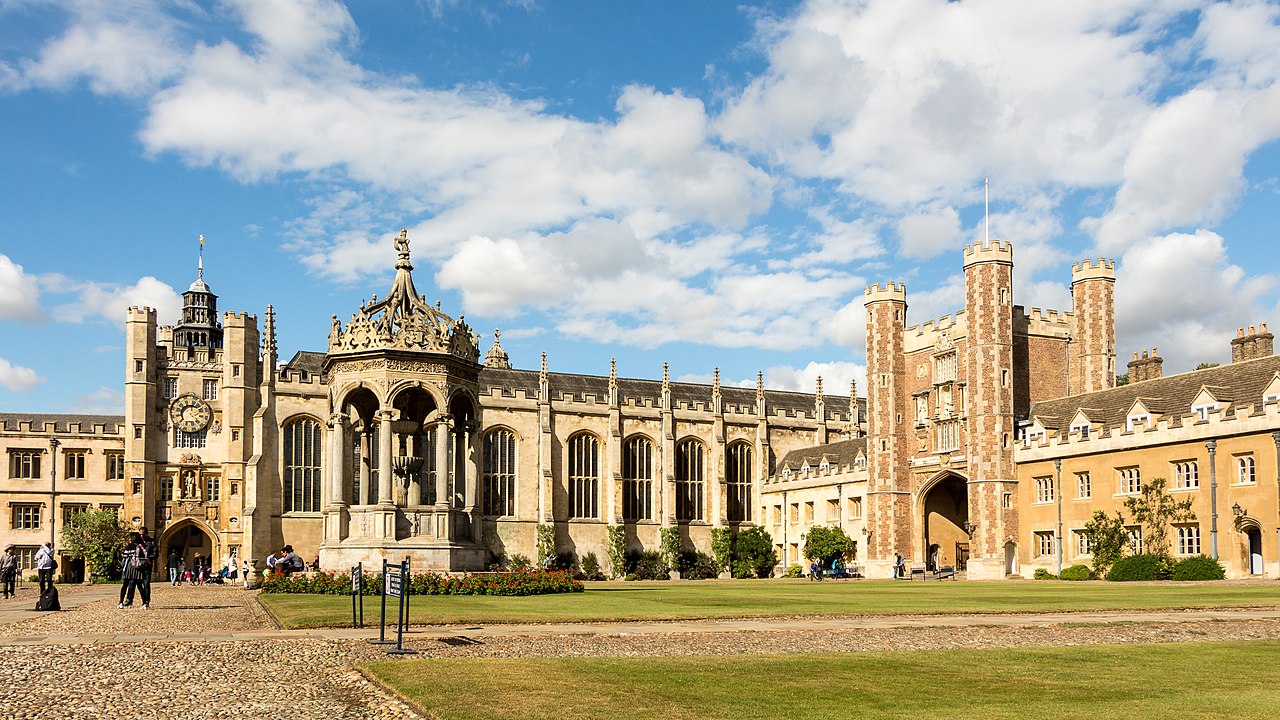


Origins and development
Trinity was founded by royal charter in the mid-16th century when King Henry VIII united two older Cambridge foundations. Those predecessor houses were Michaelhouse, originally founded in the early 14th century by Hervey de Stanton, and King's Hall, an institution with roots in the reign of Edward II and later royal re-endowment under Edward III. The merger produced a single college intended to serve both teaching and the collegiate governance model that characterises Cambridge. Over subsequent centuries Trinity expanded its buildings, endowment and academic scope, becoming one of the most prominent colleges in the university.
Buildings, collections and library
The college's architectural ensemble includes formal courts, a chapel and the Wren Library, designed by Sir Christopher Wren and completed in the 17th century. The Wren Library houses a large collection of printed books and manuscripts, including early scientific works and rare editions, and it remains open to researchers and visitors. The library is often highlighted among Cambridge's principal repositories of historical material and is a focal point for the college's cultural and scholarly life.
Academic profile and alumni
Trinity has educated a large number of prominent figures across science, philosophy, politics and the arts. Its alumni include eminent scholars such as Isaac Newton, who studied at Trinity in the 17th century, and the philosopher Ludwig Wittgenstein. The college also counts a significant number of Nobel laureates and senior government leaders among its former students. Trinity's tutorial and supervision system, combined with its financial resources, have supported sustained strengths in mathematics, natural sciences and humanities.
Contributions, traditions and influence
Beyond individual alumni, Trinity has been associated with a range of cultural and sporting developments. For example, early formulations of the Cambridge rules for association football were drafted in the 19th century at meetings and matches involving Cambridge colleges and clubs, a milestone in the codification of modern association football. The college maintains traditional events and ceremonies that form part of student life and the broader heritage of the university.
Quick facts and visiting
- Part of the collegiate system of the University of Cambridge and often compared with leading colleges at Oxford as the two centres of the so-called Oxbridge tradition.
- Recognised as one of the most financially endowed and wealthiest colleges, enabling extensive academic funding and property investment.
- Has historical links to the British monarchy and to members of the royal family who have studied or visited the college.
- Maintains public-facing collections and the Wren Library for visitors and researchers; the college site and chapel are accessible by arrangement.
Trinity College continues to play a central role in the intellectual life of Cambridge, balancing a long heritage with ongoing contributions to research, education and public scholarship.
Related articles
Author
AlegsaOnline.com Trinity College, Cambridge Leandro Alegsa
URL: https://en.alegsaonline.com/art/101537
Sources
- telegraph.co.uk : "Trinity College buys O2 concert arena"
- cam.ac.uk : "Nobel Prize Winners"
- trin.cam.ac.uk : "Nobel Laureates"
- newton.ac.uk : "Isaac Newton's Life"
- trin.cam.ac.uk : "Trinity College Cambridge"