
Transatlantic telegraph cable
Submarine telegraph cables that linked Europe and North America in the 19th century, enabling near‑instant communication across the Atlantic and paving the way for modern undersea telecommunications.
Overview
A transatlantic telegraph cable is a submarine cable laid across the floor of the Atlantic Ocean to carry telegraph signals between continents. These heavy, insulated conductors made it possible to exchange messages in minutes rather than the days or weeks required by ship, transforming diplomacy, commerce and news transmission. The general concept of a long‑distance undersea telegraph line is sometimes summarized simply as a submarine cable.
Image gallery
10 Images




Construction and technology
Early transatlantic cables consisted of a central copper conductor surrounded by insulating material (notably gutta‑percha in the 19th century) and an outer armouring of iron wires for mechanical strength. Telegraphy over such long undersea routes posed particular electrical challenges, including signal attenuation and timing effects, which required sensitive receiving instruments and careful handling of transmission voltages rather than electronic repeaters inside the cable itself.
History and milestones
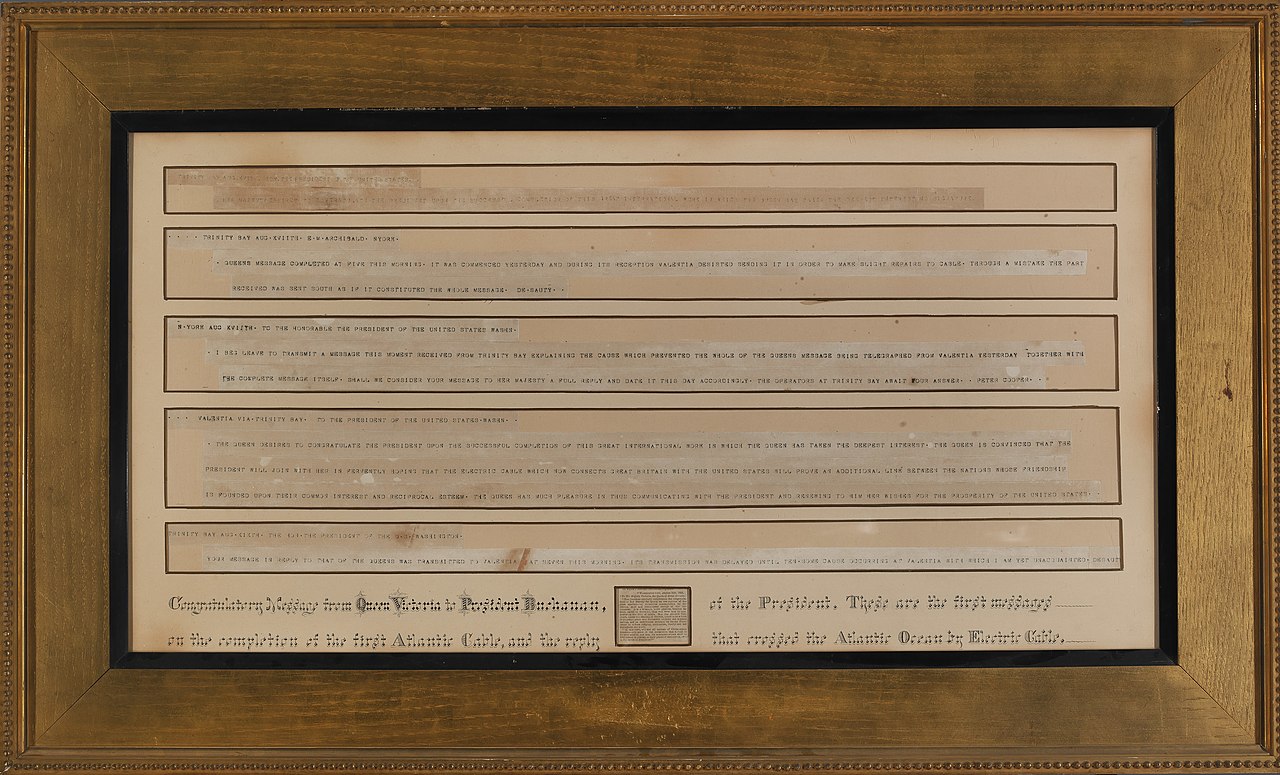
The first attempt to join Europe and North America by telegraph reached from Ireland to Newfoundland. A famous early success sent the first message on 16 August 1858: a congratulatory dispatch from Queen Victoria to the President James Buchanan. That inaugural cable, however, functioned for only a few weeks before failing. Subsequent expeditions and technical improvements led to more durable links in later years, including the successful mid‑1860s laying of a permanent connection that established reliable service.
Uses and significance
By cutting communication time between North America and Europe from days to minutes, transatlantic telegraphy accelerated international finance, news reporting and government correspondence. Companies, newspapers and governments depended on the new speed for real‑time pricing, diplomacy and crisis response. The transatlantic cables thus marked a major step in creating a connected global information system.
Legacy and later developments
Transatlantic telegraph cables were gradually superseded by more advanced undersea systems as technology advanced — first by telephone-capable lines and then by fibre‑optic links that carry vast amounts of data today. Modern undersea networks, sometimes called transatlantic telecommunications, owe their route planning, ship‑laid techniques and many operational practices to the pioneering telegraph projects of the 19th century.
Notable distinctions
- Early cables were telegraph‑only and lacked powered repeaters; later submarine systems include powered amplifiers or optical repeaters.
- The first 1858 connection demonstrated the possibility of instant intercontinental messaging even though the initial installation was short‑lived.
- Successful long‑term service required both electrical insight and advances in cable manufacturing and laying ships.
These developments established patterns of international communication that persist in today's global networks.
Related articles
Author
AlegsaOnline.com Transatlantic telegraph cable Leandro Alegsa
URL: https://en.alegsaonline.com/art/101123
Sources
- commons.wikimedia.org : Transatlantic telegraph cable