
Tiberius Claudius Cogidubnus
1st‑century client king of the Regnenses in southern Britain who allied with Rome after the Claudian invasion; known from inscriptions and linked to Fishbourne Palace and Chichester.
Tiberius Claudius Cogidubnus was a 1st‑century ruler in southern Britain who acted as a Roman client during the early years of occupation. He is commonly identified with the native ruling house of the coastal people usually called the Regnenses or Regni and is associated with the area around modern Chichester. His Roman name signals that he received citizenship during or shortly after the Claudian conquest of AD 43 and that he maintained close links with the imperial administration.
Image gallery
2 Images
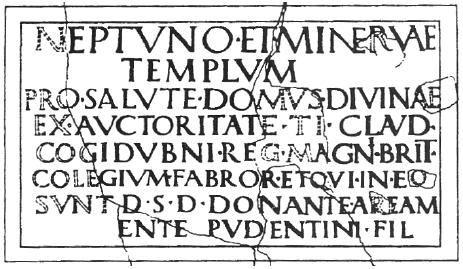
Identity and contemporary record
Our knowledge of Cogidubnus depends largely on archaeological finds and a small number of Roman references. A damaged stone inscription found near Chichester records a name rendered as Tiberius Claudius Cogidubnus and gives him an uncommon imperial style. The inscription and nearby monuments are the principal evidence used to reconstruct his position. Later Roman writers and campaign accounts provide context for the period but offer little direct detail about his life.
The Romanized name indicates Roman citizenship under the emperor who granted it. The form of his title on the inscription has been read by some scholars as "rex legatus Augusti in Britannia," a phrase that mixes royal and official language and has generated debate about whether it denotes an especially privileged provincial role or reflects a damaged text. Cogidubnus is often presented as a loyal client of the Roman Emperor Claudius, whose invasion and occupation shaped local power structures after AD 43.
Territory, court and Roman links
Cogidubnus is associated with the territory of the Regnenses, centered on the civitas capital sometimes identified with Chichester (the Roman Noviomagus) and nearby settlements. Contemporary political arrangements in Britain allowed Rome to maintain control through cooperative local rulers: as a client‑king, he would have retained domestic authority while aligning policy with Roman interests. The surviving inscription implies that Claudius recognized and perhaps enlarged his kingdom after local leaders submitted to Roman power.
Sources suggest Cogidubnus persuaded many of his people to accept Roman rule rather than resist; this kind of collaboration secured relative peace, Roman investment in towns and temples, and access to trade and military protection. References to the submission of other tribes in the same campaigns provide background for how Rome integrated tribal polities into provincial structures centered on settlements such as Colchester.
Archaeology and building projects
Archaeological work in West Sussex has strengthened the link between Cogidubnus and major building programs. The rich complex known as Fishbourne Roman Palace, together with temple remains and urban development around Chichester, illustrates a rapid process of Romanization in the region. Although direct documentary links are limited, the scale and date of these projects make it plausible that an allied local ruler like Cogidubnus played a leading role in sponsoring or benefiting from them.
Significance and scholarly views
Cogidubnus is significant as an example of how Rome governed newly conquered provinces by co‑opting indigenous elites. Scholars debate the precise meaning of his recorded title, the extent of his authority, and his exact lifespan, but there is broad agreement that his career highlights the mixture of Roman and native practices in early provincial Britain. For further study of regional archaeology and inscriptional evidence see general surveys and local museum catalogues for the Chichester and Fishbourne finds.
- Key associations: king, Regnenses, Roman Britain.
- Principal sites: Chichester, Fishbourne.
- Historical context: aftermath of the Claudian invasion and submission of local tribes centered on urban hubs like Colchester.
Despite uncertainties about particulars, Cogidubnus remains an important figure for understanding provincial accommodation, the Romanization of southern Britain, and the political mechanisms Rome used to extend its influence across local societies.
Related articles
Author
AlegsaOnline.com Tiberius Claudius Cogidubnus Leandro Alegsa
URL: https://en.alegsaonline.com/art/99763