
Thermal radiation: emission of heat as electromagnetic waves
Thermal radiation is electromagnetic energy emitted and absorbed by matter due to temperature. This article explains its physical basis, spectrum, laws, examples, and practical significance.
Thermal radiation is the electromagnetic energy that objects emit and absorb because of their temperature. All matter above absolute zero releases some form of radiation; this energy may be experienced directly as heat or, when energetic enough, as visible light. Unlike conduction and convection, thermal radiation is a mode of heat transfer that travels by electromagnetic waves and does not require intervening matter to propagate.
Image gallery
8 Images





Physical basis and characteristics
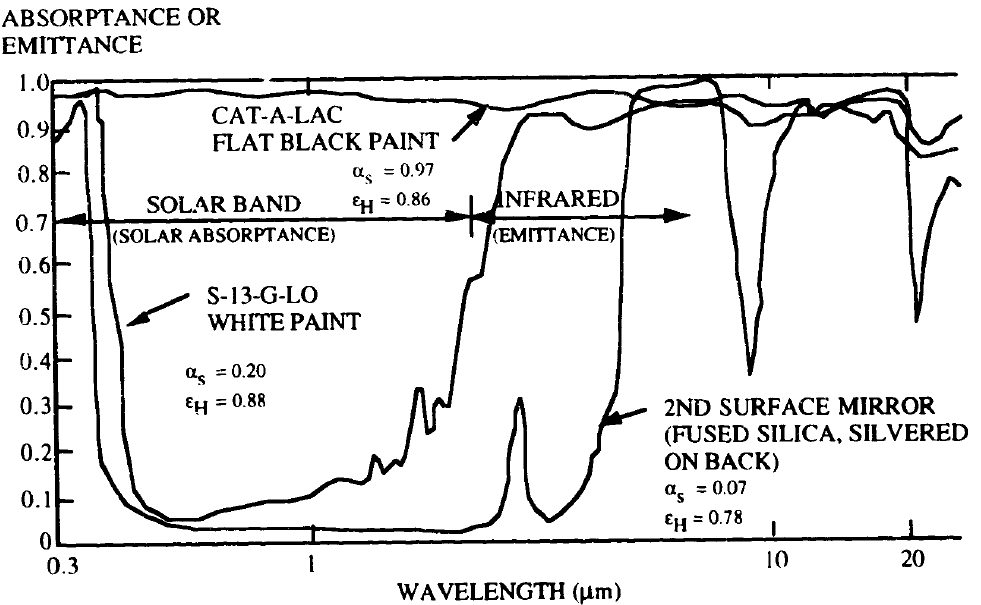
Every object with a temperature above 0 K emits a spectrum of electromagnetic radiation determined by its temperature and surface properties. The peak wavelength shifts to shorter wavelengths as temperature increases, so very hot solids may glow visibly while objects at ordinary temperatures mainly emit in the infrared. Emission occurs in all directions and propagates through vacuum at the speed of light; surfaces that emit well (high emissivity) also tend to absorb incoming thermal radiation efficiently, while smooth, shiny surfaces reflect more and emit less.
Key laws and models
Understanding thermal radiation relies on a few foundational concepts and laws. The idealized concept of a black body describes an object that absorbs and emits the maximum possible radiation at each wavelength. Quantitative relations that stem from this model include Planck's law, which gives the distribution of emitted energy across wavelengths; Wien's displacement law, which links temperature to the wavelength of peak emission; and the Stefan–Boltzmann relation, which states that a body’s total emitted power grows rapidly with temperature. These laws are central to fields ranging from materials science to astrophysics.
Common examples and applications
- A person standing near a fire feels warmer because the fire’s thermal radiation transfers energy directly to exposed skin.
- The warmth received from the Sun across space is thermal radiation that heats the Earth, drives climate processes, and powers solar technologies.
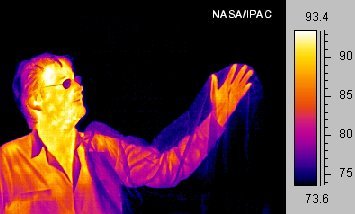
- Most everyday objects emit primarily infrared radiation; thermal cameras exploit this to make heat visible for diagnostics, surveillance, and medicine.
- Incandescent bulbs illustrate how raising temperature shifts emission into the visible band, producing light alongside heat.
Practical importance and notable distinctions
Thermal radiation plays a crucial role in energy balance, engineering insulation, building design, and remote sensing. Distinguishing radiation from conduction and convection is important when designing thermal systems: radiation can transfer energy across vacuums and through transparent media, and its effectiveness depends on wavelength, surface emissivity, and geometry. Materials and coatings are engineered to control emissivity for applications such as radiative cooling, thermal camouflage, and spacecraft thermal control.
In measurement and analysis, emissivity and reflective properties must be considered: a dull, dark surface generally emits and absorbs thermal radiation more effectively than a bright, polished one. The study of thermal radiation connects laboratory physics with practical technologies and planetary-scale phenomena, linking microscopic thermal motion to macroscopic energy flows and observational techniques used across science and industry.
Related articles
Author
AlegsaOnline.com Thermal radiation: emission of heat as electromagnetic waves Leandro Alegsa
URL: https://en.alegsaonline.com/art/99296