
Thermal resistance
Thermal resistance quantifies how strongly a material or assembly opposes heat flow. It relates to geometry and material properties and is used in electronics, building insulation, and thermal design.
Thermal resistance is a measure of how much a body or an interface opposes the transfer of heat. In engineering it plays the same organising role that electrical resistance plays in circuit analysis: heat flow (power) is driven by a temperature difference and reduced by resistance. Thermal resistance is widely used to evaluate insulating materials, to size heat sinks and to characterise contact layers between components.
Image gallery
4 Images


Definition and basic formulas
For simple steady-state conduction through a uniform plane layer, thermal resistance R is defined as R = L/(kA), where L is thickness, k is thermal conductivity and A is cross-sectional area. The common unit is kelvin per watt (K/W), often expressed as degrees Celsius per watt since temperature differences share the same scale. For convective heat transfer at a surface, an analogous resistance is R = 1/(hA), where h is the convective heat transfer coefficient. Radiative heat exchange cannot always be expressed as a linear resistance, but small temperature differences are sometimes linearised into an effective radiative resistance.
Networks, combinations and analogies
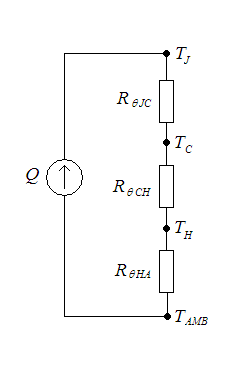
Thermal resistances combine like electrical resistances: resistances in series add, while parallel paths follow the reciprocal-sum rule. This allows construction of thermal networks that model multilayer walls, composite materials or stacked components. The result is a convenient way to predict the temperature drop across each layer and the overall heat transfer for a given driving temperature difference.
Besides bulk material resistance, contact resistance — the additional thermal drop at the interface between two surfaces — can be significant. Thin thermal interface materials (TIMs), surface roughness, pressure and assembly methods all influence contact resistance and therefore the total R seen by a device.
Practical applications include building insulation (where R-values quantify resistance and U-values are the reciprocal for whole assemblies), electronic cooling (specifying junction-to-ambient or junction-to-case resistances in K/W), heat exchanger and furnace design, and material selection for thermal barriers. Designers also consider temperature dependence: many materials change conductivity with temperature, so R may vary over an operating range.
Measurement techniques range from steady-state methods like the guarded hot plate to transient methods such as laser flash or transient plane source, each suited to particular materials and sample geometries. When working with systems that involve radiation, convection, conduction and contact effects, careful modelling or measurement of individual resistance contributions is essential to obtain reliable thermal performance predictions.
Related articles
Author
AlegsaOnline.com Thermal resistance Leandro Alegsa
URL: https://en.alegsaonline.com/art/99297