
Electromagnetic radiation: properties, spectrum, history and uses
A concise encyclopedia overview of electromagnetic radiation: its nature, spectrum, history, practical uses and safety, with distinctions from mechanical waves.
Overview
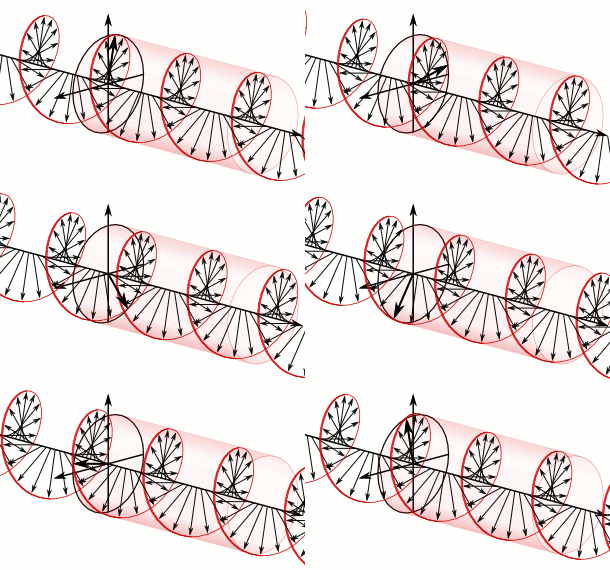
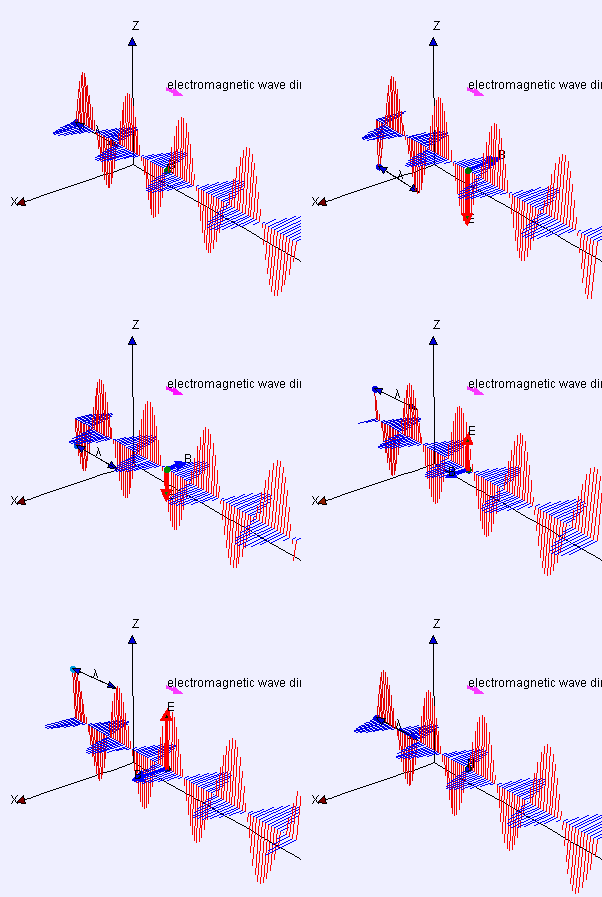
Electromagnetic radiation consists of oscillating electric and magnetic fields that propagate through space as waves and also behave as streams of particles called photons. These disturbances carry energy and momentum without requiring a material medium. The phenomenon is commonly described as electromagnetic waves formed by an electric field perpendicular to a magnetic field, together transporting energy. In vacuum these waves travel at the universal constant known as the speed of light, and their properties are governed by classical electromagnetism and by quantum theory.
Image gallery
5 Images


Basic characteristics
Two quantities define an electromagnetic wave: wavelength (distance between repeating points of the wave) and frequency (how many oscillations per second). Energy of a photon is proportional to frequency, a relationship central to quantum mechanics. The human eye detects a tiny portion of the spectrum as visible light, which appears in the familiar rainbow of colors from red to violet. Light outside that window is invisible but physically important.
The electromagnetic spectrum
The spectrum is continuous and conventionally divided into bands by wavelength and frequency. From longest wavelength to shortest, common categories include:
- Radio waves — used for broadcasting and communication; long wavelengths and low frequency.
- Microwaves — used in radar, satellite links and heating.
- Infrared — associated with thermal radiation and heat sensing; often called infrared.
- Visible light — the narrow band the eye perceives, spanning colors from red to violet (rainbow).
- Ultraviolet — higher energy than visible light; responsible for chemical effects such as sunburn and useful in sterilization (ultraviolet).
- X‑rays — still higher energy, penetrate many materials and are used in medical imaging; they are a form of ionizing radiation.
- Gamma rays — produced by nuclear and subatomic processes; the most energetic band.
Longer-wavelength bands such as microwave and infrared are lower in photon energy, while ultraviolet, X-rays and gamma rays carry greater quantum energy and can alter atomic structure.
History and scientific development
Understanding of electromagnetic radiation evolved from 19th-century experiments and theory. Observations of light and electricity merged into James Clerk Maxwell’s field equations, which predicted electromagnetic waves. Early 20th-century studies of blackbody radiation and the photoelectric effect led to quantization ideas that founded modern quantum theory, connecting wave descriptions to particle-like photons and shaping fields such as quantum mechanics.
Applications and effects
Electromagnetic radiation underpins many technologies: radio and television broadcasting, mobile communications, radar, microwave ovens, medical imaging and therapy (X-rays, MRI uses electromagnetic principles), optical instruments and remote sensing. Infrared is widely used for heating and night vision; ultraviolet is used for disinfection but can cause skin damage (sunburn). High-energy bands like X-rays and gamma rays require shielding and regulation because of ionizing effects on biological tissue.
Distinctions and notable facts
Unlike sound, which is a mechanical pressure wave that needs a medium such as air or water, electromagnetic waves propagate in vacuum and are not pressure oscillations in matter. Sound and electromagnetic phenomena are therefore distinct categories of waves (sound waves are mechanical; they move pressure variations in a medium, not fields). Wavelength, frequency, and photon energy are three interrelated descriptors of any part of the spectrum; engineers and scientists choose the most useful one for a given problem.
For further introductory materials and resources see: electromagnetic spectrum overview, frequency and energy, infrared and heat, mechanical vs electromagnetic waves, and specialized entries on wavelength, sound comparison, and scientific histories at waves, electric field, magnetic field.
Note: This article summarizes broad, well-established concepts without exhaustive technical detail. For precise formulas, safety standards, and advanced topics consult dedicated textbooks and technical standards referenced above.
Questions and answers
Q: What are electromagnetic waves?
A: Electromagnetic waves are waves that contain an electric field and a magnetic field and carry energy. They travel at the speed of light (299,792,458 meters per second).
Q: What is quantum mechanics?
A: Quantum mechanics is a field of study that developed from the study of electromagnetic waves. It includes the study of both visible and invisible light.
Q: What types of electromagnetic radiation can be harmful to your body?
A: Some types of electromagnetic radiation, such as X-rays, are ionizing radiation and can be harmful to your body.
Q: Where do ultraviolet rays fall on the light spectrum?
A: Ultraviolet rays are near the violet end of the light spectrum.
Q: Where do infrared rays fall on the light spectrum?
A: Infrared rays are near the red end of the light spectrum.
Q: How do infrared rays differ from ultraviolet rays?
A: Infrared rays are used as heat rays and ultraviolet rays cause sunburn.
Q: Are sound waves considered electromagnetic waves?
A: No, sound waves are not electromagnetic waves but rather they are waves of pressure in air, water or any other substance.
Related articles
Author
AlegsaOnline.com Electromagnetic radiation: properties, spectrum, history and uses Leandro Alegsa
URL: https://en.alegsaonline.com/art/30726