
Thermodynamic cycle: principles, types, and applications
A thermodynamic cycle is a sequence of processes that returns a system to its initial state. It underlies engines, refrigerators, and power plants and is constrained by the laws of thermodynamics.
Overview
A thermodynamic cycle is a sequence of thermodynamic processes that begins and ends at the same thermodynamic state. Because properties such as temperature, pressure and internal energy depend only on the thermodynamic state, those state variables are unchanged after one complete cycle. Path-dependent quantities, however, such as heat and work, can be nonzero for a cycle and represent energy transfer between the system and its surroundings. The first law of thermodynamics, often stated as energy conservation, requires that the net heat supplied to a cyclic device equals the net work produced by the device over one cycle; this balance is central to the analysis of cyclic machines and processes and is summarized in many textbooks and references on thermodynamics.
Image gallery
3 Images

Characteristics and key concepts
Several conceptual distinctions help characterize thermodynamic cycles:
- State functions vs path functions: Quantities like internal energy and entropy depend only on state and return to their original values after a cycle, while heat and work depend on the path taken through state space.
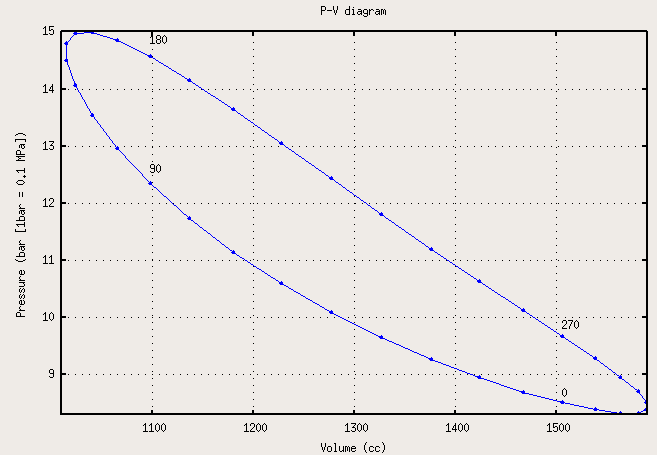
- Direction and purpose: On a typical pressure–volume diagram, a cyclic process traced in a clockwise direction usually describes a heat engine that converts heat into net positive work (see heat engine), whereas a counterclockwise loop represents a refrigerator or heat pump that consumes work to move heat from cold to hot (see heat pump).
- First law constraint: For any cycle the algebraic sum of heat transfers equals the algebraic sum of work transfers; this places a firm energy balance but does not set limits on efficiency by itself. The second law introduces the concept of irreversibility and upper bounds on conversion efficiency.
Common cycles and historical context
Idealized cycles are models that capture dominant features of practical machines. The Carnot cycle, introduced by Sadi Carnot in the early 19th century, sets the theoretical maximum efficiency between two temperature reservoirs and is a benchmark for reversible operation. Other important ideal cycles include the Otto cycle (a simple model for spark-ignition internal combustion engines), the Diesel cycle (compression-ignition engines), the Brayton cycle (gas turbines), and the Rankine cycle (steam power plants). These idealizations were developed and refined by many early investigators, including Nicolas Léonard Sadi Carnot, Rudolf Clausius and Lord Kelvin, and help engineers compare real devices against thermodynamic limits.
Applications and examples
Thermodynamic cycles provide the conceptual backbone for a wide range of technologies:
- Power generation: Steam turbines in Rankine cycles and combined-cycle gas turbines rely on cyclic operation to convert heat into electrical work.
- Transportation: Internal combustion engines in cars and aircraft are analyzed using Otto, Diesel or Brayton cycle approximations.
- Heating and cooling: Refrigerators and heat pumps operate on reverse cycles (counterclockwise loops) to move heat against its spontaneous direction.
- Industrial processes: Chemical plants and refrigeration systems use cycles to manage energy flows and material temperatures efficiently.
Distinctions and practical limits
Real cycles differ from ideal ones because of irreversibilities: friction, unrestrained expansions, finite-rate heat transfer and nonideal working fluids reduce performance compared with reversible models. Engineers therefore distinguish between reversible cycles (theoretical limits), idealized cycles (useful approximations for design), and actual cycles (measured performance in real machines). Understanding the direction of the cycle on a diagram clarifies its role: a clockwise cycle produces net positive work and is treated as a heat engine, while a counterclockwise cycle requires input work to transfer heat from a colder to a warmer reservoir and is analyzed as a heat pump. Analysis of cycles frequently invokes the first law of thermodynamics to track energy and uses the second law to evaluate limits and efficiencies.
For further introductory material and diagrams that illustrate typical cycles and their P–V or T–S representations, consult textbooks and reputable educational resources on thermodynamics. See also short discussions of heat and work as path-dependent quantities (heat, work) and the role of state variables (state) in cycle analysis.
Questions and answers
Q: What is a thermodynamic cycle?
A: A thermodynamic cycle is a series of thermodynamic processes that returns a system to its initial state.
Q: Do properties change over a thermodynamic cycle?
A: No, properties depend only on the thermodynamic state and thus do not change over a cycle.
Q: Are heat and work zero over a thermodynamic cycle?
A: No, heat and work are not zero over a cycle, but rather depend on the process.
Q: What does the first law of thermodynamics dictate over a cycle?
A: The first law of thermodynamics dictates that the net heat input is equal to the net work output over any cycle.
Q: Why is the cycle an important concept in thermodynamics?
A: The repeating nature of the process path allows for continuous operation, making the cycle an important concept in thermodynamics.
Q: What does a clockwise thermodynamic cycle represent?
A: If the cyclic process moves clockwise around the loop, then it represents a heat engine, and W will be positive.
Q: What does a counterclockwise thermodynamic cycle represent?
A: If it moves counterclockwise, then it represents a heat pump, and W will be negative.
Related articles
Author
AlegsaOnline.com Thermodynamic cycle: principles, types, and applications Leandro Alegsa
URL: https://en.alegsaonline.com/art/99302