
Taurus (constellation): overview, notable objects, history and observing
Taurus is a northern zodiac constellation notable for Aldebaran, the Hyades and Pleiades open clusters, and the Crab Nebula; prominent in myth, navigation and astronomical study.
Taurus is a prominent constellation of the northern celestial hemisphere whose Latin name literally means bull. The name and pattern are rooted in Latin and ancient sky lore. Located along the plane of Earth's orbit, Taurus is one of the classical zodiac constellations and therefore crosses the apparent path of the Sun, the ecliptic. It is most conspicuous in the late autumn and winter sky of the northern hemisphere and forms a familiar part of seasonal star maps.
Image gallery
8 Images



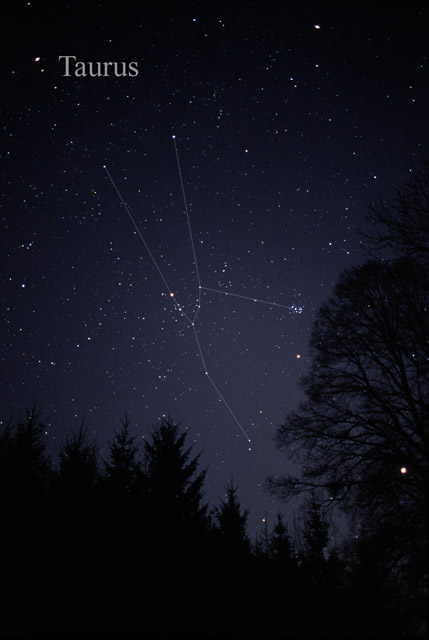

Notable stars and patterns
The constellation is anchored by several well-known stars and patterns used by observers. The bright orange star Aldebaran is the most luminous in Taurus and marks the eye of the bull; it is an evolved red giant visible to the unaided eye. Around Aldebaran the Hyades open cluster creates a characteristic V-shaped asterism that defines the bull's face. The compact Pleiades cluster, often called the Seven Sisters, lies to the northwest and is one of the sky's most easily recognised clusters.
Deep-sky objects
Taurus contains important deep-sky objects of scientific interest. The Crab Nebula, catalogued as M1, is the remnant of a historical supernova that was bright enough to be recorded by observers in the 11th century; it is now studied across the electromagnetic spectrum as a young supernova remnant and pulsar wind nebula. The broader Taurus region also includes nearby molecular clouds and sites of recent star formation that are rich targets for infrared and radio studies.
History and culture
Taurus is one of the constellations listed by the astronomer Ptolemy in antiquity and persists among the 88 modern constellations defined by the IAU. For many cultures the bull motif carried agricultural and mythological significance: the Pleiades and Hyades served as seasonal markers for planting and navigation, and myths associated with a celestial bull appear across the Mediterranean and beyond. The familiar cluster shapes and bright stars made Taurus a convenient reference for night-time orientation.
Observing tips
To find Taurus, locate the neighbouring constellation Orion and extend the line of Orion's belt toward the northwest to reach Aldebaran and then the Pleiades. The Hyades form the broad V that points toward Aldebaran. Under suburban skies the Pleiades and Hyades are visible without optical aid; binoculars reveal dozens of cluster members while small telescopes resolve many fainter stars and nebulosity. The Crab Nebula requires a larger amateur instrument or long-exposure imaging to show its structure.
Scientific importance
Objects in Taurus provide valuable opportunities for the study of stellar evolution, cluster dynamics and the interstellar medium. Nearby open clusters like the Hyades and Pleiades help calibrate distance measurement techniques and models of stellar ageing. The Crab Nebula remains a benchmark object for understanding the aftermath of stellar explosions and the behaviour of young neutron stars and relativistic particle winds.
Further reading and related topics: bull, Latin, zodiac, ecliptic, Ptolemy, IAU, star clusters, Crab Nebula, supernova, red giant, Aldebaran.
Related articles
Author
AlegsaOnline.com Taurus (constellation): overview, notable objects, history and observing Leandro Alegsa
URL: https://en.alegsaonline.com/art/96544