
Tempel 1 (9P/Tempel): discovery, Deep Impact encounter, and scientific legacy
Tempel 1 is a short-period comet discovered in 1867. NASA's Deep Impact probe struck it in 2005, revealing insights into cometary composition, structure and the presence of exposed water ice.
Overview
Tempel 1 (officially 9P/Tempel) is a periodic, Jupiter-family comet that completes an orbit around the Sun roughly every 5½ years. It was discovered in 1867 by the astronomer Ernst Wilhelm Leberecht Tempel. As a relatively accessible short-period comet, Tempel 1 became the focus of close spacecraft study in the 21st century, offering a direct look at a cometary nucleus and its near-surface materials.
Image gallery
10 Images




Physical characteristics
The nucleus of Tempel 1 is a dark, irregularly shaped body a few kilometres across with a low surface reflectivity typical of many cometary nuclei. Its surface is covered in a mixture of fine dust, organic-rich material and localized patches of exposed ice. Like other comets, Tempel 1 develops a coma and tail when heated by the Sun, releasing gas and dust from volatile-rich layers beneath the surface.
Deep Impact mission and impact event
In 2005 NASA's Deep Impact mission deliberately released an impactor to collide with Tempel 1 on 4 July. The collision, performed at high relative speed, excavated material from beneath the surface and produced a bright cloud of ejecta that was observed by the mission's flyby spacecraft and by telescopes on Earth. Observing the ejecta allowed scientists to sample subsurface material that is normally hidden beneath a weathered crust.
Key findings
- The impact exposed icy grains and a mixture of water ice and dust, confirming that some cometary material near the surface can contain frozen water.
- Spectra and dust analysis showed silicates, carbon-bearing compounds and other primitive materials, offering clues about conditions in the early Solar System.
- The crater and ejecta properties helped refine models of cometary strength and layering, indicating a porous, weakly consolidated interior.
Follow-up studies and significance
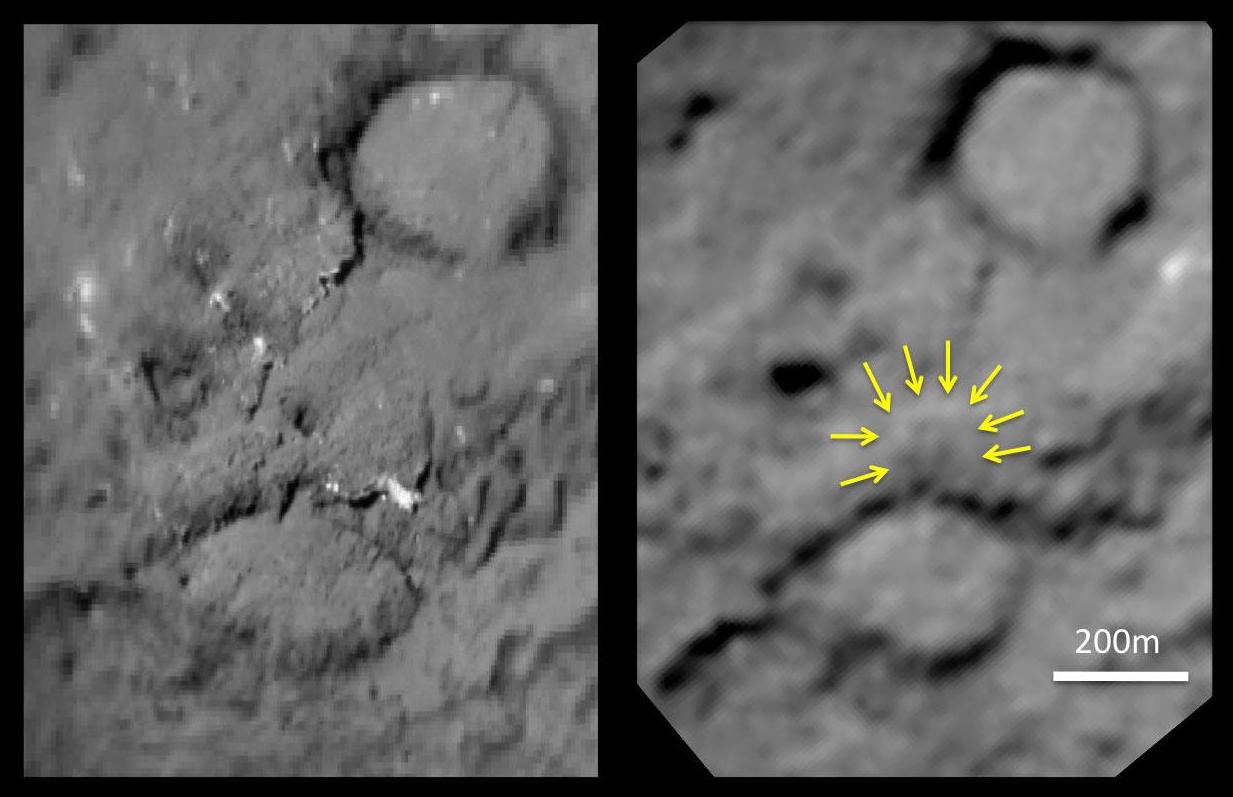
Tempel 1 was revisited by NASA's follow-up flyby mission in 2011, which imaged the impact site to assess long-term surface changes and to measure the crater. Together, these observations advanced our understanding of how comets evolve under repeated solar heating and how subsurface materials are exposed. The mission highlighted the value of active experiments—using an impactor to reveal hidden composition—over remote observation alone.
Context and distinctions
While water in the form of vapor had been detected from comets earlier through spectroscopy, the Deep Impact event provided direct evidence of water ice and other primitive materials excavated from beneath a comet's surface, not merely gaseous emissions. Tempel 1 remains an important case study for comet science, linking telescopic data, in situ spacecraft encounters and laboratory analysis of returned information to build a more complete picture of small icy bodies in the Solar System.
For general background on comets, see comet resources. For mission details visit summaries of Deep Impact and follow-up data from the 2011 encounter. Comparisons of area and scale appear in various mission reports (for example, area conversions like 7 acres or 3 hectares are often used to illustrate exposed patches of ice).
Related articles
Author
AlegsaOnline.com Tempel 1 (9P/Tempel): discovery, Deep Impact encounter, and scientific legacy Leandro Alegsa
URL: https://en.alegsaonline.com/art/96901
Sources
- nasa.gov : "NASA - Overview"
- nasa.gov : "NASA - Deep Impact Team Reports First Evidence of Cometary Ice"