
Tenma (ASTRO-B): Japan's second X‑ray astronomy satellite
Tenma (ASTRO‑B) was Japan's second dedicated X‑ray astronomy satellite, launched in 1983 by ISAS/University of Tokyo to observe cosmic X‑ray sources and advance high‑energy astrophysics research.
Tenma (also designated ASTRO-B, Japanese: てんま) was a Japanese scientific satellite dedicated to X‑ray astronomy. Developed under the Institute of Space and Astronautical Science (ISAS) within the research framework of the University of Tokyo, Tenma was placed into low Earth orbit on 20 February 1983. The mission is commonly cited as part of Japan’s early programme in high‑energy astrophysics and formed a key step in the country’s development of space science capabilities.
Image gallery
2 Images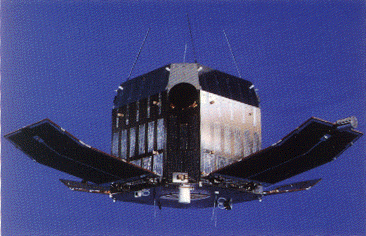

Mission goals and scientific focus
Tenma’s primary objective was to measure X‑ray emission from cosmic sources with improved spectral and timing performance compared with earlier experiments. Its scientific programme emphasised spectroscopy and temporal studies of compact objects, active galactic nuclei, supernova remnants and other high‑energy phenomena. The mission contributed to systematic observations that helped probe accretion processes, emission mechanisms and the physical conditions near neutron stars and black holes in the X‑ray band (X‑ray astronomy).
Instruments and capabilities
The satellite carried a suite of detectors and support systems typical for dedicated X‑ray observatories of the era. Instrumentation and spacecraft systems were designed to obtain moderate resolution spectra and to follow rapid variability from bright X‑ray sources. Capabilities included energy‑sensitive detectors, timing electronics for variability studies, collimation or modest directional capability for source identification, and data telemetry to return observations to ground teams.
Launch, orbit and operations
Tenma was launched into low Earth orbit on 20 February 1983; records of the launch and initial orbital insertion are part of the mission archive (launch and orbit). Operated by an academic–research consortium centred at the University of Tokyo, the satellite supported a programme of targeted observations and monitoring campaigns. Routine spacecraft functions included pointing, attitude control and telemetry downlink to mission ground stations as part of the overall satellite programme.
Data, legacy and scientific contributions
Observations from Tenma were used by researchers to characterise spectra and time variability of many X‑ray sources and to compare results with theoretical models. The mission’s data contributed to the body of high‑energy astrophysics knowledge and helped establish technical and scientific practices for later Japanese missions. Tenma served as a bridge between Japan’s first X‑ray efforts and subsequent ASTRO‑series observatories, strengthening national expertise in instrument building, mission operations and data analysis.
Context and collaborations
Although primarily a national effort, Tenma operated in a period of growing international exchange of data and ideas in astronomy; results were shared with and used by the global scientific community. The mission illustrates the close relationship between academic institutions and national space research agencies in Japan during the late twentieth century and the gradual expansion of Japan’s role in space‑based high‑energy astrophysics.
Related articles
Author
AlegsaOnline.com Tenma (ASTRO-B): Japan's second X‑ray astronomy satellite Leandro Alegsa
URL: https://en.alegsaonline.com/art/96979
Sources
- isas.ac.jp : "Catalogue of ISAS Missions"