
Aldebaran — the orange giant star in Taurus
Aldebaran is a prominent orange giant (α Tauri) about 65 light-years away in Taurus. Bright and historically notable, it is a nearby evolved star with reports of a possible substellar companion.
Overview
Aldebaran (Alpha Tauri, α Tau) is a conspicuous orange giant visible to the naked eye. It is classified as a K-type giant and lies roughly 65 light years from the Sun. With an average apparent magnitude near 0.87 it is the brightest star in the zodiac belt within its region and among the brightest stars seen in the night sky.
Image gallery
7 Images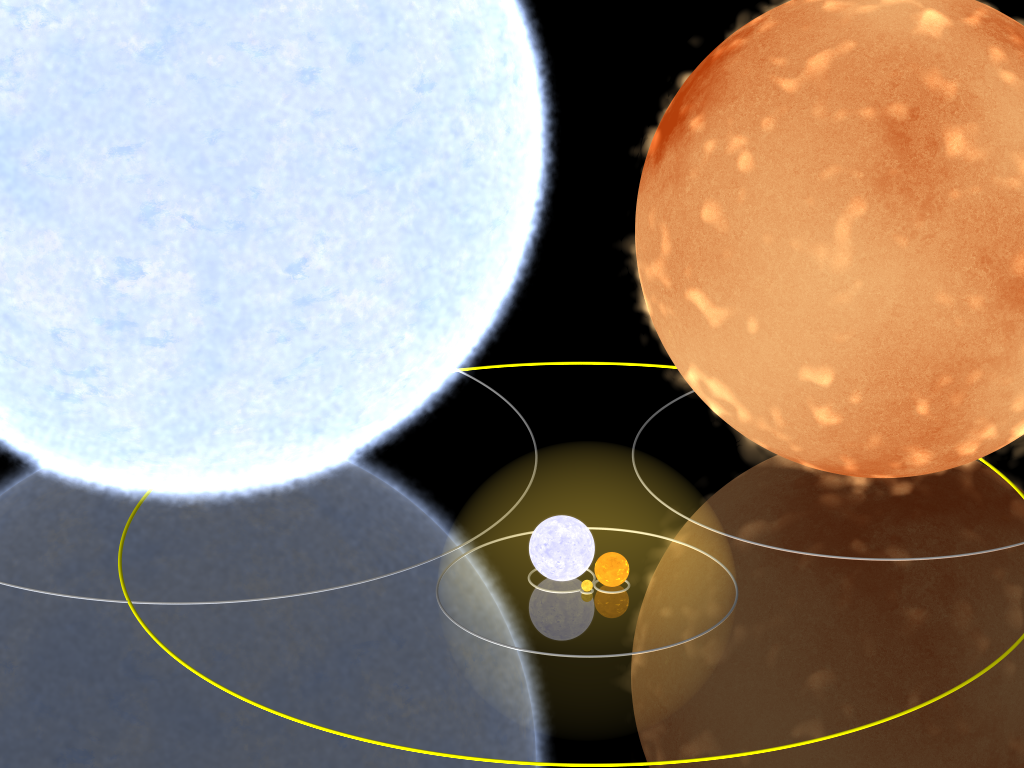





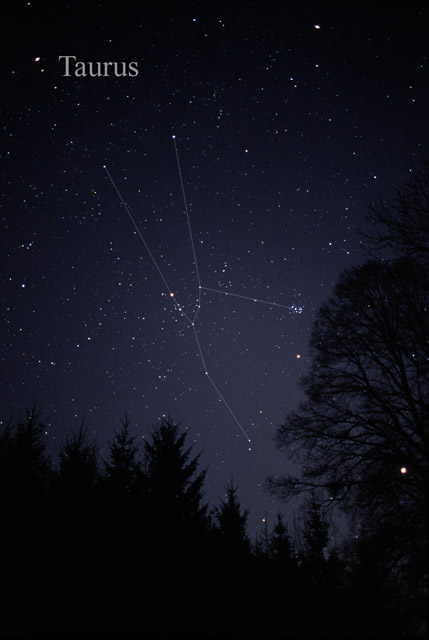
Physical characteristics
Aldebaran has exhausted the hydrogen in its core and has expanded into a giant phase. Spectroscopically it is a K-type giant (often listed as K5 III), giving it a distinct orange hue. Its radius is many times that of the Sun—typically described as on the order of a few dozen solar radii—and its luminosity is correspondingly larger than the Sun's. These properties reflect normal stellar evolution for a star of roughly solar mass that has left the main sequence and begun shell hydrogen burning or helium fusion in the core.
Position, observation and context
The star sits in the direction of the Hyades open cluster in the constellation Taurus, but Aldebaran is a foreground object and not a true cluster member. Its common Arabic name, recorded as al-dabarān, means "the Follower," likely because it appears to follow the nearby Pleiades across the sky. Because of its brightness and color it has been used for orientation by observers and in traditional celestial lore for many cultures.
History, culture and naming
References to Aldebaran appear in ancient astronomical records and in navigation guides across civilizations. Its prominence in the winter sky made it a useful marker for seasonal observations. Modern catalogs use the Bayer designation Alpha Tauri (α Tauri) and include Aldebaran among the notable stars of the Taurus grouping.
Companions and scientific interest
Long-term radial-velocity monitoring has shown variations that led to reports of a companion as early as the 1990s. More recent studies have presented evidence consistent with a substellar or planetary-mass companion, though the interpretation remains under active study; the data include stellar activity and oscillation signatures that must be disentangled from orbital motion. See research summaries for detailed status of the proposed planetary companion.
Notable facts
- Aldebaran is the brightest star in Taurus and an easy naked-eye target for northern-hemisphere observers.
- Its orange color distinguishes it from nearby bluish and white stars, making it a visual anchor in the winter sky.
- Although it appears near the Hyades cluster on the sky, it lies significantly closer to Earth, so the association is only line-of-sight.
- Historical and cultural references to Aldebaran span Arabic, Babylonian and later Western star lore.
For more general information and observational data, consult star catalogs and modern summaries of stellar evolution and exoplanet searches using spectroscopic and precise radial-velocity methods. Related resources cover giant-star structure, red-giant oscillations, and the observational distinction between stellar activity and true companions (Taurus, distance, constellation, zodiac).
Questions and answers
Q: What type of star is Aldebaran?
A: Aldebaran is an orange giant star.
Q: How far away is Aldebaran?
A: It is about 65 light years away.
Q: In which constellation is Aldebaran located?
A: Aldebaran is located in the zodiac constellation of Taurus.
Q: What is the average apparent magnitude of Aldebaran?
A: The average apparent magnitude of Aldebaran is 0.87.
Q: What does the name Aldebaran mean?
A: The name Aldebaran is Arabic and means "the Follower."
Q: What is the diameter of Aldebaran?
A: The diameter of Aldebaran is larger than 50 million kilometers.
Q: Was a planetary companion discovered orbiting Aldebaran?
A: Yes, a planetary companion was reported in 1993 and there is evidence for it in a recently accepted paper.
Related articles
Author
AlegsaOnline.com Aldebaran — the orange giant star in Taurus Leandro Alegsa
URL: https://en.alegsaonline.com/art/2210
Sources
- oxforddictionaries.com : Oxford Dictionary: Aldebaran
- merriam-webster.com : Merriam-Webster: Aldebaran
- stars.astro.illinois.edu : "Aldebaran" · web.archive.org
- arxiv.org : arxiv.org/abs/1505.03454