
Battle of the Wilderness (May 5–7, 1864)
A major 1864 clash in dense Virginia thickets during the Overland Campaign where Ulysses S. Grant and Robert E. Lee fought an indecisive but strategically important battle.
Overview
The Battle of the Wilderness was fought from May 5 to 7, 1864 in a tangled region of Virginia as part of the Overland Campaign. It was one of the opening encounters in Union general Ulysses S. Grant's 1864 effort to move on Richmond and to apply continuous pressure on Confederate forces in the American Civil War. The opposing field armies met in an area known as the Wilderness — a mix of second‑growth forest, briars and narrow roads that shaped how the fighting unfolded.
Image gallery
10 Images




Forces and commanders
The main Confederate force was the Army of Northern Virginia under General Robert E. Lee. The Union field force was the Army of the Potomac commanded in the field by Major General George G. Meade, with Lt. Gen. Ulysses S. Grant accompanying and directing the campaign at the highest level. Both sides committed large corps and numerous brigades; the Wilderness brought experienced troops into chaotic and close-quarters combat rather than the open‑field maneuvering common in earlier campaigns.
Terrain and combat conditions
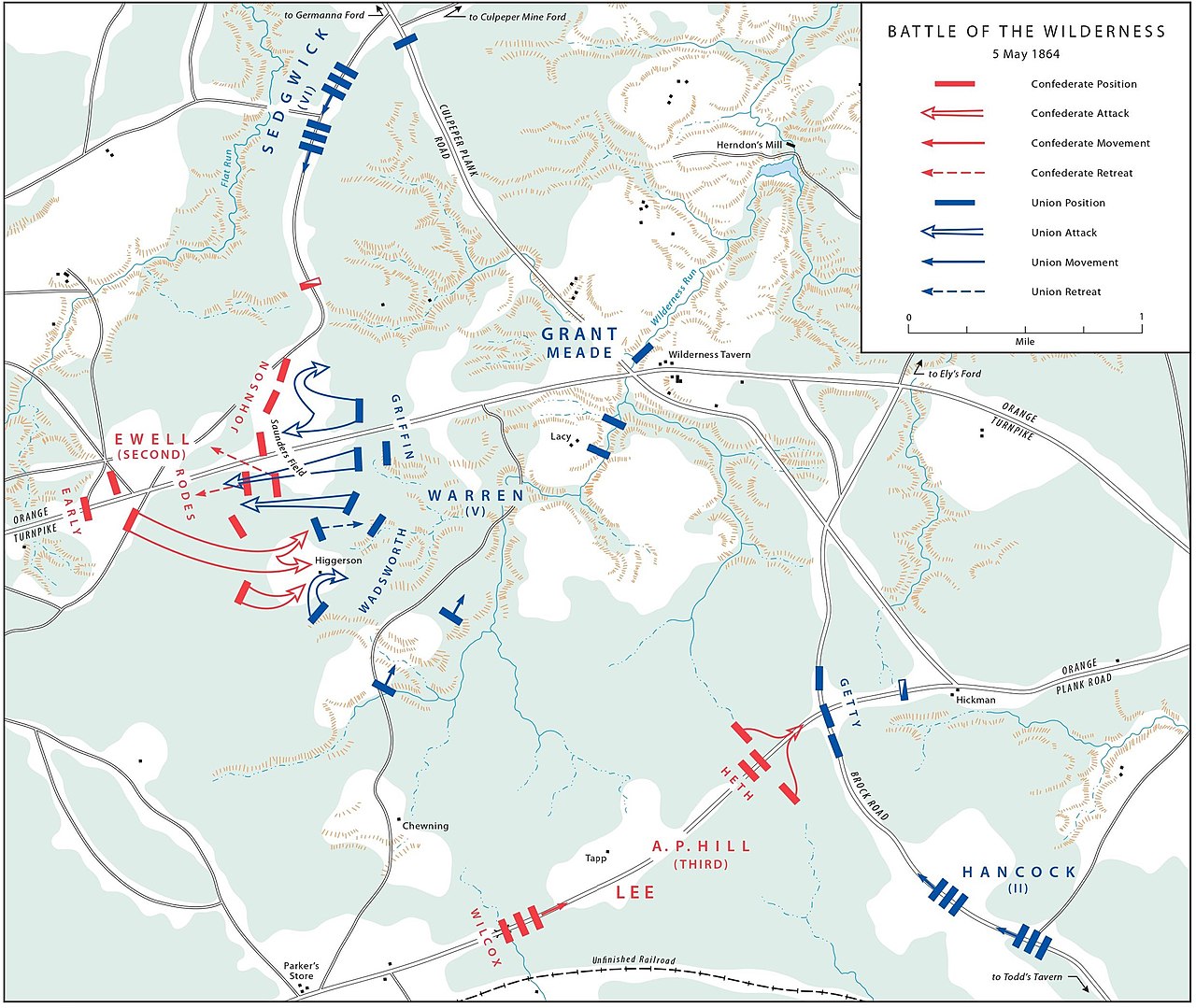
The Wilderness was characterized by dense undergrowth, stunted trees and few clear fields of fire. Tangled thickets prevented large formations from operating effectively and often reduced clashes to small, disjointed firefights. The ground and vegetation also increased the danger of fires started by burning powder and cooking fires; accounts from the battle describe men burned or trapped by flames. These conditions made command and control difficult and caused high confusion and disorder on both sides.
Course of the battle
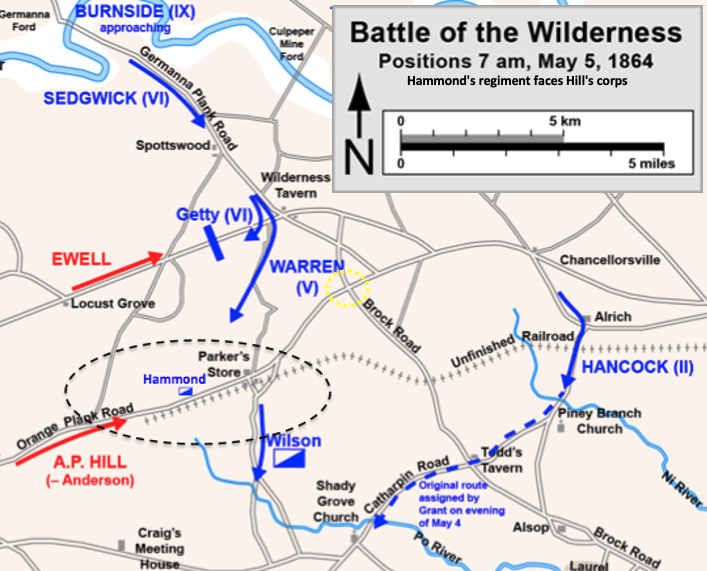
Fighting began as Union columns advanced and encountered Confederate forces intent on blocking their route to Richmond. Over three days the armies exchanged repeated attacks and counterattacks across multiple localities rather than along a single continuous line. Neither army achieved a decisive breakthrough; Confederate assaults halted some Union advances, while Union pressure inflicted substantial losses and forced Lee to respond defensively. At the close of the fighting Grant chose not to withdraw but to move his army south and east, seeking to place his forces between Lee and Richmond—an action that led directly into the subsequent Battle of Spotsylvania Court House.
Aftermath and significance
Tactically the Battle of the Wilderness is often described as inconclusive: neither side won a clear battlefield victory. Strategically it marked a turning point in Union operations in the Eastern Theater because Grant continued offensive operations instead of retreating after a costly confrontation. The campaign that followed reflected Grant's willingness to trade territory and endure casualties in order to deplete Confederate strength over time. The Wilderness also signaled that modern high-casualty, attritional warfare would characterize the final year of the conflict.
Notable aspects
- Dense terrain and undergrowth made large-scale maneuvering nearly impossible and produced confused, short-range fighting.
- Both sides suffered heavy losses; the human cost was substantial and affected later operations.
- Grant's decision to keep pressing south instead of retreating distinguished his approach from earlier Union commanders and shaped the remainder of the Overland Campaign.
- The battle connected directly to the wider strategy of bringing continuous pressure on Confederate armies and supply centers.
For further context on the campaign and the broader war see introductory overviews of the Overland Campaign, studies of the American Civil War, and detailed accounts of Richmond’s defense and the operations of the Army of Northern Virginia under Lee. Contemporary battlefield maps and unit histories illuminate how the Wilderness’s terrain shaped tactics and outcomes; the immediate follow-up action at Spotsylvania Court House continued the series of costly engagements that defined the spring and summer of 1864.
Readers seeking a succinct timeline or unit lists may consult specialized battle studies and primary-source collections that compile orders, reports and eyewitness testimony for the dates May 5–7, 1864.
Tags
Related articles
Author
AlegsaOnline.com Battle of the Wilderness (May 5–7, 1864) Leandro Alegsa
URL: https://en.alegsaonline.com/art/9575