
Overland Campaign (May–June 1864): Grant vs. Lee in the Eastern Theater
The Overland Campaign was a sequence of brutal, continuous battles in the Eastern Theater of the American Civil War (May–June 1864) in which Ulysses S. Grant pressed Robert E. Lee’s Army of Northern Virginia toward Richmond.
The Overland Campaign was a concentrated Union offensive in the Eastern Theater of the American Civil War. Launched in May 1864, it marked a sustained effort by Lieutenant General Ulysses S. Grant to apply continuous pressure on the Confederate Army of Northern Virginia led by General Robert E. Lee. The campaign took place in and around the tangled forests and open fields of central Virginia as both armies maneuvered between Washington, D.C., and the Confederate capital of Richmond. It has been remembered for fierce fighting, high casualties, and a change in Union strategy toward relentless engagement.
Image gallery
10 Images


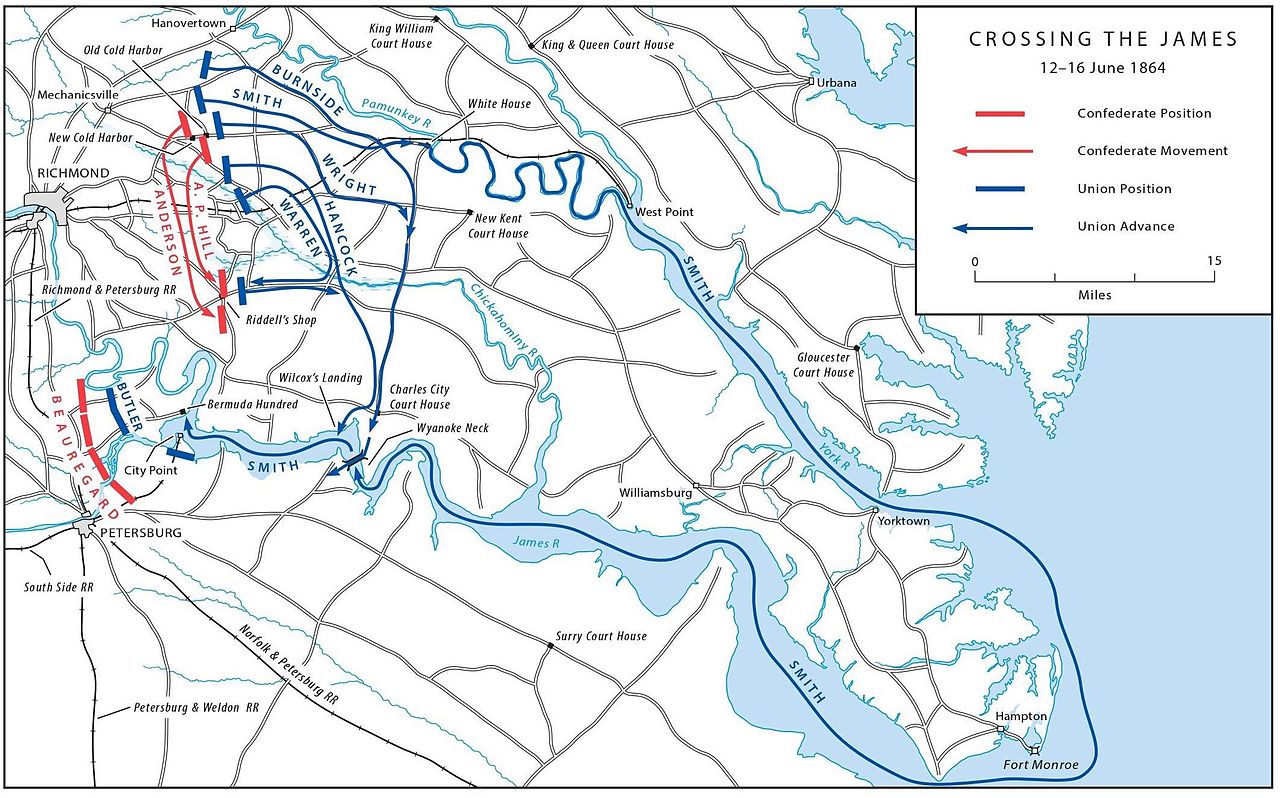
Major engagements and movements
- The campaign began in early May and continued through June of 1864 in the May–June period, with operations in the Eastern Theater.
- Key battles during the series included the Battle of the Wilderness, the prolonged fighting at Spotsylvania Court House, actions along the North Anna River, and the confrontations at Cold Harbor.
- For the Union the principal force was the Army of the Potomac under Meade but directed in overall strategy by Union General Grant.
Grant’s objective was not merely to win isolated tactical victories but to wear down Lee’s army and to move inexorably closer to Richmond. Unlike earlier Union generals who had often retreated after costly clashes, Grant chose to keep advancing, accepting heavy losses if this meant depriving the Confederacy of manpower and territory. Lee, commanding the Army of Northern Virginia, used interior lines, entrenchments, and aggressive counterattacks to slow Union progress.
Fighting in the Wilderness was characterized by close-range combat in dense woods where coordinated assaults were difficult. At Spotsylvania the campaign became a grinding exchange of fortified positions. After a series of maneuvers and battles, the campaign culminated in the costly frontal assaults at Cold Harbor, after which Union forces shifted to operations that would lead into the prolonged siege of Petersburg.
Strategically, the Overland Campaign demonstrated a shift toward attrition and coordinated, multi-theater pressure: Grant remained with the army in the field and coordinated operations even while other Union armies operated elsewhere. The campaign reduced Confederate options, strained Southern resources, and helped set conditions for the final year of the war.
Notable facts include the campaign’s intensity over a short period, the willingness of the Union high command to accept sustained casualties, and the way the fighting presaged trench warfare later seen around Petersburg. For more on related units, battles, and primary accounts see additional resources: Virginia campaign studies, and broader Civil War overviews at Eastern Theater collections and archival material covering May–June 1864.
Related articles
Author
AlegsaOnline.com Overland Campaign (May–June 1864): Grant vs. Lee in the Eastern Theater Leandro Alegsa
URL: https://en.alegsaonline.com/art/73728
Sources
- history.com : "Grant's Overland Campaign, 150 Years Ago"
- study.com : "Grant's Overland Campaign: History & Summary"
- historyofwar.org : "U.S. Grant's 1864 Overland Campaign"
- thefreedictionary.com : "north"
- civilwar.org : "Valley Thunder: The Battle of New Market"
- civilwar.org : "Just How Wild Was the Wilderness?"
- civilwar.org : "The Wilderness; Spotsylvania and Orange Counties, Virginia"
- civilwar.org : "The Overland Campaign of 1864"