
Sympathetic nervous system
The sympathetic nervous system is the vertebrate autonomic branch that mobilizes the body for action. It controls cardiovascular, respiratory, thermoregulatory and metabolic responses during stress and activity.
Overview
The sympathetic nervous system (SNS) is one of the two main divisions of the autonomic nervous system. It coordinates a set of rapid, whole‑body adjustments commonly called the "fight or flight" response, increasing alertness and preparing tissues for increased activity. It works in concert with the parasympathetic system to maintain internal balance; when one branch is more active, the other is typically less active. For a basic classification, see the autonomic nervous system.
Image gallery
3 Images

Anatomy and pathways
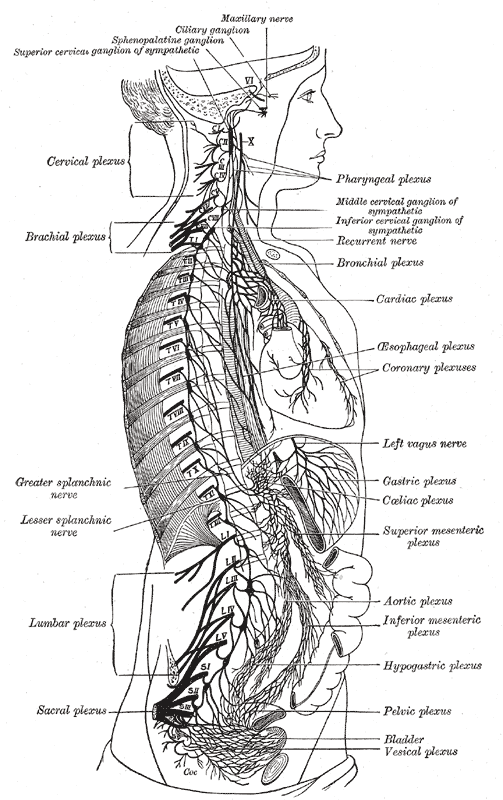
Preganglionic sympathetic neurons arise primarily from the thoracic and upper lumbar spinal cord. Their fibers project to the sympathetic chain (paravertebral) ganglia, to prevertebral ganglia, or through splanchnic nerves to the adrenal medulla. Postganglionic fibers then innervate target organs. The system uses mostly norepinephrine as a neurotransmitter at postganglionic synapses, while the adrenal medulla releases epinephrine and norepinephrine into the bloodstream. Sweating is an exception: many sweat glands are activated by sympathetic cholinergic fibers.
Physiological effects
- Heart: increased rate and contractility, often described as an increase in heart rate.
- Respiratory: bronchodilation to improve airflow.
- Vessels: generally vasoconstriction raising peripheral resistance, though some beds (e.g., skeletal muscle) dilate under certain receptor influences, contributing to elevated blood pressure.
- Digestive tract: reduced motility and secretions—for example a decrease in large‑intestine movement and changes in esophageal peristalsis; see notes on reduced motility and altered peristalsis.
- Eyes and skin: pupil dilation, piloerection (goose bumps), and activation of sweat glands (sweating).
Clinical relevance and pharmacology
Understanding the SNS is important in medicine and pharmacology. Drugs that mimic sympathetic activity (sympathomimetics) are used as bronchodilators, vasopressors and stimulants; blockers (sympatholytics) treat hypertension and certain arrhythmias. Dysregulation contributes to conditions such as dysautonomia, orthostatic intolerance, hyperhidrosis and exaggerated stress responses. Acute activation can be adaptive, while chronic overactivity is linked to cardiovascular and metabolic risks.
Origins and significance
The sympathetic division is conserved across vertebrates and evolved to enable rapid mobilization for danger, locomotion and competition. Its balance with the parasympathetic branch underlies much of physiological regulation, and it remains a central concept in physiology, neurology and clinical practice.
For introductory reading and diagrams, consult resources on the autonomic nervous system and clinical summaries that explain how adjustments such as an increased heart rate and changes in blood pressure are produced by the sympathetic pathway.
Related articles
Author
AlegsaOnline.com Sympathetic nervous system Leandro Alegsa
URL: https://en.alegsaonline.com/art/95632