
Synapomorphy: shared derived traits in cladistics
A synapomorphy is a shared, derived trait used to infer common ancestry. This article defines the concept, gives examples, outlines its history and importance, and distinguishes it from related terms in evolutionary biology.
Overview
A synapomorphy is a trait shared by two or more taxa that is inferred to have been present in their most recent common ancestor but absent in more distant ancestors. The concept is central to modern cladistics, where such shared derived characters are used to identify clades — groups of organisms that include an ancestor and all its descendants. In plain terms, a synapomorphy helps scientists recognize evolutionary branching points by marking features that evolved in a lineage after it split from its relatives.
Image gallery
1 Image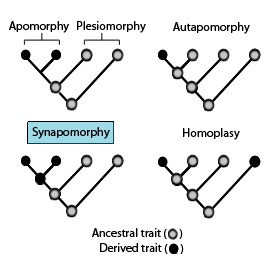
Key characteristics
Synapomorphies are a subset of homologous traits: they reflect common ancestry rather than similarity by convergence. For a character to be considered a synapomorphy, it must be (1) present in multiple descendant taxa, (2) present in their most recent common ancestor, and (3) absent in older, more remote ancestors. This distinguishes synapomorphies from plesiomorphies (ancestral traits) and from autapomorphies, which are derived traits unique to a single taxon.
Common examples
- Mammalian hair and mammary glands are classic synapomorphies that unite mammals relative to other amniotes.
- The presence of an amniotic egg unites reptiles, birds, and mammals within the amniotes.
- Four limbs with digits are treated as synapomorphies for tetrapods in many analyses.
These examples illustrate how synapomorphies can be anatomical, physiological, or molecular (such as specific DNA sequence changes).
History and methodological role
The explicit use of shared derived characters to reconstruct evolutionary relationships emerged with the development of cladistic methodology in the mid-20th century. Researchers began to favor synapomorphies as the most reliable markers of common descent when building branching diagrams (cladograms). In practice, taxa are grouped by the presence of nested suites of synapomorphies, and alternative trees are evaluated by which set of synapomorphies best explains observed distributions.
Uses and importance
Synapomorphies serve several roles: they define clades, guide taxonomy, and provide hypotheses about trait evolution. Molecular synapomorphies, such as shared insertions or unique amino acid substitutions, are widely used in phylogenetic studies alongside morphology. When combined with fossil evidence and stratigraphy, synapomorphies help infer the timing and sequence of evolutionary changes. For methodological guidance see phylogenetic practice and resources on character coding.
Distinctions, pitfalls, and notable facts
Not every shared trait is a synapomorphy. Convergent evolution can produce similar features in unrelated lineages (homoplasy), and incomplete or ambiguous fossil records can make the polarity of a character (ancestral vs. derived) hard to determine. Careful outgroup comparison is used to polarize characters: selecting taxa outside the group of interest helps reveal which traits are likely ancestral and which are derived. For further conceptual background see homology concepts and discussions of phylogenetic inference.
Questions and answers
Q: What is a synapomorphy?
A: A synapomorphy is a common character present in two or more species by common descent.
Q: What is the meaning of synapomorphy in cladistics?
A: In cladistics, a synapomorphy is a type of homologous character or homology.
Q: What is the precise definition of synapomorphy?
A: A synapomorphy is a trait shared by two or more taxa and their most recent common ancestor, whose own ancestor in turn does not possess the trait.
Q: Is a synapomorphy just an ancestral trait?
A: No, a synapomorphy is not just an ancestral trait but a recently evolved distinguishing trait.
Q: What is the importance of a synapomorphy?
A: A synapomorphy helps to distinguish between two trees of descent which would otherwise be equally likely.
Q: What is the relationship between a synapomorphy and a homologous character?
A: A synapomorphy is a type of homologous character or homology.
Q: Does a synapomorphy represent a unique trait in each species?
A: No, a synapomorphy may be a trait shared by two or more species, as it indicates common descent.
Related articles
Author
AlegsaOnline.com Synapomorphy: shared derived traits in cladistics Leandro Alegsa
URL: https://en.alegsaonline.com/art/95658