
Synovial fluid: composition, function, and clinical importance
Synovial fluid is the viscous, lubricating fluid in movable joints. This article describes its composition, production, mechanical properties, clinical uses, and role in joint disease.
Synovial fluid is a clear to slightly yellow, viscous fluid that fills the spaces within movable joints. It is produced and maintained by the synovial membrane and combines an ultrafiltrate of plasma with secretions from specialized cells. The fluid shows shear‑thinning, or non‑Newtonian, behavior that helps joints move smoothly; see studies of non-Newtonian fluids for its rheological context. The term "synovial" reflects an ancient description of a yolk- or egg‑like substance used to convey the fluid's appearance.
Image gallery
1 Image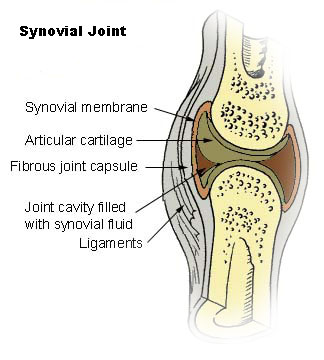
Composition and physical properties
Major molecular components include high‑molecular‑weight hyaluronan (hyaluronic acid), lubricin, a mixture of proteins, lipids and salts, and a small number of cells. Hyaluronan gives the fluid its bulk viscosity and elastic response, while lubricin and phospholipids contribute boundary lubrication of surfaces. Synovial fluid is derived partly from plasma that filters across vessels and partly from secretions by synoviocytes: macrophage‑like and fibroblast‑like cells of the synovial lining.
Functions and importance
- Reduces friction between opposing articular cartilage surfaces during movement.
- Dissipates mechanical loads and assists shock absorption.
- Transports nutrients and metabolic waste to and from avascular cartilage.
- Contains cells and factors involved in joint homeostasis and immune defense.
These combined roles are essential for maintaining smooth, pain‑free motion in synovial joints, such as the knee, hip and shoulder. The fluid’s ability to change viscosity with shear rate helps it both cushion slow pressures and allow low‑resistance rapid movements.
Clinical relevance
Analysis of synovial fluid obtained by aspiration (arthrocentesis) is a key diagnostic tool. Examination includes color and clarity, viscosity, white blood cell count, gram stain and culture, and crystal analysis. Common pathologies that alter synovial fluid include septic arthritis (high WBC count, bacteria), gout (monosodium urate crystals) and pseudogout (calcium pyrophosphate crystals). In osteoarthritis the fluid may be less viscous and show biochemical changes; intra‑articular hyaluronic acid injections are sometimes used as "viscosupplementation" in symptomatic management.
Understanding synovial fluid bridges basic joint biomechanics and clinical practice. For additional technical or rheological background, see resources on joint physiology and fluid mechanics at reference collections and targeted reviews at specialty sites and clinical guidelines. More general overviews are available through educational portals such as fluid dynamics primers and orthopedic summaries at professional societies.
Related articles
Author
AlegsaOnline.com Synovial fluid: composition, function, and clinical importance Leandro Alegsa
URL: https://en.alegsaonline.com/art/95682