
Sun Tzu (Sun Zi) — Chinese mathematician and author of the Sunzi Suan Jing
Sun Tzu (Sun Zi) was a Chinese mathematician of the third century CE, known for the Sunzi Suan Jing and an early statement of the Chinese remainder theorem; he studied calendar and astronomical problems.

Sun Tzu (also written Sun Zi) was a Chinese mathematician traditionally dated to the third century CE. He is distinct from the better-known military writer of the same name — see Sun Tzu — and is remembered chiefly for a short mathematical treatise called the Sunzi Suan Jing (pinyin: Sun Zi Suan Jing). His work survives as an important source on early Chinese number theory and methods used for practical problems such as calendars and astronomy (astronomy).
Image gallery
5 Images
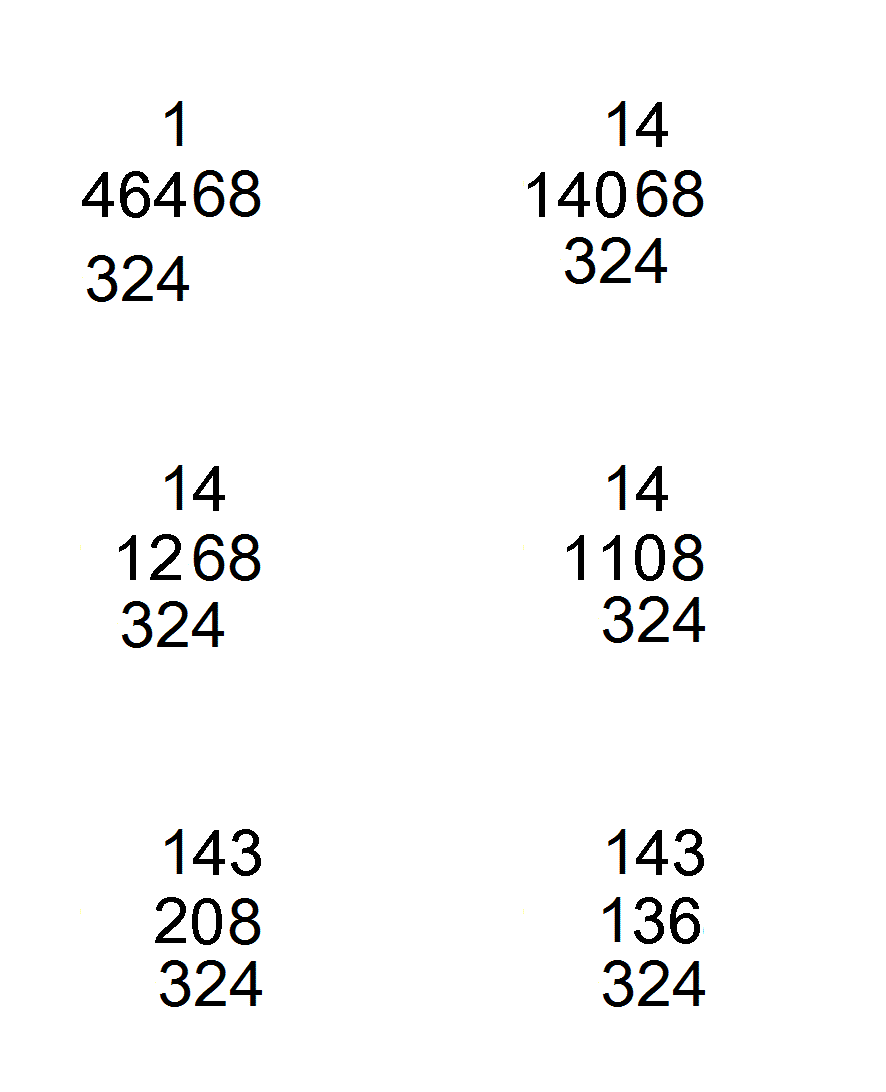
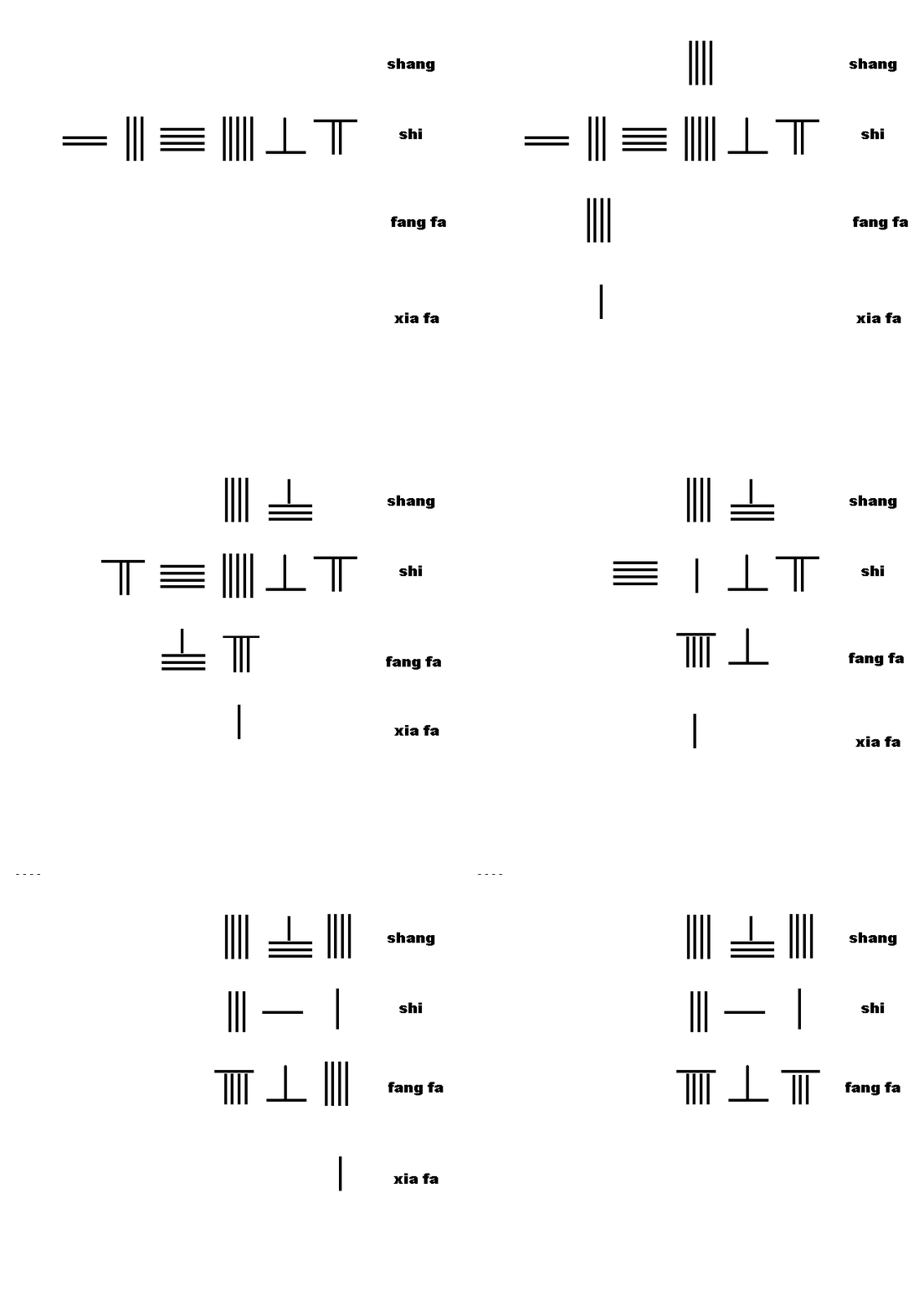


Historical context and life
Little is known with certainty about Sun Tzu's biography; his activity is commonly placed in the third century CE in ancient China. Contemporary historical records are sparse, and what survives of his contribution comes through the mathematical text attributed to him. The treatise reflects techniques employed by scholars working on timekeeping and celestial calculation, fields that often required solving congruences and other integer problems.
Main work and mathematical content
The Sunzi Suan Jing is a short collection of problems and solutions. It contains one of the earliest extant statements of what later became known in the West as the Chinese remainder theorem (Chinese remainder theorem), presented as a practical rule for finding numbers that satisfy several remainders simultaneously. Sun Tzu's problems typically lead to linear congruences and simple Diophantine situations; the text records methods for combining modular conditions and for handling calendar-like questions (calendar).
Methods and mathematical significance
Sun Tzu's procedures show an algorithmic approach: break a problem into congruence conditions, manipulate remainders, and construct a number that fits all conditions. These are early examples of working with what modern writers call Diophantine equations (Diophantine equations) and modular arithmetic. Though the formal algebraic language used today was not available, the ideas display clear number-theoretic thinking and influenced how later Chinese mathematicians organized computational rules (mathematician).
Examples and legacy
- Classic example: find a number that leaves specified remainders when divided by several small moduli — the kind of question used to illustrate the Chinese remainder theorem.
- Calendar problems: using integer solutions to reconcile cycles of days, months, or years (calendar).
Sun Tzu's treatise was studied and commented on by later generations, and its problems are often cited in surveys of early Chinese mathematics. Modern historians recognize the text as a key document in the development of modular reasoning in East Asia and as a source for how mathematical practice addressed practical needs of administration and astronomy.
For brief reference points and related material, see mathematical histories and translations that discuss the Sunzi Suan Jing and the early appearance of modular techniques; further bibliographical and explanatory resources are available in many surveys of ancient mathematics (Diophantine, astronomy, Chinese remainder, third century, China). For transliteration and modern editions, consult editions that list the pinyin and commentary (pinyin, disambiguation).
Related articles
Author
AlegsaOnline.com Sun Tzu (Sun Zi) — Chinese mathematician and author of the Sunzi Suan Jing Leandro Alegsa
URL: https://en.alegsaonline.com/art/94854