
Squirrel monkey (Saimiri) — small New World primates
Small, arboreal New World primates of the genus Saimiri found in Central and South America; social, diurnal, frugivorous-insectivorous, with long tails and distinctive alarm calls.
Overview
Squirrel monkeys are small New World primates of the genus Saimiri that inhabit tropical forests in Central America and South America. They are diurnal and largely arboreal, spending most of their time moving through the forest canopy in search of food. Their diminutive size and agile bodies allow them to forage on thin branches that larger primates cannot reach.
Image gallery
10 Images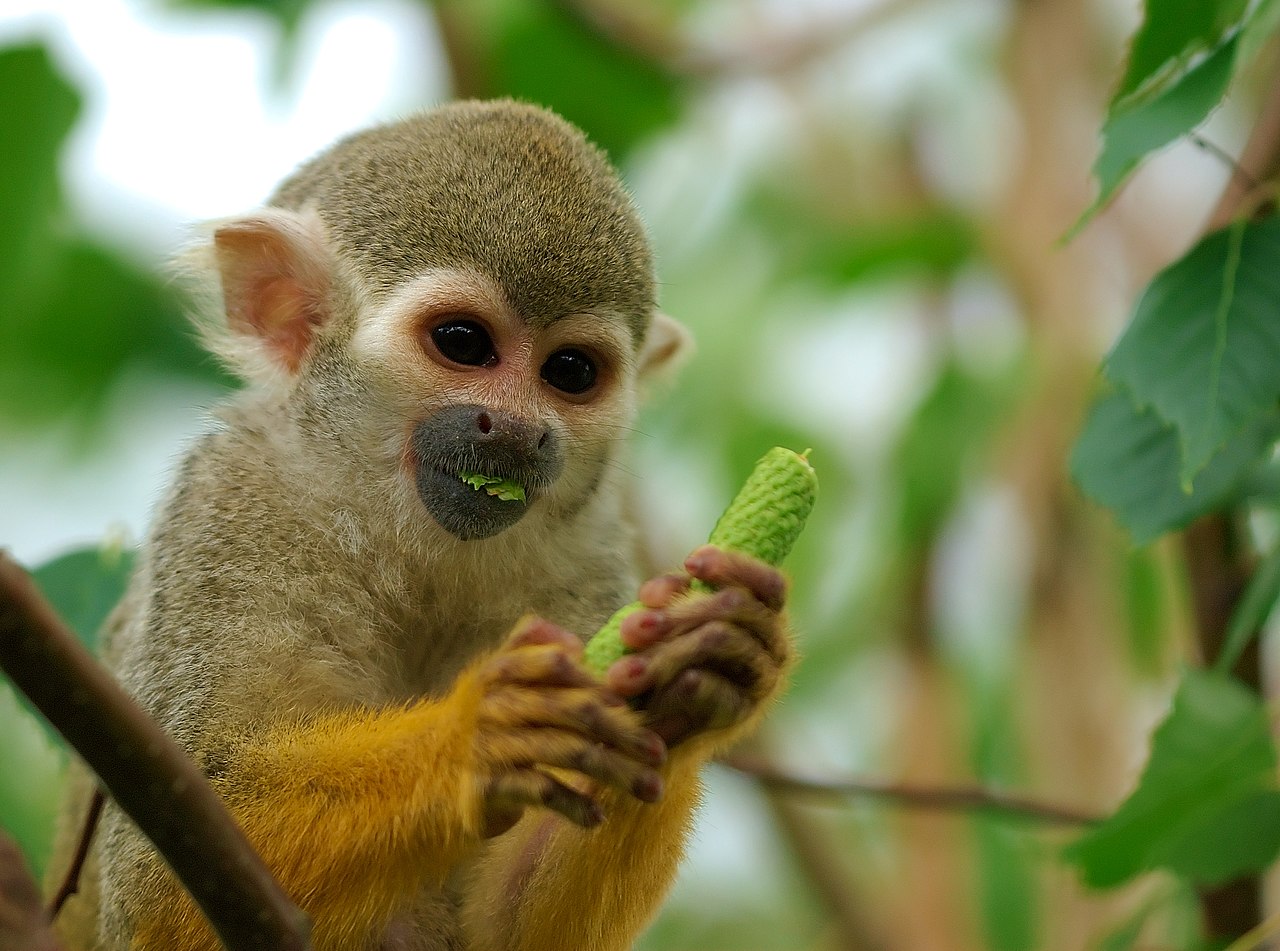


Physical characteristics
Adults typically have a compact body measuring about 25 to 35 cm in length, with a considerably longer tail often measuring around 35 to 42 cm. Their fur pattern includes a pale face with darker markings around the eyes and a generally olive, grey or yellowish coat. The tail is not prehensile but functions as a balancing aid during rapid, acrobatic movement.
Behavior and diet
Squirrel monkeys are social animals that form groups that may range from a few individuals to several dozen, and sometimes larger aggregations. They feed primarily on fruits and a wide variety of small animals. Typical food items include ripe fruit, insects and other arthropods, and occasionally nectar and small vertebrates. Common dietary components include fruit, insects, and at times nectar when fruit is scarce. Foraging is usually active and visually guided.
Habitat, predators, and communication
These monkeys occupy a range of forested habitats, from lowland rainforests to seasonally flooded woodlands. Predation pressure is significant: they are hunted by raptors and large snakes, which has favoured the evolution of vigilant behaviours and an elaborate set of alarm calls. Predators recorded for squirrel monkeys include large falcons and birds of prey (falcons) and various arboreal snakes (snakes). Vocalizations, visual postures and group coordination reduce individual risk.
Taxonomy and conservation
Squirrel monkeys belong to the family Cebidae and the genus Saimiri. Several species or subspecies are recognized across their range; taxonomic treatments have changed as new studies appear. Human impacts such as habitat loss, fragmentation and the pet trade affect populations in parts of their range, so conservation attention varies by region and species.
Notable facts
- Squirrel monkeys are notable for their high activity levels and rapid, precise movements among thin twigs and leaves.
- Although small, they have complex social systems with cooperative behaviours and a rich vocal repertoire used to maintain group cohesion and warn of danger.
- They are frequently studied in behavioural ecology and primate research because of their social dynamics and foraging strategies.
Related articles
Author
AlegsaOnline.com Squirrel monkey (Saimiri) — small New World primates Leandro Alegsa
URL: https://en.alegsaonline.com/art/92954