
Adaptive optics: correcting optical distortion in real time
Adaptive optics (AO) measures and corrects rapidly varying optical distortions—most notably atmospheric turbulence—to sharpen images and recover near-diffraction-limited performance in telescopes, microscopes and other systems.
Adaptive optics (AO) is a set of technologies and control methods that measure and compensate for time-varying distortions in an optical wavefront so an imaging or beam-delivery system can approach its diffraction-limited performance. AO is most widely known for improving ground-based astronomical observations by removing blurring from atmospheric turbulence, but it is also used in solar telescopes, ophthalmic instruments, microscopes and free-space optical communications. For a general technical overview see background on adaptive optics and for examples in optical systems see optical system applications.
Image gallery
6 Images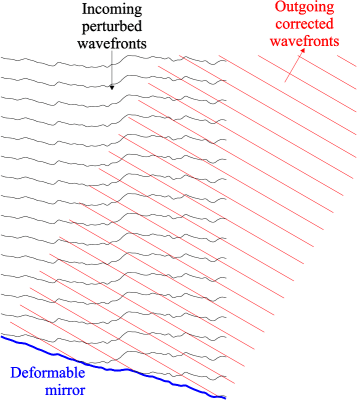



How adaptive optics works
The basic loop measures the incoming wavefront, computes a corrective command and applies that command to a deformable element so the net wavefront becomes flatter. A typical system uses a wavefront sensor (for example a Shack–Hartmann sensor), a real-time controller that performs the computations and filters, and a corrective element such as a deformable mirror. Corrections must be computed and applied at rates high enough to follow the evolving turbulence, so modern AO relies on fast detectors, low-latency electronics and optimized algorithms; see notes on computational requirements. The corrective element can be a continuous-faceplate mirror, a segmented mirror or devices based on microelectromechanical systems (MEMS); further information on mirror choices is available at deformable mirror technologies.
Key components
- Wavefront sensor: measures local wavefront slopes or phase; common types include Shack–Hartmann, curvature and interferometric sensors.
- Corrective element: deformable mirrors and fast tip–tilt mirrors provide low- and high-order corrections; adaptive lenses and liquid-crystal devices are used in some niches.
- Real-time controller: converts sensor data to actuator commands, often using integrators, modal control and predictive filters to reduce latency effects.
- Reference source: natural guide stars or laser guide stars provide the probe of the atmospheric turbulence; lasers create artificial beacons when bright stars are not available.
Wavefront sensing and atmospheric considerations
Atmospheric turbulence produces random phase distortions across a telescope aperture. Characteristic parameters such as the Fried coherence length (r0), the Greenwood frequency and the isoplanatic angle set the spatial and temporal scales that AO must address. Under good observing conditions r0 may be on the order of tens of centimeters at visible wavelengths, but it varies with site and weather. Laser guide star techniques help extend sky coverage where suitable natural guide stars are scarce, though they bring additional issues such as the cone effect and the need to sense tip–tilt from a natural star.
Performance metrics and limits
Performance is often quantified by the Strehl ratio (the ratio of peak image intensity to the theoretical diffraction-limited peak) or by residual root-mean-square wavefront error. Limits arise from finite guide-star brightness, sensor noise and detector speed, control-loop latency, actuator stroke and density, and the angular region over which a single correction remains valid (the isoplanatic patch). Practical systems balance these trade-offs through sensor design, actuator count and predictive control strategies.
Variants and advanced architectures
Several AO architectures address different needs. Single-conjugate AO (SCAO) corrects turbulence averaged over a single conjugate plane and works well on-axis. Multi-conjugate AO (MCAO) employs multiple deformable mirrors conjugated to different altitudes to widen the corrected field. Ground-layer AO (GLAO) focuses on the lowest turbulent layers to improve a large field at modest correction level. Multi-object AO (MOAO) and tomographic approaches use multiple guide stars to reconstruct three-dimensional turbulence for simultaneous correction of several targets. Extreme AO (XAO) systems push actuator density and speed for high-contrast imaging, for example in exoplanet searches.
Applications
In astronomy AO provides sharper images, higher spatial resolution spectroscopy and improved contrast for faint companions near bright stars. Solar telescopes use AO to resolve fine structure on the Sun and to reduce seeing during daytime observations; see solar instrument notes at solar applications. In vision science and ophthalmology AO corrects the eye's aberrations to reveal retinal detail. In microscopy AO compensates for index variations in biological samples. Free-space optical communications and directed-energy systems use AO to stabilize and focus transmitted beams. Atmospheric effects remain the principal disturbance for ground-based AO systems; further discussion of turbulence and its modeling is available at atmospheric turbulence discussion.
History and outlook
The concept of correcting wavefront distortions in real time was proposed in the mid-20th century; practical implementations arrived later as detectors, actuators and computers improved. Work in the late 20th century, and especially in the 1990s, made wide deployment feasible; historical and developmental accounts are summarized in reviews of the field on development. Ongoing advances in MEMS mirrors, faster sensors, machine-learning–assisted control algorithms and scalable real-time computers are broadening AO use for extremely large telescopes and diverse scientific and industrial applications.
For introductory material and surveys of technologies and implementations consult general resources at adaptive optics introductions, technical summaries of mirror technologies at deformable-mirror overviews and discussions of real-time control requirements at computational resources. Practical examples from observatories and vendors appear in application notes and system descriptions of optical instruments (optical systems).
Related articles
Author
AlegsaOnline.com Adaptive optics: correcting optical distortion in real time Leandro Alegsa
URL: https://en.alegsaonline.com/art/905