
Adjustable wrench (adjustable spanner)
Hand tool with a movable jaw that fits multiple fastener sizes. Covers design, common names, history of development, typical uses, variants and care.
An adjustable wrench, commonly called an adjustable spanner in British English, is a hand tool with a movable jaw that can be set to grip a range of nut and bolt head sizes. Its core feature is a sliding or screw-actuated jaw that adjusts the opening width so a single tool can replace a set of fixed-size wrenches. This versatility makes the tool a standard item in household toolkits, professional mechanic sets, and general maintenance work.
Image gallery
9 Images




Design and main parts
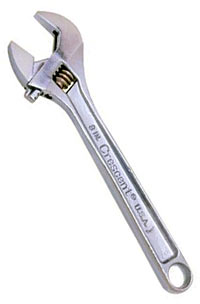
The adjustable wrench typically consists of a fixed jaw integrated with the handle and a movable jaw whose position is changed by a worm screw or sliding mechanism. Key parts include:
- Fixed jaw: the stationary section attached to the handle.
- Movable jaw: the adjustable section that closes against the fastener.
- Worm screw or rack: a threaded spindle or toothed track used to alter jaw spacing precisely.
- Handle: often forged steel, sometimes coated for grip; longer handles provide greater leverage.
Some models carry scale markings to estimate jaw opening, and heavier-duty versions are heat-treated or chrome-plated for wear resistance and corrosion protection.
History and development
Different inventors and makers contributed to the adjustable wrench's evolution. Early adjustable spanners date from the 19th century. Several individuals are associated with improvements to the basic concept: Edwin Beard Budding is sometimes mentioned among early engineers, and Enoch Harris was granted a U.S. patent in the 1880s for a design that adjusted both jaw width and handle angle. Johan Petter Johansson, a Swedish inventor, secured an influential patent in the 1890s for an improved adjustable spanner; in some countries the tool is still called a "Swedish key" in reference to his version. Johansson's work built on earlier designs from engineers such as Richard Clyburn.
Common uses and advantages
Adjustable wrenches are prized for flexibility: one tool can serve many fastener sizes, reducing the need to carry multiple fixed wrenches. They are used for plumbing, automotive work, assembly and repair tasks where non-standard or mixed fastener sizes are encountered. Operators are advised to fit the movable jaw tightly to the fastener and pull the wrench toward the fixed jaw side to reduce rounding of corners.
Variations, names and notable distinctions
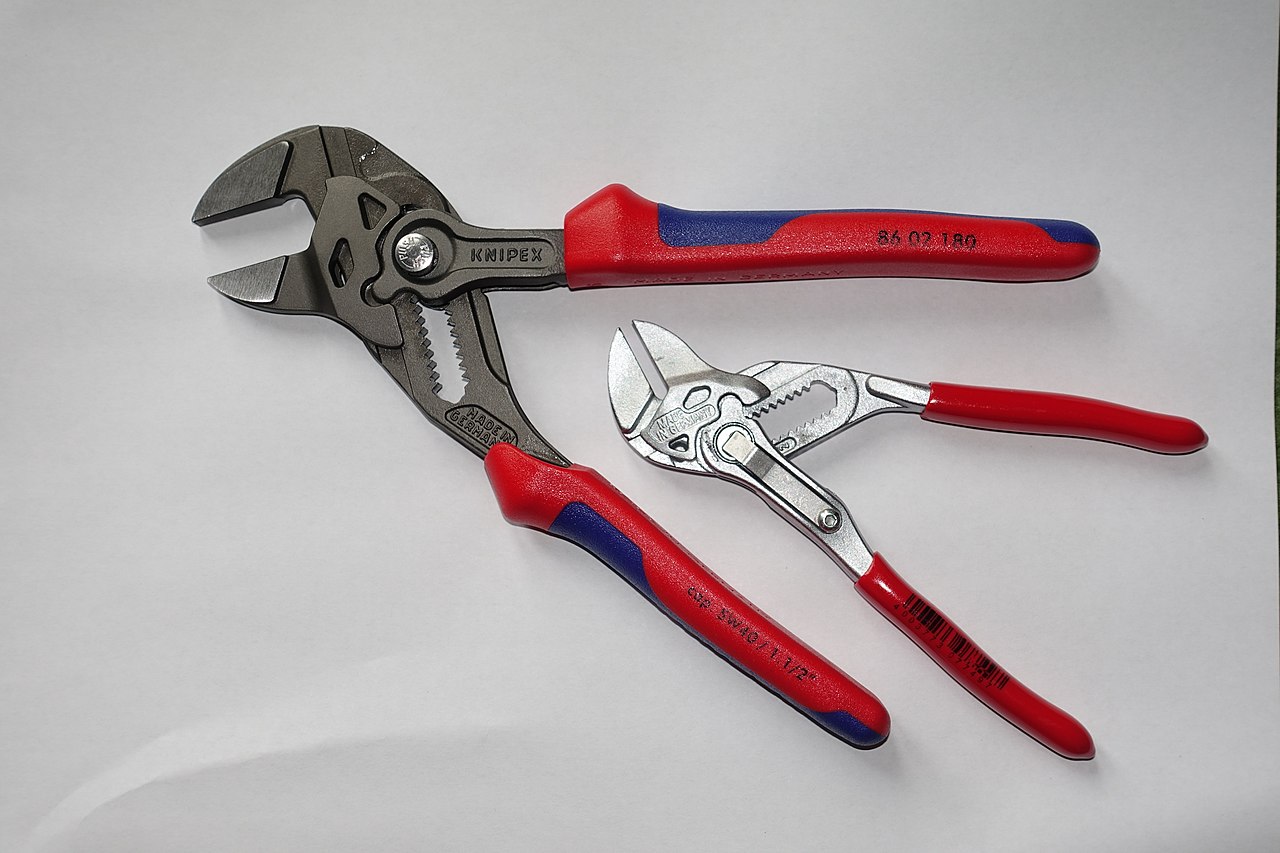
Names and specific styles vary by region. In the United States the term "crescent wrench" is often used generically after a brand name, while in the United Kingdom "adjustable spanner" is conventional. Other related tools, such as pipe wrenches or adjustable pliers, perform different functions and should not be confused with a general-purpose adjustable wrench. For specialist tasks there are slim-jaw, heavy-duty, and long-handle variants that trade compactness for strength or access.
Care, limitations and safe use
- Keep the worm screw clean and lubricated to maintain smooth adjustment.
- A snug fit between jaw and fastener reduces slippage and damage.
- Do not use an adjustable wrench as a hammer or pry bar; it is designed for torque in the plane of the jaws.
For additional technical or historical details, consult a specialized tool history reference or patent records, for example those related to early designs and subsequent improvements, including patents credited to inventors such as Enoch Harris and Johan Petter Johansson (patent reference). For general information about fasteners and compatible tools see resources on nuts (nuts) and bolts (bolts).
Questions and answers
Q: What is an adjustable wrench?
A: An adjustable wrench is a tool used for fastening or loosening nuts or bolts of different sizes, which has a jaw of adjustable width.
Q: What are some other names for an adjustable wrench?
A: An adjustable wrench may have different names in different parts of the world.
Q: Who is one claimed inventor of the adjustable wrench?
A: Edwin Beard Budding, an engineer from Stroud, England, is claimed to be one of the inventors of the adjustable wrench.
Q: Who received the US patent for an adjustable spanner that permitted both the jaw width and the angle of the handles to be adjusted and locked?
A: Enoch Harris received the US patent 326868 for his adjustable spanner that allowed both the jaw width and the angle of the handles to be adjusted and locked.
Q: What is another name for an adjustable wrench in some countries?
A: Some countries refer to an adjustable wrench as a "Swedish key" after Swedish inventor Johan Petter Johansson.
Q: Who is Johan Petter Johansson, and what is his contribution to the development of the adjustable wrench?
A: Johan Petter Johansson is a Swedish inventor who invented an improved version of the adjustable spanner for which he received a patent in 1891, which is still used today. He improved the invention of another English engineer Richard Clyburn in 1842.
Q: What is the primary function of the adjustable wrench?
A: The primary function of an adjustable wrench is to fasten or loosen nuts or bolts of different sizes using its adjustable jaw width.
Related articles
Author
AlegsaOnline.com Adjustable wrench (adjustable spanner) Leandro Alegsa
URL: https://en.alegsaonline.com/art/997
Sources
- patimg2.uspto.gov : "Patent Images"
- davistownmuseum.org : "The Boston Wrench Group (imported English coach wrenches or 18th w19th century American copies?)"