
Advanced Encryption Standard (AES)
AES is a widely used symmetric block cipher standardized by NIST for secure data encryption, supporting 128-bit blocks and 128/192/256-bit keys and implemented across software and hardware.
Overview
The Advanced Encryption Standard (AES) is a symmetric-key block cipher used to protect digital information. In modern cryptography it serves as a common building block for confidentiality. AES is a symmetric-key algorithm operating on fixed-size data blocks (128-bit blocks) and is often described simply as a block cipher. The standard was chosen through a public competition and adopted by the National Institute of Standards and Technology (NIST) in 2001 for general use in encrypting data worldwide.
Image gallery
2 Images
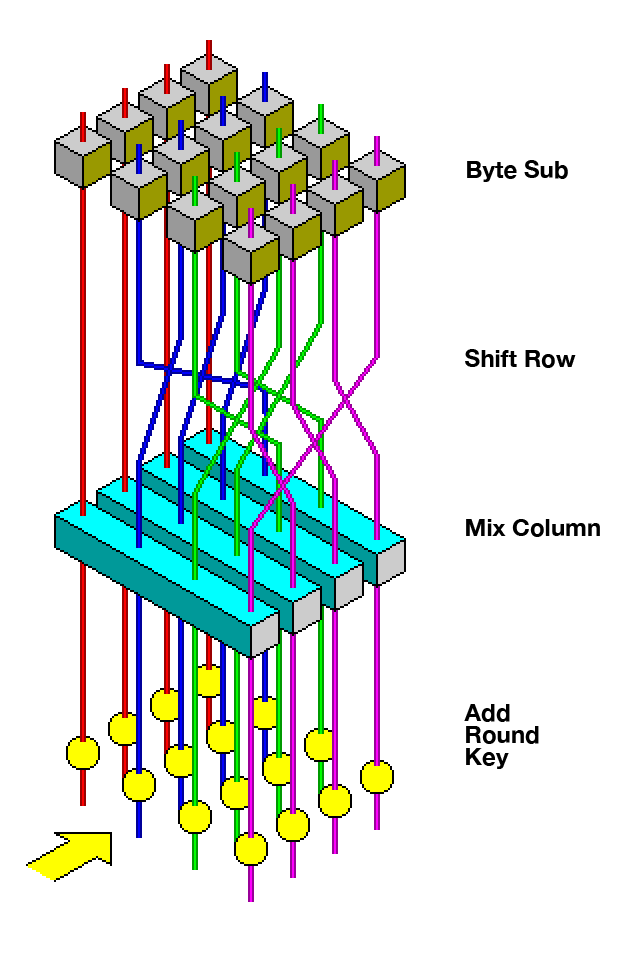
Design and internal structure
AES is based on the Rijndael cipher designed by Joan Daemen and Vincent Rijmen. It implements a substitution–permutation network: plaintext is arranged into a 4x4 byte matrix called the state and transformed through a series of rounds. Each round typically applies a non-linear byte substitution (the S-box), row shifts, column mixing, and a round key addition derived from the original key. AES supports three key lengths — 128, 192 and 256 bits — and the number of rounds depends on the key size (commonly 10, 12 or 14 rounds respectively).
History and standardization
In the late 1990s, NIST organized an open competition to replace the aging Data Encryption Standard. Rijndael was selected and standardized as AES in 2001 after public review and analysis. AES supplanted older ciphers such as the Data Encryption Standard (DES), offering a much larger key space and modern design suited to both software and hardware implementations.
Uses and implementations
AES is used extensively across protocols and applications that require confidentiality. Common examples include secure web traffic (TLS), virtual private networks (VPNs), disk and file encryption, secure messaging, and wireless security. To apply AES correctly in these contexts it is combined with modes of operation (such as CBC, CTR or authenticated modes like GCM) and appropriate key management. AES is widely available in libraries and software packages and as dedicated hardware accelerating cryptographic operations.
Security considerations
As of today AES remains secure against practical ciphertext-recovery attacks when used with recommended key sizes and modes. Academic cryptanalysis has produced some theoretical results (including related-key concerns under unusual conditions) but no broadly practical attack that breaks full AES in typical deployments. Implementations must be careful to defend against side-channel attacks such as timing or cache-based exploits. The algorithm’s resistance to brute-force attacks is reduced in theory by quantum search algorithms, which underscores the practice of using longer keys where higher security margins are required.
Notable facts and distinctions
- AES is now the de facto standard for symmetric encryption and is implemented in many cryptographic algorithms stacks.
- It is unencumbered by patents and widely supported in commercial and open-source products.
- Choice of mode, key length and implementation quality determines real-world security more than the cipher itself.
For practical deployment, adopt vetted libraries, follow current guidance on modes and padding, and keep keys and firmware updated to mitigate implementation flaws and evolving threats.
Questions and answers
Q: What is the Advanced Encryption Standard (AES)?
A: The Advanced Encryption Standard is a symmetric-key, block cipher algorithm used for encrypting data.
Q: When was the AES selected and by whom?
A: The AES was selected by the National Institute of Standards and Technology (NIST) in 2001.
Q: What has the AES replaced?
A: The AES has replaced the Data Encryption Standard (DES).
Q: When did AES become one of the most popular algorithms used in symmetric key cryptography?
A: As of 2008, AES became one of the most popular algorithms used in symmetric key cryptography.
Q: Who has access to AES?
A: AES is available to programmers and the general public with various software packages.
Q: What type of cipher algorithm is AES?
A: AES is a symmetric-key, block cipher algorithm.
Q: What is the primary purpose of AES?
A: The primary purpose of AES is to encrypt data.
Related articles
Author
AlegsaOnline.com Advanced Encryption Standard (AES) Leandro Alegsa
URL: https://en.alegsaonline.com/art/1098
Sources
- cryptobook.nakov.com : "The AES Cipher - Concepts"
- cryptobook.nakov.com : "Popular Symmetric Algorithms"
- findarticles.com : "NIST reports measurable success of Advanced Encryption Standard"
- csrc.nist.gov : "AES Development - Cryptographic Standards and Guidelines | CSRC"
- rijndael.info : "'Rijndael' pronunciation"
- cnss.gov : National Policy on the Use of the Advanced Encryption Standard (AES) to Protect National Security Systems and National Se
- schneier.com : schneier.com
- nvlpubs.nist.gov : nvlpubs.nist.gov
- iso.org : "ISO/IEC 18033-3:2010"