
Saxe‑Altenburg: Ernestine duchy of the House of Wettin
Saxe-Altenburg was one of the Ernestine duchies in Thuringia ruled by the House of Wettin; it existed in various forms from the 17th century until German monarchies ended in 1918 and was integrated into Thuringia in 1920.
Overview
Saxe-Altenburg (German: Sachsen-Altenburg) was a small historical duchy in what is now central Germany. It belonged to the Ernestine branch of the House of Wettin, a dynasty that produced many of the rulers of Saxony and several smaller Thuringian states. The duchy had a capital at Altenburg and existed in several territorial configurations from the 17th century until the abolition of the German monarchies in 1918.
Image gallery
10 Images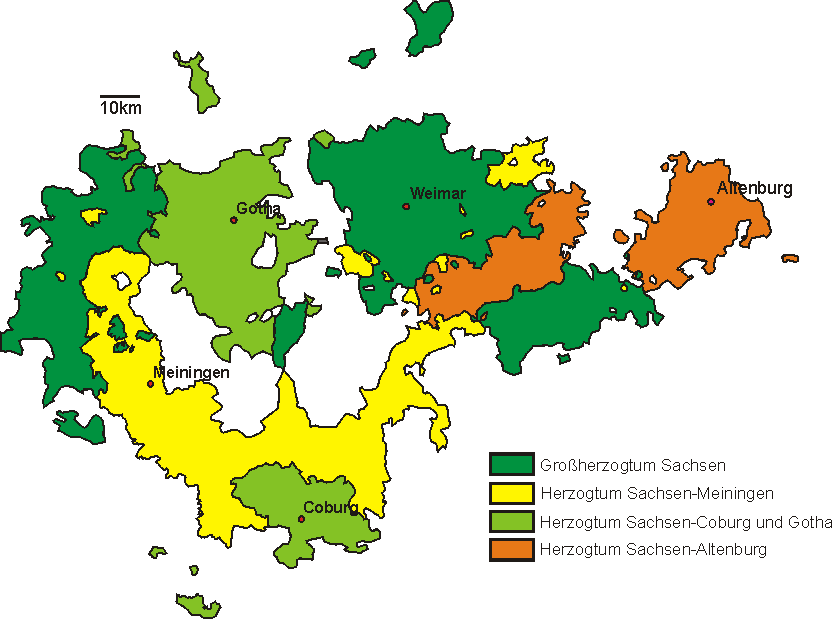



Geography and government
At its greatest extent in the 19th century Saxe-Altenburg covered a compact area in eastern Thuringia, with an administrative centre in the historic town of Altenburg. It was governed as a hereditary duchy under the Wettin family law that preferred male succession, and its institutions were typical of small German states of the era: a ducal court, a small civil service, local estates and municipal corporations. In 1905 the duchy numbered around 200,000 inhabitants and measured roughly 1,300 km², making it one of the smaller members of the German Confederation and later the German Empire.
Historical development
The history of Saxe-Altenburg is best understood within the frequent partitions and reunifications of the Ernestine lands. Altenburg operated with considerable autonomy through much of the 1600s until the male line failed in 1672, after which the title and lands passed by dynastic marriage to the ducal house of Saxe-Gotha. The personal union and subsequent rearrangements produced Saxe-Gotha-Altenburg and later territorial swaps in 1825, when the extinction of a ducal line led to a redistribution of territories among neighboring Ernestine branches. As part of that settlement, the Duchy of Altenburg was assigned to the Duke of Saxe-Hildburghausen, while Gotha went to Saxe-Coburg-Saalfeld, and other lands shifted to Saxe-Meiningen.
Rulers, succession and end of monarchy
Throughout the 19th and early 20th centuries the duchy remained under the Wettin dukes who administered local legislation, education and infrastructure on a scale appropriate to a small state. The political landscape changed dramatically with World War I: the German monarchies collapsed in 1918 and Saxe-Altenburg ceased to exist as a sovereign duchy. In 1920 its territory was incorporated into the newly formed Free State of Thuringia within the Weimar Republic (Weimar Republic), joining other former Ernestine territories in a modern federal state. The Saxe-Altenburg dynastic male line later became extinct with the death of Prince George Moritz in 1991.
Significance and legacy
Although small, Saxe-Altenburg played a role in the complex dynastic politics of central Germany. Its ducal house participated in the network of marriages and successions that shaped the patchwork of Thuringian principalities. Architecturally and culturally, Altenburg town retains historic buildings, museums and collections that reflect its ducal past. In administrative history the state serves as an example of how familial succession laws and dynastic partitions influenced territorial boundaries in the Holy Roman Empire’s successor states and in 19th-century Germany.
Notable facts and distinctions
- The duchy’s German name is recorded as Sachsen-Altenburg and it is classified among the Ernestine duchies.
- It was briefly linked to Saxe-Gotha-Altenburg before the 1825 rearrangement that involved Saxe-Coburg-Saalfeld, Saxe-Hildburghausen and Saxe-Meiningen.
- After 1918 the territory was folded into the Free State of Thuringia and into the republican structures of the Weimar Republic.
- Basic statistical references from the early 20th century list area and population figures; for example, sources cite roughly 1,323 km² and some 200,000 residents near 1905 (area data, population data).
Related articles
Author
AlegsaOnline.com Saxe‑Altenburg: Ernestine duchy of the House of Wettin Leandro Alegsa
URL: https://en.alegsaonline.com/art/87679
Sources
- tacitus.nu : "The Ernestine Line's Saxon Duchies"