
Saxe-Coburg — historic Ernestine duchy in present-day Bavaria
Saxe-Coburg was a small Ernestine duchy centered on Coburg in what is now Bavaria, Germany. It existed in various forms between the 16th and 18th centuries and later formed part of Saxe-Coburg-Saalfeld.
Overview
Saxe-Coburg (German: Sachsen-Coburg) was a small territorial duchy of the Ernestine branch of the House of Wettin located around the town of Coburg in what is today northern Bavaria, Germany. Like many states in the Holy Roman Empire, its boundaries and status changed repeatedly through dynastic division, inheritance and reorganisation. The town of Coburg served as the ducal seat and local administrative centre.
Image gallery
9 Images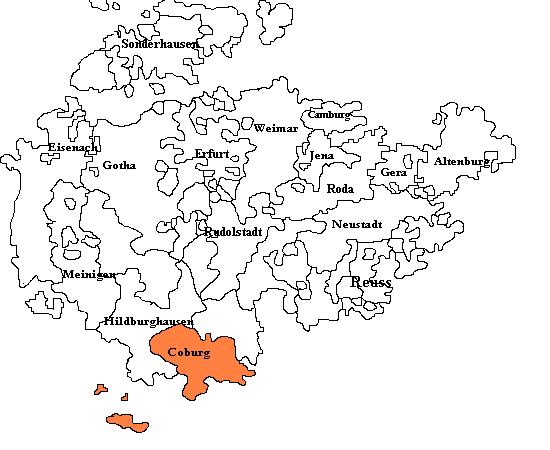


History and political development
The origins of Saxe-Coburg are tied to the late 16th-century divisions of the Ernestine lands. After the Division of Erfurt (1572) the territory was part of the duchy known as Saxe-Coburg-Eisenach (Saxe-Coburg-Eisenach). Subsequent partitions among brothers created distinct and short-lived duchies. In 1596 the combined duchy was split: Johann Casimir received Saxe-Coburg while his brother Johann Ernst received Saxe-Eisenach (Saxe-Eisenach).
When Duke Johann Casimir died in 1633 the two brothers' branches briefly reunited under Ernst of Saxe-Eisenach, but that arrangement ended with Ernst's death in 1638 and the Coburg territories passed to other Ernestine lines. The title and an independent Saxe-Coburg duchy re-emerged in the later 17th century: by the 1680s the area again functioned as a separate duchy under a cadet branch of the family.
From the end of the 17th century the pattern of personal unions and mergers continued. After the death of Duke Albrecht in 1699 without direct male heirs, Saxe-Coburg entered into a personal union with the neighboring duchy of Saxe-Saalfeld. This arrangement culminated in a formal merger in 1735, when the two territories were joined to create the Duchy of Saxe-Coburg-Saalfeld (Saxe-Coburg-Saalfeld), a polity that would later be reshaped into Saxe-Coburg and Gotha in the 19th century.
Characteristics and significance
As an Ernestine duchy, Saxe-Coburg was typical of the fractured political geography of the Holy Roman Empire: relatively small in territory, dynastically governed by a local duke, and subject to frequent territorial realignments. The town of Coburg held strategic and cultural importance; its hilltop fortress, the Veste Coburg, was a prominent stronghold in the region and later acquired cultural significance.
Although Saxe-Coburg itself was modest in size, the ducal family that bore the Coburg name became prominent in European dynastic politics. Members of the Saxe-Coburg lines married into several royal houses, and descendants played influential roles in the monarchies of the 19th and early 20th centuries. The reorganisation of these Ernestine states into larger entities in subsequent centuries increased the political footprint of the Coburg dynasty beyond the original territory.
Key events and timeline
- 1572 — Division of Erfurt establishes Saxe-Coburg-Eisenach.
- 1596 — Saxe-Coburg-Eisenach is partitioned; Johann Casimir takes Saxe-Coburg.
- 1633–1638 — Reunification under Ernst of Saxe-Eisenach, then transfer of lands to other Ernestine duchies.
- Late 17th century (c. 1681) — Saxe-Coburg reappears as a separate duchy.
- 1699 — After Duke Albrecht's death the duchy enters personal union with Saxe-Saalfeld.
- 1735 — Formal merger creates Saxe-Coburg-Saalfeld.
These phases illustrate common features of territorial rule in early modern central Europe: dynastic partition, short-lived sovereignties, and eventual consolidation. Today the historical territory of Saxe-Coburg lies within Bavaria and survives in the region's cultural heritage and place names.
Questions and answers
Q: What is Saxe-Coburg?
A: Saxe-Coburg is a former country located in Bavaria, Germany.
Q: When was Saxe-Coburg-Eisenach split?
A: Saxe-Coburg-Eisenach was split in 1596.
Q: Who got the Saxe-Coburg part of Saxe-Coburg-Eisenach?
A: Johann Casimir got Saxe-Coburg when Saxe-Coburg-Eisenach was split in 1596.
Q: What happened to Saxe-Coburg when Johann Casimir died in 1633?
A: When Johann Casimir died in 1633, Saxe-Coburg was given to other Ernestine duchies.
Q: When did Saxe-Coburg become a duchy again?
A: Saxe-Coburg became a duchy again in 1681.
Q: Who did Saxe-Coburg share a ruler with from 1699 to 1735?
A: From 1699 to 1735, Saxe-Coburg shared a ruler with the Duke of Saxe-Saalfeld, Albrecht of Saxe-Coburg.
Q: What happened in 1735 to Saxe-Coburg and Saxe-Saalfeld?
A: In 1735, Saxe-Coburg and Saxe-Saalfeld were merged and became known as Saxe-Coburg-Saalfeld.
Related articles
Author
AlegsaOnline.com Saxe-Coburg — historic Ernestine duchy in present-day Bavaria Leandro Alegsa
URL: https://en.alegsaonline.com/art/87682
Sources
- web.archive.org : Saxe-Coburg and Gotha Royal Family