
Duchy of Saxe-Jena
Short-lived Ernestine duchy centered on the town of Jena. Created in 1672 for Bernhard of Saxe-Weimar and reabsorbed by Saxe-Weimar in 1690; part of the Wettin dynastic partitions in Thuringia.
The Duchy of Saxe-Jena was a small, short-lived state of the Holy Roman Empire in central Germany. It belonged to the branch of ducal territories known collectively as the Ernestine duchies and was ruled by members of the House of Wettin, a dynasty with long-standing influence in Saxony and Thuringia (House of Wettin). The duchy was centered on the town of Jena and existed as a distinct territorial unit for only a few decades in the late 17th century.
Image gallery
2 Images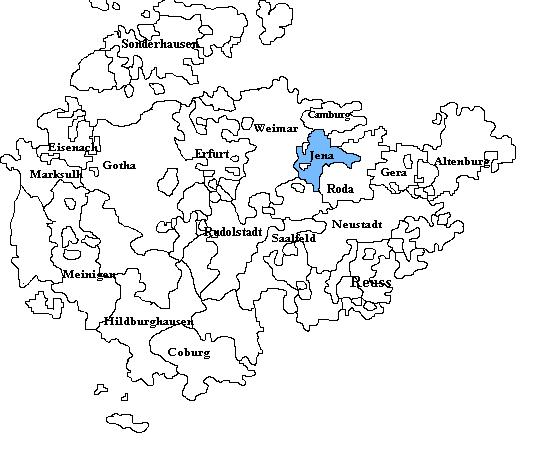

Origins and foundation
Saxe-Jena was created in 1672 as part of the frequent partitions of Ernestine lands that followed dynastic practice of providing appanages for younger sons. In that year the territory was separated from Saxe-Weimar and granted to Bernhard, the fourth son of Wilhelm, Duke of Saxe-Weimar. This kind of subdivision was common among the Ernestine branch: rulers divided their holdings to provide for male offspring while retaining overall family influence across Thuringia and neighboring regions. The creation of Saxe-Jena illustrates how inheritance customs shaped the political map of the Holy Roman Empire in this period (creation 1672).
Territory and administration
The duchy was modest in size and included the town of Jena and surrounding lands. Jena itself was an established market town and seat of a university founded in the 16th century, which continued to serve as an intellectual center within the duchy. Administratively, Saxe-Jena functioned like other small German principalities of the era: the duke exercised judicial, fiscal, and military rights within his domain, while many local institutions and estates preserved traditional privileges. The small scale of the state limited its diplomatic role, but it retained the trappings and responsibilities of sovereignty within the imperial system.
Decline and reintegration
The line of Saxe-Jena was brief. The second duke left no surviving male heir, and upon his death in 1690 the duchy did not persist as an independent polity. Its lands were taken back into Saxe-Weimar, demonstrating the frequent ebb and flow of territorial boundaries among the Ernestine duchies. The reversion to the senior branch is noted in contemporary sources as part of the dynastic consolidation that occasionally followed fragmenting successions (reversion to Saxe-Weimar, 1690).
Legacy and historical significance
- Illustrates the dynastic partitioning practices of the Ernestine branch of the Wettin family and their impact on the political geography of Thuringia.
- Highlights Jena's continued importance as a cultural and educational hub, even under short-lived political arrangements.
- Serves as an example of how many microstates of the Holy Roman Empire could appear and disappear within a single generation.
While Saxe-Jena had only a fleeting existence as an independent duchy, its creation and absorption reflect broader themes in early modern German history: inheritance customs, regional fragmentation, and the interaction between dynastic ambition and local institutions. For readers seeking further background on the Ernestine partitions or the House of Wettin, consult general works on German territorial history and dynastic politics of the Holy Roman Empire (Ernestine duchies overview, Wettin dynasty).
Questions and answers
Q: What was the Duchy of Saxe-Jena?
A: The Duchy of Saxe-Jena was one of the Ernestine duchies of the House of Wettin.
Q: Who was given part of the Duchy of Saxe-Weimar?
A: Bernhard, the fourth son of Wilhelm, Duke of Saxe-Weimar, was given part of the Duchy of Saxe-Weimar.
Q: When was Bernhard given part of the Duchy of Saxe-Weimar?
A: Bernhard was given part of the Duchy of Saxe-Weimar in 1672.
Q: Why was the territory taken back by Saxe-Weimar?
A: The second duke had no male heirs to inherit the title, so the territory was taken back by Saxe-Weimar when the second duke died in 1690.
Q: Which house ruled the Duchy of Saxe-Jena?
A: The House of Wettin ruled the Duchy of Saxe-Jena.
Q: How many dukes did Saxe-Jena have?
A: The text does not provide information on how many dukes Saxe-Jena had.
Q: Was the Duchy of Saxe-Jena a part of Saxe-Weimar?
A: The text does not provide information on whether the Duchy of Saxe-Jena was a part of Saxe-Weimar.
Related articles
Author
AlegsaOnline.com Duchy of Saxe-Jena Leandro Alegsa
URL: https://en.alegsaonline.com/art/87686