
Satellite flare (satellite glint)
A satellite flare is a brief bright reflection of sunlight from a man-made satellite. It is predictable for many spacecraft and can be very bright, sometimes disrupting astronomical observations.
Overview
A satellite flare, also called a satellite glint (and historically associated with "Iridium flares"), is a short-lived brightening seen when sunlight reflects from a smooth or flat surface on an artificial satellite and is redirected toward an observer on Earth. The flash typically lasts a few seconds and can range from barely noticeable to extremely bright, occasionally outshining planets in the dawn or dusk sky. For general background see further information.
Image gallery
10 Images


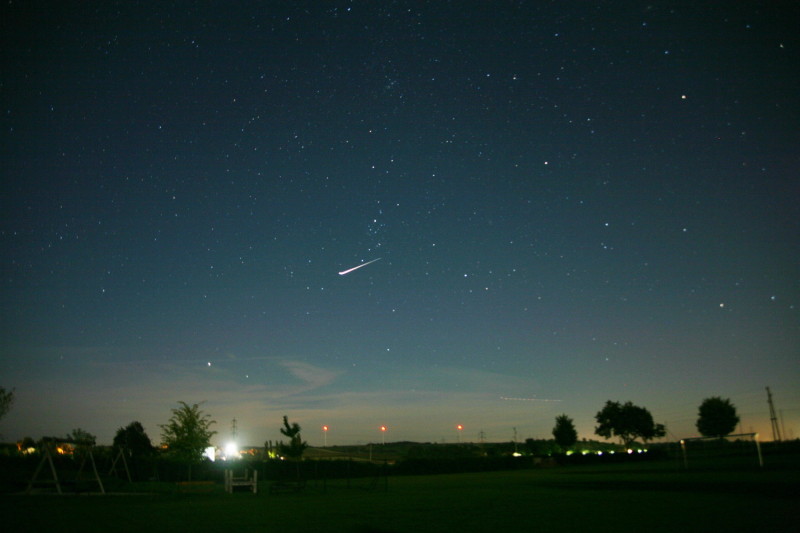



How flares form
The phenomenon requires three elements: sunlight, a reflective surface on a satellite, and the specific geometry that sends the reflected beam back to a particular location on Earth. Sunlight falling on metallic panels, antennas or thermal blankets can act like a mirror. When the angle between the Sun, the satellite surface and an observer lines up, a concentrated flash occurs. This basic process — sunlight (light source) reflected (reflection) back toward Earth (target) — produces what observers call a flare.
Characteristics and examples
- Duration: usually a few seconds at most.
- Brightness: can be faint or very bright; some historic flares have been far brighter than Venus (planetary comparison).
- Sources: many types of satellites with flat or reflective components can produce glints; not all spacecraft do so.
Iridium satellites and predictability
Among the most famous examples were flares from the Iridium telecommunications constellation, which had large, door-sized antenna panels that produced reliable glints when geometry aligned. Because the satellites flew in known, stable orbits (controlled orbit) and their reflecting surfaces had fixed orientations, prediction software and phone apps could forecast when and where a flare would be visible. Predictive tools and ephemerides are examples of the kind of computer programs observers use. Iridium hardware also supported communications and navigation roles (navigation and services).
Observing, impact and mitigation
Flares are popular with casual skywatchers because they are dramatic, punctual and easy to photograph. However, bright glints can interfere with long-exposure astronomical imaging and surveys, and have been a nuisance to professional observers (impact on astronomy). Mitigation approaches include planning observations to avoid predicted flares, using image-processing techniques to remove brief streaks, and designing satellites with less-reflective finishes or adjustable panels. The characteristic three-panel reflectors that produced many notable flares illustrate how design details such as antennas (reflective antennas) affect visibility.
Modern context and notable facts
Not all flares are as predictable as the classical Iridium events. Tumbling or uncontrolled satellites and rocket bodies can produce irregular glints. Large new constellations change the visual environment of the night sky: they tend to create trains or streaks rather than isolated, very bright flares, but they increase the chance of satellite light affecting observations. Amateur and professional communities continue to track, catalogue and model flaring behavior to support outreach and minimize interference. For tools, forecasts and educational resources see reflection models, observing guides and other technical references (resource, satellite lists, sunlight geometry, visibility notes, service contexts, orbital data, prediction software, hardware details, astronomy impact).
In summary, satellite flares are a simple optical effect with outsized cultural and scientific visibility: they are easy to predict in many cases, entertaining to observe, and important to consider when planning sensitive sky surveys.
Related articles
Author
AlegsaOnline.com Satellite flare (satellite glint) Leandro Alegsa
URL: https://en.alegsaonline.com/art/87445
Sources
- space.com : "Reflections from Space: Spot Iridium Flares"
- satobs.org : "Catch a *Flaring/Glinting Iridium"