
Saturn: the Ringed Gas Giant
Saturn, the sixth planet from the Sun, is a large gas giant known for its extensive ring system, numerous moons (including Titan), layered interior, and key role in studies of planetary formation and dynamics.
Overview
Saturn is the sixth planet from the Sun in the Solar System. It is the second-largest planet after Jupiter and one of the four major gas giant planets along with Uranus and Neptune. Saturn is well known for a low overall density, a strong equatorial bulge caused by rapid rotation, and a banded atmosphere with storms and long-lived vortices visible in reflected sunlight.
Image gallery
10 Images




Name and cultural background
The planet’s English name derives from the Latin name of the Roman god Saturnus, equated by the Romans with the Greek figure Kronos from Greek mythology. The classical astrological symbol for Saturn is a stylized sickle; cultural associations link the planet to themes of agriculture, time and cycles.
Atmosphere and weather
Saturn’s visible atmosphere is dominated by hydrogen and helium with trace amounts of methane, ammonia and other compounds. Cloud layers form at different altitudes and produce the banded appearance; differential rotation makes equatorial regions rotate faster than higher latitudes. The planet produces powerful storms that can grow to global scale and can be tracked by spacecraft and ground-based telescopes. A magnetosphere surrounds the planet and interacts with the solar wind and charged particles from icy satellites.
Internal structure
Models of Saturn’s interior indicate a layered structure. Beneath the outer gaseous envelope lie layers of molecular and liquid hydrogen and molecular hydrogen mixed with helium. Deeper still, hydrogen is expected to assume an electrically conducting metallic hydrogen state that helps generate the planet’s magnetic field. At the center there is likely a compact core composed of heavier materials such as iron, nickel and silicon compounds together with oxygen-bearing materials like water and other volatiles (oxygen compounds). Many interior details remain under active study because direct sampling is not yet possible.
Rings and small particles
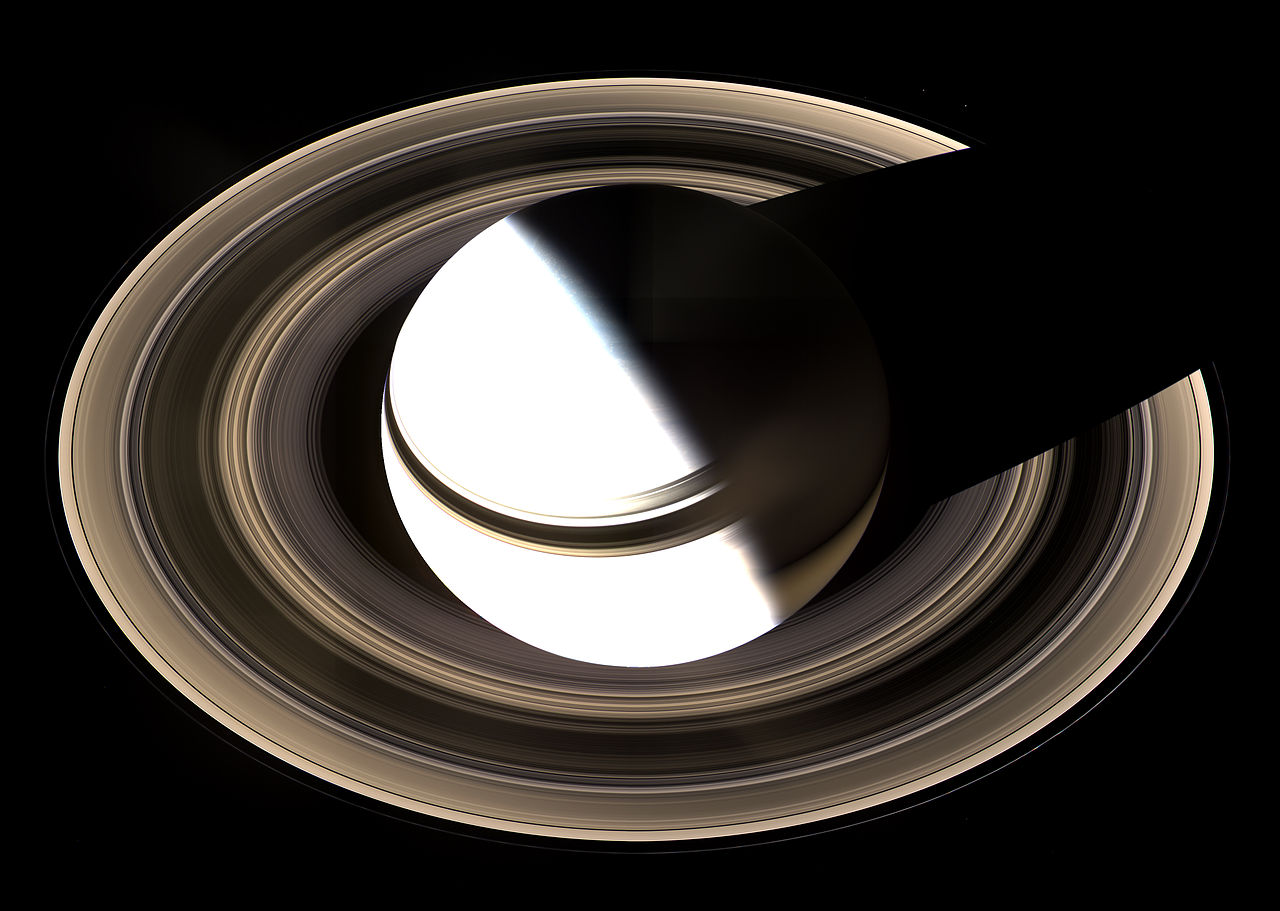
Saturn’s dramatic system of concentric rings is made primarily of water ice with mixed dust and rock. The rings extend across hundreds of thousands of kilometers while remaining very thin. They exhibit multiple major divisions and thousands of narrow ringlets, including well-known features such as the Cassini Division. Ring structure is sculpted by gravity, resonances with moons, collisional processes and meteoroid bombardment. Theories for the rings’ origin include disruption of a comet or moon and gradual accumulation of debris; current research treats the rings as dynamic and evolving.
Moons and satellites
Saturn is orbited by a large population of natural satellites. There are dozens of confirmed moons orbiting the planet, with counts updated as new discoveries are confirmed. The largest, Titan, possesses a dense nitrogen atmosphere and stable surface liquids in the form of methane and ethane lakes, and its volume exceeds that of the planet Mercury. Other notable moons include icy Enceladus, which ejects water-rich plumes from a subsurface source, and many smaller shepherd moons that influence ring edges and gaps.
Orbit, rotation and seasons
On average Saturn lies at a great mean distance from the Sun and takes nearly 30 Earth years to complete one orbit, producing long seasonal cycles due to its axial tilt. The planet’s rapid rotation (a period of around ten hours) produces a pronounced equatorial bulge and affects atmospheric circulation. Observers note seasonal changes in cloud patterns, ring illumination and magnetospheric conditions as Saturn progresses around the Sun.
Exploration and scientific importance
Saturn has been the subject of telescopic study for centuries and of detailed investigation by spacecraft in the modern era. Flyby missions and the long-lived Cassini–Huygens mission provided extensive maps of ring structure, insights into atmospheric chemistry, in situ sampling of the moon Titan by the Huygens probe, and detailed observations of satellite geology and cryovolcanism. These data make Saturn a cornerstone for understanding giant-planet formation, satellite evolution, and the physics of hydrogen under extreme pressure.
Observation and practical notes
Saturn can be observed from Earth with modest telescopes; its rings and some moons are visible to amateur observers under good conditions. Professional observatories and planetary missions continue to refine knowledge about the system, and online mission archives and planetary science resources collect up-to-date results (Solar System resources and mission pages are useful starting points).
Key facts at a glance
- Position: sixth planet from the Sun.
- Type: gas giant with extensive rings.
- Major satellite: Titan, larger in volume than Mercury.
- Interior: heavy-element core with layers of metallic hydrogen and liquid/molecular hydrogen and helium.
- Rings: primarily water ice and dust in a complex, thin system (rings).
- Orbit: a great mean distance from the Sun with a near 30-year orbital period.
Questions and answers
Q: What is Saturn?
A: Saturn is the sixth planet from the Sun located in the Solar System. It is one of the four gas giant planets, along with Jupiter, Uranus, and Neptune.
Q: Who was Saturn named after?
A: Saturn was named after the Roman god Saturnus (called Kronos in Greek mythology).
Q: What symbol represents Saturn?
A: The symbol for Saturn is ♄ which is the symbol of Saturnus' sickle.
Q: What does the inside of Saturn consist of?
A: Inside Saturn there is probably a core of iron, nickel, silicon and oxygen compounds surrounded by a deep layer of metallic hydrogen, then a layer of liquid hydrogen and liquid helium and finally an outer gaseous layer.
Q: How many moons does Saturn have?
A: There are 82 known moons orbiting around planet Saturn - 53 are officially named and 29 are waiting to be named. The largest moon is Titan which has a larger volume than Mercury.
Q: Are there rings around planet Satrun?
A: Yes, there is a very large system of rings around planet Satrun made up ice with smaller amounts rocks and dust. Some people believe that these rings were caused by a moon impact or other event.
Q: How far away from the Sun on average is Planet Satrun?
A:Saturn on average lies 1,433,000,000 km (870,000,000 mi) away from the Sun.
Related articles
Author
AlegsaOnline.com Saturn: the Ringed Gas Giant Leandro Alegsa
URL: https://en.alegsaonline.com/art/87499
Sources
- jpl.nasa.gov : "Scientists Finally Know What Time It Is on Saturn"
- doi.org : 10.3847/1538-4357/aaf798
- tp.umu.se : "On The Atmospheres Of Different Planets" · web.archive.org
- astrophysicsspectator.com : "Giant gaseous planets"
- ssd.jpl.nasa.gov : "Planetary Satellite Discovery Circumstances"
- credoreference.com : "Cronia (Kronia)"
- crystalinks.com : "Saturn Mythology"
- oarval.org : "Saturn"
- jpl.nasa.gov : "Cassini–Huygens Saturn arrival"
- mira.org : "Saturn"
- mira.org : Monterey Institute of Research in Astronomy
- nasa.gov : "A gas giant with super-fast winds"
- books.google.com : Probing the new solar system
- nasa.gov : "Saturn's storms run rings around Earth's"