
Saturn Nebula (planetary nebula in Aquarius)
The Saturn Nebula is a bright planetary nebula in Aquarius, famed for ring-like features and small jet-like 'handles'. It lies at roughly 2,400 light‑years and illustrates the late stages of low‑mass stellar evolution.
Overview
The Saturn Nebula is a well-known planetary nebula named for its visual resemblance to the planet Saturn: a bright central region with faint extensions that look like rings or handles. It is located in the constellation Aquarius and is classified as a planetary nebula, the glowing shell of gas expelled by a dying low- to intermediate-mass star. The nebula lies at a distance of roughly 2,400 light‑years from Earth, making it a relatively nearby example of this class of objects.
Image gallery
3 Images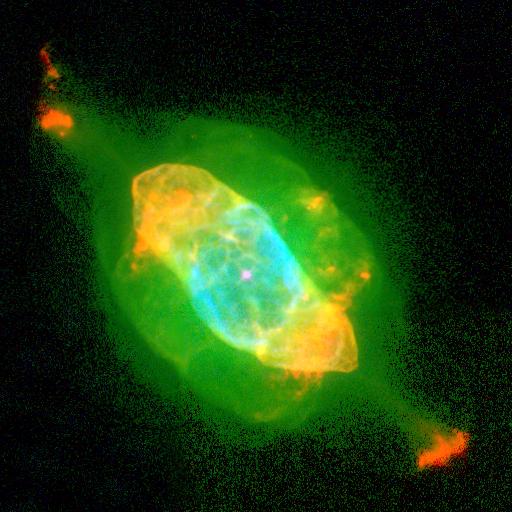


Appearance and structure
In telescopic images the nebula shows a bright inner shell with fainter outer halos and small, symmetric protrusions often called "ansae" or "handles." These features give the object a ringed look that inspired its common name. Its colors are dominated by emission lines: greenish hues from doubly ionized oxygen and reddish tints from hydrogen and nitrogen when viewed in color or through narrowband filters.
Composition and central star
Like other planetary nebulae, the Saturn Nebula consists mainly of ionized hydrogen and helium with heavier elements such as oxygen and nitrogen present at lower abundances. The gas glows because ultraviolet radiation from the hot central star ionizes the expelled material. The remnant central star is a hot, compact object evolving toward a white dwarf, and its temperature and wind shape the nebula's appearance.
Formation and significance
Planetary nebulae form during the late stages of evolution for stars roughly one to eight times the mass of the Sun. As the star runs out of nuclear fuel it expels its outer layers; the exposed core then ionizes that expelled gas. Objects like the Saturn Nebula offer astronomers direct insight into stellar mass loss, chemical enrichment of the interstellar medium, and the processes that sculpt circumstellar envelopes into shells, rings, and jets.
Observing and notable facts
- The nebula is a popular target for amateur and professional observers because of its brightness and distinctive shape.
- Narrowband imaging (for example isolating oxygen and hydrogen lines) highlights different structural components and colors.
- Its nickname reflects visual similarity rather than any physical relationship to the planet Saturn.
Together, the Saturn Nebula and other planetary nebulae serve as laboratories for studying atomic emission processes, the late evolution of stars like the Sun, and how stellar material is recycled into future generations of stars and planets.
Related articles
Author
AlegsaOnline.com Saturn Nebula (planetary nebula in Aquarius) Leandro Alegsa
URL: https://en.alegsaonline.com/art/87494