
Artificial satellite
An artificial satellite is a human-made object placed into orbit to observe, communicate, navigate, or conduct experiments; this article explains types, orbits, history, and common uses.
An artificial satellite is a human-made object intentionally placed into orbit around a larger body. In broad terms a satellite travels around an orbited body while remaining in motion under the influence of gravity and inertia. Satellites operate in outer space and contrast with natural satellites such as the Moon, which orbits the Earth. Artificial satellites may instead circle other planets, the Sun, or even lunar trajectories for scientific or communications purposes.
Image gallery
10 Images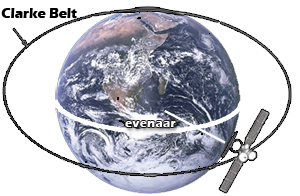




Characteristics and components
Most artificial satellites share a set of core subsystems: a structure to house electronics and payloads; power generation (commonly solar panels and batteries); an attitude control system to orient the vehicle; propulsion for orbit adjustments; communications equipment to exchange data with ground stations; and mission-specific instruments such as cameras, sensors, transmitters, or scientific packages. Size and mass vary widely, from compact CubeSats about the size of a shoebox to large modular platforms and assembly-capable facilities.
Types and common uses
Satellites are designed for many purposes. Typical categories include:
- Weather satellites that monitor atmospheric conditions and help forecast storms and climate patterns (weather).
- Communications satellites providing television, telephone, internet relays and data backhaul (communications).
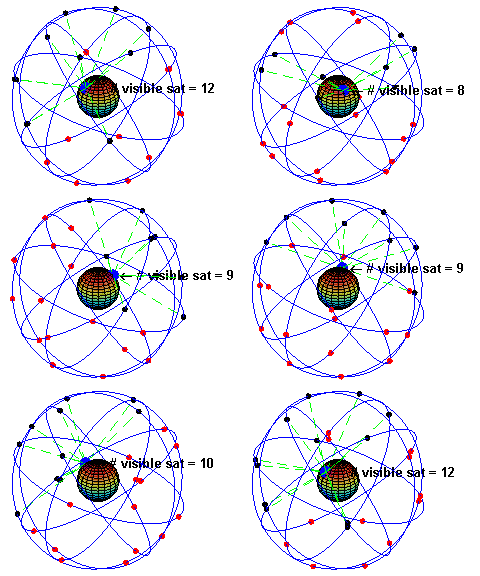
- Navigation satellites that form global or regional positioning systems used for mapping, transport, and timing (navigation).
- Reconnaissance and Earth observation satellites used for security, resource monitoring, and scientific remote sensing (reconnaissance).
- Astronomy and space science platforms that observe phenomena above the atmosphere (astronomy).
History and development
The era of artificial satellites began in the late 1950s. The first successful orbital satellite was launched by the Soviet Union in 1957, a milestone that accelerated space activity worldwide. Soon after, a second early mission carried a living passenger into orbit; that mission included the dog Laika. The United States and other countries followed with their own satellites, and by the 1960s several nations, including the United Kingdom, had launched orbiting spacecraft. Over subsequent decades the number and diversity of satellites expanded rapidly, and some complex platforms such as space stations have been assembled in orbit from multiple launches.
Orbits and operational considerations
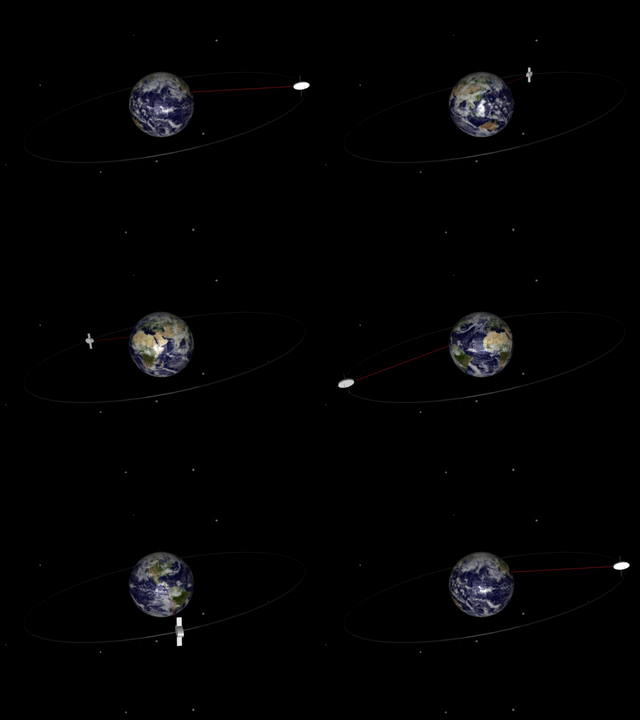
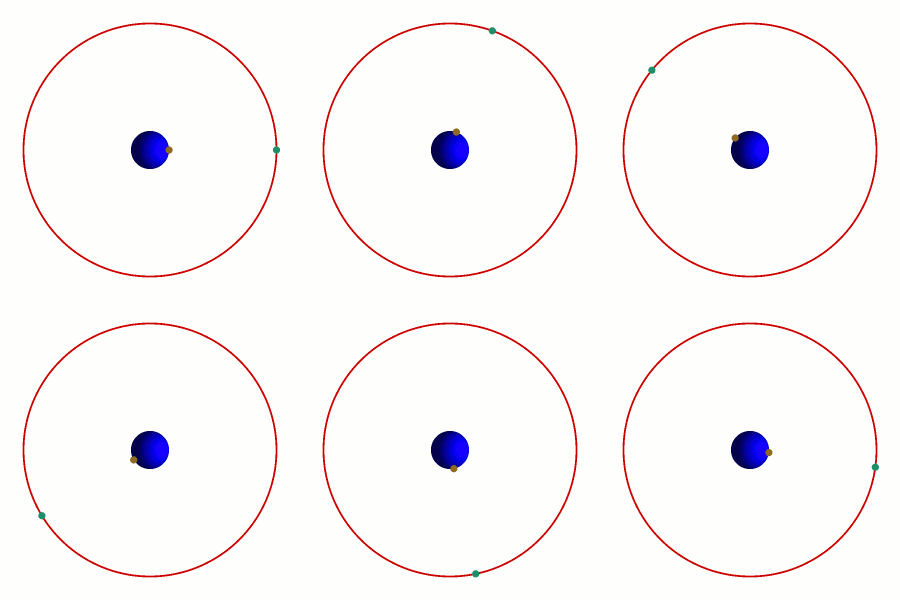
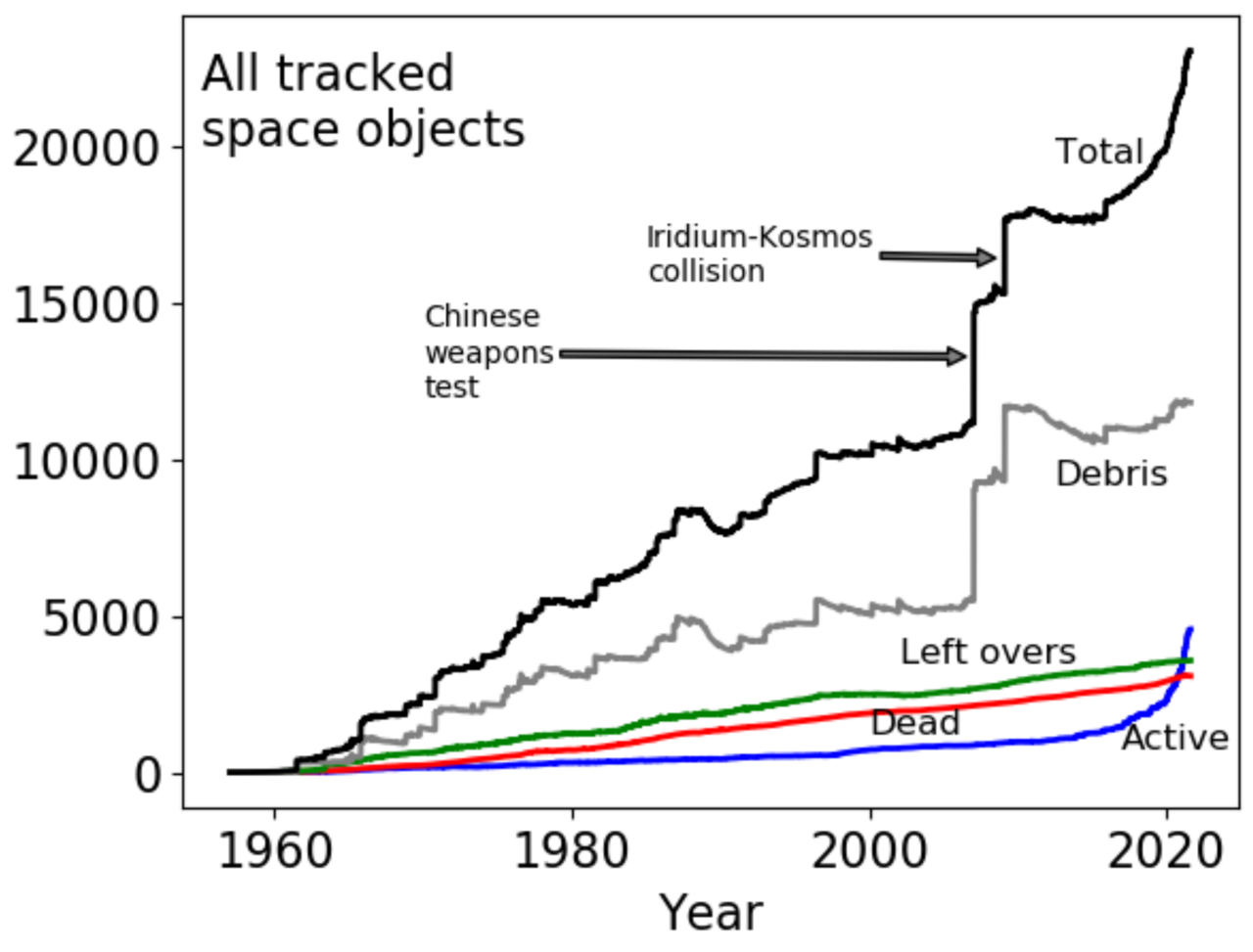
Satellites are placed into different kinds of orbits depending on mission needs: low Earth orbit (LEO) for detailed Earth observation and many small satellites; medium Earth orbits used by some navigation systems; geostationary orbit (GEO) for fixed-position communications and weather monitoring; and highly elliptical orbits for specialized coverage. Operators must manage orbital lifetime, collisions, space debris mitigation, and end-of-life disposal to limit long-term hazards in increasingly crowded orbital regions.
Importance and notable facts
Artificial satellites underpin much of modern life: global communications, weather forecasting, navigation, environmental monitoring, and scientific discovery all rely on orbital platforms. The continued growth of small satellites and constellations has reduced costs and enabled new services, but it also raises policy and technical challenges about spectrum use, orbital traffic management, and space sustainability. From early pioneering launches to today's complex international programs, satellites remain central to both civilian and military space activity.
For further reading on specific missions, orbit types, and instrumentation, see detailed resources and mission catalogs via the linked topics above.
orbited body | outer space | Moon | Earth | Sun | weather | communications | navigation | reconnaissance | astronomy | Soviet Union | Laika | United Kingdom | space stations
Questions and answers
Q: What is a satellite?
A: A satellite is an object that orbits another object in space. It can be either natural, such as the moon orbiting the Earth, or artificial.
Q: What are satellites used for?
A: Satellites are used for many purposes, including weather forecasting, communications, navigation, reconnaissance and astronomy.
Q: When was the first artificial satellite launched?
A: The world's first artificial satellite, Sputnik 1, was launched by the Soviet Union on October 4th 1957.
Q: Who was the first living passenger to be sent into orbit?
A: The first living passenger to be sent into orbit was a dog named Laika who was aboard Sputnik 2 which launched on November 3rd 1957.
Q: When did the United States launch their first satellite?
A: The United States launched their first satellite called Explorer 1 on January 31st 1958.
Q: When did the UK launch its first satellite?
A: The UK launched its first satellite in 1962.
Q: How many satellites have been launched since then?
A: Since then thousands of satellites have been launched into orbit around Earth.
Related articles
Author
AlegsaOnline.com Artificial satellite Leandro Alegsa
URL: https://en.alegsaonline.com/art/87439
Sources
- history.nasa.gov : "Dawn of Space Age"
- bbc.co.uk : "Solar Orbiter"
- sci.esa.int : "Venus Express satellite"
- spaceflightnow.com : "GRAIL satellites to be crashed into the moon"
- aircosmosinternational.com : "Europe's Solar Orbiter on track for 2019 launch - Air & Cosmos - International"