
Salmonberry (Rubus spectabilis): appearance, habitat, and uses
Salmonberry (Rubus spectabilis) is a bramble of the rose family native to western North America. It produces red to orange aggregate fruits, grows in moist forests, and is used for food, preserves, and wildlife habitat.
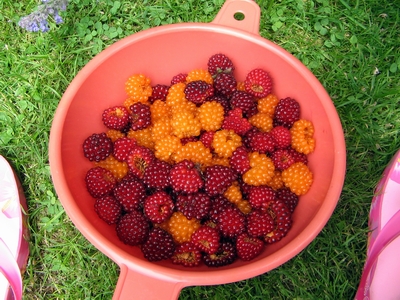
The salmonberry (Rubus spectabilis) is a deciduous bramble in the rose family (Rosaceae) native to western North America. It is best known for its clustered, raspberry-like fruits that range in color from deep red to bright orange or golden. Common in moist, coastal and riparian forests, salmonberry is valued both ecologically and culturally: it provides summer fruit for people and wildlife and grows readily on disturbed ground and forest edges.
Image gallery
8 Images


Identification and physical characteristics
Salmonberry is a shrubby plant that forms canes and thickets. Key identifying features include:
- Stems: Erect or arching canes that are often smooth or sparsely prickled, sometimes forming dense patches.
- Leaves: Compound leaves typically with three leaflets (occasionally five); leaf surfaces vary from smooth to slightly hairy and may show paler undersides.
- Flowers: Showy pink flowers with five petals appear in spring; they are solitary or in small clusters.
- Fruit: An aggregate of drupelets resembling a raspberry; color varies from orange to red. The flesh is soft and juicy when ripe.
Range, habitat and growth
Salmonberry occupies a range along the Pacific coast and nearby inland areas, occurring from southern Alaska through British Columbia and into parts of the Pacific Northwest and adjacent interior regions. It favors cool, moist sites such as streambanks, wet clearings, forest edges, and recently disturbed areas. The species tolerates shade but fruits best where some sunlight reaches the canopy openings.
Ecology, wildlife and human uses
Ecologically, salmonberry is an important early- to mid-season food source for birds, small mammals, and bears. Its dense thickets provide cover and nesting habitat for wildlife. Humans have long harvested salmonberries for fresh eating, cooking, and preservation. Common uses include:
- Fresh consumption: ripe berries are eaten raw and are noted for a mildly sweet flavor.
- Processed foods: jams, jellies, syrups, and fruit preserves using salmonberries are traditional and popular.
- Traditional uses: Indigenous peoples of the Pacific Northwest have used the berries and other parts of the plant for food and, in some cases, for cultural purposes.
- Other uses: berries can be used for natural dyes; stems and canes may be incorporated in informal crafts.
Cultivation, spread and management
Salmonberry spreads by seed and by vegetative means such as rhizomes, which allows it to colonize disturbed soils and to form extensive stands. Because of its rapid growth and ability to dominate openings, some land managers classify it as weedy in certain contexts. When cultivating or harvesting, people commonly select sunny spots to encourage larger fruit yields. Management of unwanted thickets often involves mechanical removal, repeated cutting, or careful site restoration to favor other vegetation.
Similar species and notable distinctions
Salmonberry can be confused with other Rubus species such as thimbleberry (Rubus parviflorus) and certain raspberries. Distinguishing traits are the combination of pink flowers, three-part leaves, and the distinctive orange-to-red fruit color range. Like other members of the rose family, salmonberry produces aggregate fruits made of small drupelets rather than a single berry.
For general species information and identification keys see species overview. For habitat and management guidance consult regional plant guides. Cultural histories and traditional uses are discussed in sources such as ethnobotanical references. Field observations and photographs are available via plant databases, and conservation or land-management details can be found through resource pages.
Related articles
Author
AlegsaOnline.com Salmonberry (Rubus spectabilis): appearance, habitat, and uses Leandro Alegsa
URL: https://en.alegsaonline.com/art/86521