
Ruwer River — Tributary of the Mosel in Rhineland-Palatinate
The Ruwer is a 46 km tributary of the Mosel in western Germany, flowing through a historic wine valley near Trier known for steep-slope Riesling and attractive hiking and cultural sites.
The Ruwer is a small river in western Germany that joins the Mosel River north of Trier. Rising in the hills of the Hunsrück and running through a narrow, largely rural valley, the Ruwer drains an area noted for old vineyards, compact villages and scenic, steep slopes. It is one of the Mosel's important right-bank feeders and forms a recognizable sub-valley within the larger Mosel landscape.
Image gallery
3 Images
Physical characteristics
The river is approximately 46 km long (about 28.6 mi) and functions as a tributary of the Mosel. Its course is relatively short compared with major German rivers, but it cuts through varied rock types and soils that influence land use and viticulture. The Ruwer's flow regime is typical of small temperate rivers, with higher discharge in late winter and spring and lower flows in summer.
Valley, viticulture and settlements
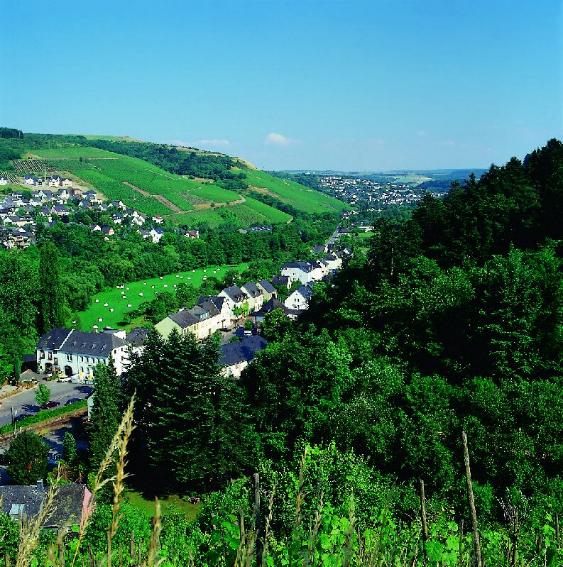
The Ruwer valley is an integral part of the historic Mosel-Saar-Ruwer wine region, today often referred to in simplified form as Mosel (Mosel-Saar-Ruwer). Vines were planted here for centuries, and steep, slate-rich slopes along the lower valley favour Riesling, a grape variety for which the area is especially renowned. Close to the confluence with the Mosel are small communities and suburbs associated with the city of Trier, and the valley includes several villages that participate in vine cultivation.
- Lower-valley settlements: Waldrach
- Kasel
- Mertesdorf
- Eitelsbach (near Trier)
- Ruwer
History and cultural importance
The area around the Ruwer has been shaped by human activity for millennia. Roman influence around nearby Trier introduced and expanded viticulture, terracing and road connections. Over successive centuries the valley remained agricultural, with wine production forming a persistent economic and cultural backbone. Old wineries, village churches and pathways attest to this long continuity.
Recreation, environment and administration
Administratively the river lies within Rhineland-Palatinate. Today the Ruwer valley attracts walkers, cyclists and wine tourists who use marked trails and local tasting routes. Conservation efforts focus on protecting riparian habitats and balancing agricultural use with biodiversity. Flood mitigation and water-quality monitoring are ongoing local priorities, especially where villages and vineyards come close to the riverbanks.
Notable facts and distinctions
Although modest in size, the Ruwer is notable for its concentrated wine terroirs and proximity to Trier, one of Germany's oldest cities. Its Riesling wines are valued for their minerality and acidity derived from slate soils and the cool Mosel climate. As part of the larger Mosel valley system, the Ruwer illustrates how small tributaries can have outsized cultural and economic importance.
Related articles
Author
AlegsaOnline.com Ruwer River — Tributary of the Mosel in Rhineland-Palatinate Leandro Alegsa
URL: https://en.alegsaonline.com/art/84927