
Celestial sphere — concept and role in astronomy and navigation
An explanatory overview of the celestial sphere: an abstract, concentric coordinate surface used to locate objects on the sky, its parts, history, applications, and limitations.
Overview
The celestial sphere is an imaginary spherical surface of arbitrarily large radius on which the positions of stars, planets and other celestial objects are projected for the purpose of mapping the sky. In practical terms it provides a two‑dimensional framework that observers use in astronomy and navigation to specify directions independent of an object’s distance. The sphere is usually treated as concentric with Earth and sharing the same axis so that familiar terrestrial directions (poles, equator) have celestial counterparts.
Image gallery
6 Images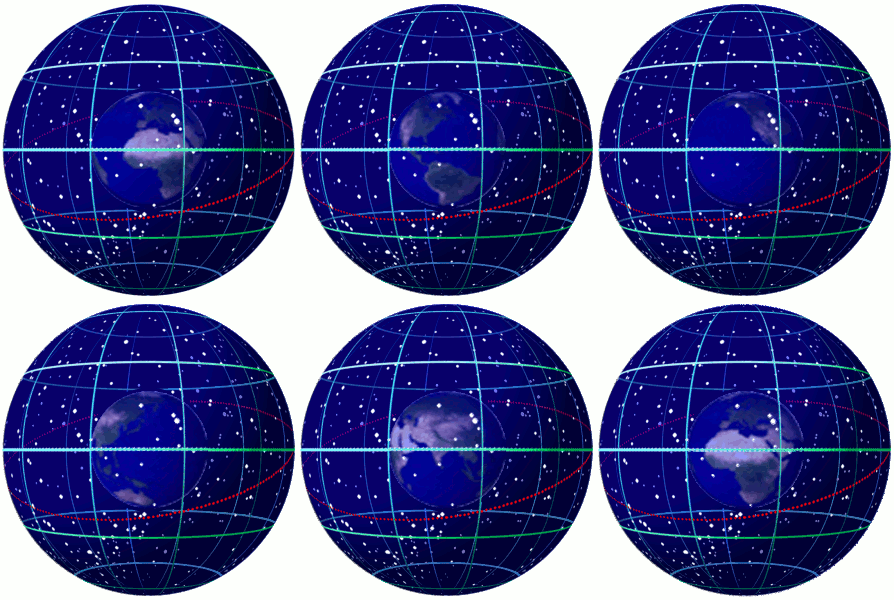




Key parts and coordinate elements
Several named circles and points on the celestial sphere underpin observational astronomy. Important ones include:
- Celestial poles — points where Earth's axis, extended to the sphere, intersects it.
- Celestial equator — projection of Earth's equator onto the sphere.
- Ecliptic — the apparent path of the Sun through the sky over a year.
- Zenith and nadir — the points directly overhead and underfoot for a given observer.
Positions on the celestial sphere are commonly given by the equatorial coordinates right ascension and declination, or by local coordinates such as altitude and azimuth. These coordinate systems turn the abstract surface into a practical coordinate grid for locating objects.
Uses and practical applications
Because the celestial sphere encodes direction but not distance, it is a convenient tool for star charts, telescopic pointing, and celestial navigation. Sailors and navigators historically used star positions to determine latitude and to guide courses; modern observers use the same conceptual grid when aligning instruments or planning observations. The sphere also simplifies calculations of rising and setting, conjunctions, and the apparent daily motion caused by Earth’s rotation, and it underlies spherical trigonometry methods used in positional astronomy.
History and conceptual development
The idea of a celestial sphere dates back to ancient observers who visualized the heavens as a dome of fixed stars rotating about Earth. Over centuries the model evolved: it became a mathematical abstraction in Hellenistic astronomy and remained prominent through medieval and early modern periods as a useful coordinate frame. With improved understanding of stellar distances and orbital mechanics the sphere is no longer thought of as a physical shell, but it persists as an indispensable conceptual and computational device.
Limitations, distinctions and notable facts
While powerful, the celestial sphere is an idealization. Phenomena such as parallax, proper motion and atmospheric refraction cause real stars and planets to deviate from fixed positions on the sphere; these effects must be corrected for precise work (parallax and proper motion) and for the observer's location and time. There is also a distinction between a geocentric celestial sphere (centered on Earth) and a topocentric version (centered on a particular observer), which affects apparent position slightly. The ecliptic’s tilt with respect to the celestial equator explains seasonal changes and is a central feature when plotting planetary paths. For foundational explanations and coordinate conventions see introductory texts and reference guides in observational astronomy and spherical astronomy (imaginary surface, axis).
Questions and answers
Q: What is the celestial sphere in astronomy and navigation?
A: The celestial sphere is an imaginary sphere of a very large unspecified size that is used in astronomy and navigation.
Q: How is the celestial sphere related to the earth?
A: The earth and the celestial sphere have the same centre and are concentric. They also rotate upon the same axis.
Q: What is the purpose of the celestial sphere?
A: The celestial sphere is a very practical tool for positional astronomy, as all objects in the sky can be thought of as projected upon it.
Q: Is the celestial sphere a physical object?
A: No, the celestial sphere is an imaginary sphere.
Q: What objects can be thought of as projected upon the celestial sphere?
A: All objects in the sky can be thought of as projected upon the celestial sphere.
Q: How is the celestial sphere useful in navigation?
A: The celestial sphere can be used to determine the position of objects in the sky relative to the observer, which can aid in navigation.
Q: What is the size of the celestial sphere?
A: The size of the celestial sphere is unspecified and is imaginary in nature.
Related articles
Author
AlegsaOnline.com Celestial sphere — concept and role in astronomy and navigation Leandro Alegsa
URL: https://en.alegsaonline.com/art/17870
Sources
- irbs.com : The American Practical Navigator