
Roman calendar
The system of months and dating used in ancient Rome, evolving from an early lunar scheme to the solar Julian calendar and influencing modern Western calendars.
The Roman calendar refers to the methods used in ancient Rome to divide the year into months, weeks and days. Early forms were closely tied to lunar phases and to agricultural cycles, but over centuries the system was reworked into a principally solar civil calendar. The calendar shaped religious festivals, legal deadlines and public life across the Roman Kingdom, Republic and Empire.
Image gallery
7 Images


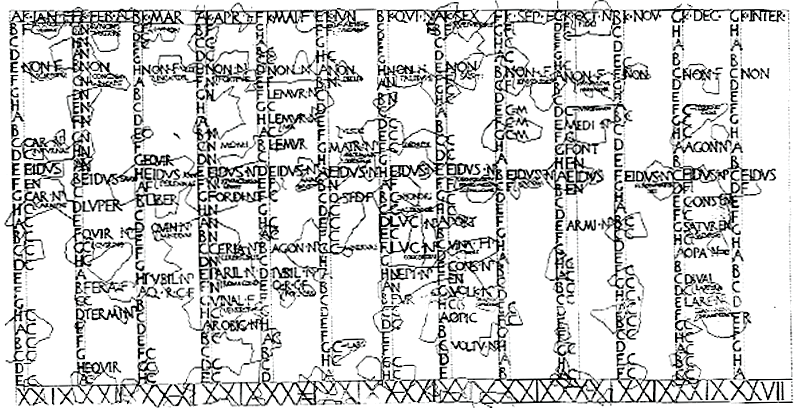
Origins and early structure
According to Roman tradition, an initial calendar attributed to Romulus had ten months and left a winter period unassigned to months. Later reforms, often credited to the second king Numa Pompilius, expanded the year to twelve months to better match the lunar year. These early arrangements retained many lunar features: months were associated with moon phases and the position of festivals.
Key features and terminology
Roman days were reckoned by counting backward from three fixed points in each month: the Kalends (first day), the Nones (around the 5th or 7th) and the Ides (around the 13th or 15th). Religious and civic observances were scheduled by these reference days rather than by sequential numbering. Intercalation — the insertion of an extra period to keep the calendar aligned with the seasons — was practised irregularly and controlled by priests, especially the pontifex maximus.
- Months had names that reflected gods, numbers or rulers (e.g., Martius, Aprilis, Quintilis/July, Sextilis/August).
- Religious festivals and market cycles were integral to the calendar’s function.
- Intercalary months and ad hoc adjustments were common before reform.
Reform and legacy
By the late Republic the lunar-based system had drifted from the solar year, disrupting agriculture and administration. In 45 BCE Julius Caesar introduced a comprehensive reform, the Julian calendar, which abandoned lunar reckoning in favor of a 365-day year with a leap day every four years. This reform standardized month lengths and names and became the civil calendar of the Roman world. Later adjustments led to the Gregorian calendar used today.
The Roman calendar influenced modern timekeeping in numerous ways: month names (July, August, March), the notion of leap days, and some dating conventions survive. For more on ancient lunar practices see resources on lunar calendars. For context about the political entities that used these systems see the Roman Kingdom and the Roman Republic.
While many details of early Roman calendrical practice remain subject to scholarly debate, its broad trajectory—from lunar origins through priestly management to the Julian solar reform—is well attested and central to understanding Roman public and religious life.
Related articles
Author
AlegsaOnline.com Roman calendar Leandro Alegsa
URL: https://en.alegsaonline.com/art/83840
Sources
- webexhibits.org : "The Christian Calendar"