
Rhinoceros hornbill (Buceros rhinoceros)
A large Southeast Asian hornbill with a prominent casque and powerful bill. Lives in lowland rainforests, eats mostly fruit and nuts, nests in tree cavities and is threatened by habitat loss and hunting.
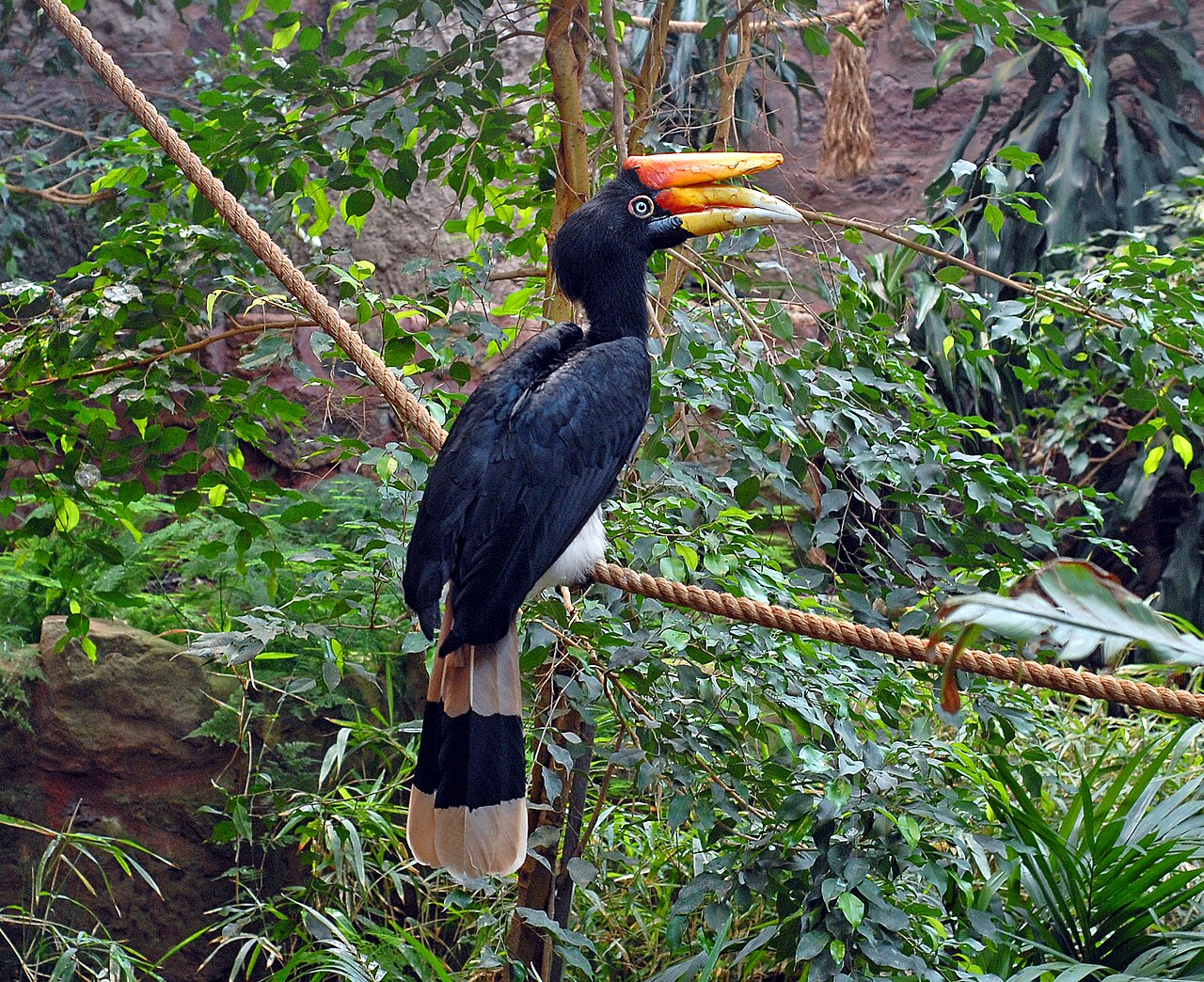
The rhinoceros hornbill (Buceros rhinoceros) is one of the largest members of the hornbill family and is immediately recognizable by the tall hollow casque that rises from the upper beak. Adults are often compared in size to a swan and stand out in the forest canopy. For general background on hornbills see hornbill overview and for size comparisons see size references.
Image gallery
9 Images


Appearance and anatomy
This species has bold black and white plumage with a long, curved bill topped by a prominent casque. The casque is lightweight and hollow, thought to amplify calls, strengthen the bill or play a role in social display. The bill itself is a versatile tool: long and robust enough to handle large fruit, strip bark and crack tough husks.
Range and habitat
Rhinoceros hornbills inhabit lowland and hill rainforests across parts of the Malay Peninsula and nearby islands, and extend into areas of southern Thailand. They are typically found in mature forest where large tree cavities are available for nesting. See region pages for Malaya and Thailand for context: Malaya, Thailand, and habitat notes at forest ecology.
Diet and behaviour
Primarily frugivorous, rhinoceros hornbills feed on a variety of forest fruits and play a key role as seed dispersers. They also consume nuts and will take small vertebrates or insects opportunistically. Their bill is used to pluck fruit, open tough shells and manipulate food: see fruit and nut references fruits and nuts.
Reproduction and conservation
These hornbills are cavity nesters. The female typically seals herself inside a tree hole during incubation and early chick-rearing, leaving only a narrow slit through which the male passes food. This specialised breeding strategy depends on large, old trees and intact forest structure. Populations are vulnerable to habitat clearance, logging and hunting; conservation actions focus on protecting forest habitat, preserving nest trees and reducing illegal capture.
Notable facts
- Important seed dispersers that help maintain tropical forest diversity.
- Have cultural significance for many indigenous and regional communities, often appearing in art and local symbols.
- Dependence on large trees makes them sensitive indicators of forest health.
For more detailed species accounts, distribution maps and conservation status consult specialist resources and regional bird guides linked above.
Related articles
Author
AlegsaOnline.com Rhinoceros hornbill (Buceros rhinoceros) Leandro Alegsa
URL: https://en.alegsaonline.com/art/82512