
Ring‑necked snake (Diadophis punctatus): description, range, and behavior
A concise overview of the ring‑necked snake, Diadophis punctatus: appearance, habits, distribution, taxonomy, defenses, diet, and conservation notes for this small North American snake.
The ring‑necked snake (Diadophis punctatus) is a small, secretive species found across much of eastern and central North America. Recognizable by a contrasting collar or "ring" around the neck and a brightly colored underside, this snake is primarily nocturnal and often remains hidden under logs, rocks, and leaf litter. For general information on snakes see snake overview.
Image gallery
10 Images


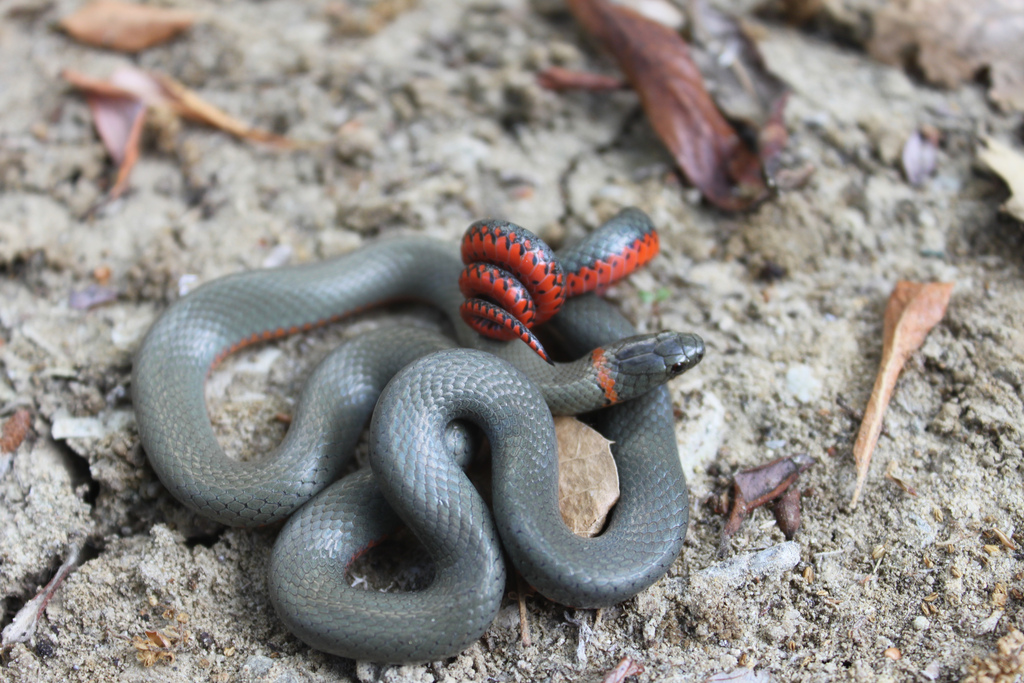


Description and behavior
Ring‑necked snakes are slender and relatively short compared with many other species. Colors and patterns vary widely between populations; many individuals have a smooth, dark dorsal surface with a pale neck band and a vivid ventral surface in shades of orange, red, or yellow. When threatened, they commonly curl the tail into a coil to display the belly and may excrete a foul musk from glands near the base of the tail.
- Nocturnal and secretive: most active at night and after rain.
- Defensive displays: tail curling, bright belly exposure, musk release.
- Small size: adults are compact and often difficult to spot.
Habitat and range
Ring‑necked snakes inhabit a variety of habitats including woodlands, grasslands, rocky hillsides, and riparian zones. Their range extends through the eastern and central United States into parts of central Mexico and southeastern Canada. Local populations occupy microhabitats that provide cover and moisture, such as under stones, beneath logs, and in decomposing leaf litter. For maps and regional details see distribution resources.
Diet, venom, and feeding
These snakes feed largely on small, soft‑bodied prey: salamanders, earthworms, slugs, small amphibians, and occasionally small reptiles. Ring‑necked snakes are rear‑fanged and produce a mild venom that helps subdue prey, but the venom is not considered dangerous to humans and bites are rare. More on their mild venom and feeding adaptations can be found at venom overview.
Taxonomy, subspecies, and research
Diadophis punctatus is the sole species in the genus Diadophis, a group recognized for its consistent neck band and bright belly coloration. Herpetologists and other researchers (scientific studies) have described numerous geographically distinct forms; depending on the authority, about a dozen to a few dozen regional subspecies or variants have been named. These subspecific distinctions reflect local color and pattern differences—see resources on subspecies and variation for more detail.
Because ring‑necked snakes are fossorial and secretive, population numbers are not precisely known in many areas. They are generally considered widespread and locally common, though habitat loss and fragmentation can cause local declines. The species attracts interest from naturalists for its striking ventral colors and calm temperament; it is sometimes kept by experienced hobbyists under specialized care. Predators include larger snakes, birds, and small mammals, and communal nesting has been reported in some regions.
Notable facts: the bright belly likely functions as an aposematic or startling signal when the snake exposes it during a defensive posture. Despite being mildly venomous, the ring‑necked snake poses little threat to people and plays an important role in controlling invertebrates and small amphibian populations in its ecosystems.
Questions and answers
Q: What is Diadophis punctatus?
A: Diadophis punctatus is a species of snake commonly known as the ring-necked snake.
Q: Where do ring-necked snakes live?
A: Ring-necked snakes live in eastern and central North America, the United States, central Mexico, and southeastern Canada.
Q: Why is it called the ring-necked snake?
A: It is called the ring-necked snake because it has a stripe around its neck that looks like a ring.
Q: When are ring-necked snakes active?
A: Ring-necked snakes are nocturnal, which means that they are active at night.
Q: Are ring-necked snakes venomous?
A: Yes, ring-necked snakes are a little venomous, but they do not hurt people because they are small and do not bite people much.
Q: How do ring-necked snakes protect themselves when scared?
A: When ring-necked snakes are scared, they curl up their tails.
Q: How many subspecies of ring-necked snake are there?
A: There are 14 subspecies of ring-necked snake, and it is the only species in its genus.
Related articles
Author
AlegsaOnline.com Ring‑necked snake (Diadophis punctatus): description, range, and behavior Leandro Alegsa
URL: https://en.alegsaonline.com/art/82958
Sources
- commons.wikimedia.org : Diadophus punctatus
- species.wikimedia.org : Ring-necked snake
- iucnredlist.org : "Diadophis punctatus"
- doi.org : 10.2305/IUCN.UK.2007.RLTS.T63769A12714288.en
- animaldiversity.org : "Diadophis punctatus (arnyi)"
- animaldiversity.ummz.umich.edu : "Diadophis punctatus arnyi "