
Ringed seal (Pusa hispida)
A small earless seal of the Arctic and sub-Arctic with distinctive light-rimmed spots. Ice-dependent, prey for polar bears, and culturally important to Arctic peoples; faces threats from sea-ice loss and habitat change.
Overview
The ringed seal (Pusa hispida) is a small phocid commonly called the jar seal and known by Inuit names such as netsik or nattiq. As an earless or true seal, it is adapted to life on and under sea ice and is the most widespread ice-associated seal in the northern hemisphere. Ringed seals are relatively small for seals, generally seldom exceeding about 1.5 metres in length, and are recognized for a distinctive coat patterned with dark spots encircled by lighter rings.
Image gallery
10 Images


Physical characteristics
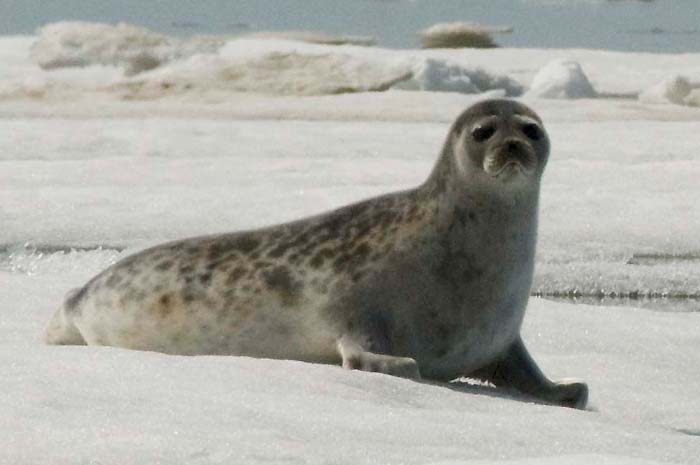
Ringed seals have a compact body, short snout and foreflippers with strong claws used to maintain breathing holes in ice. Their fur pattern — dark spots with pale rings — gives them their common name and helps break up their outline on ice and in water. They have the basic features of earless seals: no external ear pinnae, streamlined shape for efficient swimming, and a thick blubber layer for insulation in cold waters. Young pups are born with a lanugo coat that they lose as they grow.
Distribution and habitat
Ringed seals occupy a broad circumpolar range, from the central Arctic Ocean and adjacent seas to sub-Arctic waters. Populations are found across the Arctic and sub-Arctic region, including areas of the Arctic and the northern Pacific such as the Bering Sea and the Sea of Okhotsk and northern Japan, as well as across the North Atlantic coasts near Greenland and Scandinavia. Two well-known isolated freshwater populations occur in northern Europe as distinct subspecies (freshwater subspecies), restricted to lakes where they evolved after glacial isolation. Ringed seals rely on sea ice and shorefast ice for resting, moulting, and raising pups.
Behavior, reproduction and life cycle
Ringed seals are solitary or occur in loose aggregations and are most active at sea beneath the ice where they forage. They excavate and maintain breathing holes through ice with their foreflipper claws and build snow lairs on top of sea ice in which females give birth and shelter pups. Breeding occurs in late winter and pups are born in spring; pups are nursed on high-fat milk for a period of weeks to a couple of months before the first moult. The species has adaptations for diving and can remain submerged for extended periods while hunting fish and invertebrates.
Diet and predators
The diet of ringed seals consists mainly of small fish and marine invertebrates, which they capture beneath the ice. As a key component of the Arctic food web, ringed seals are the primary prey of polar bears and are also taken by other predators, including Arctic foxes (often scavenging or taking young pups) and some cetaceans. Their close ecological link to polar bears makes them important both biologically and culturally.
Human uses, conservation and notable facts
Ringed seals have long been important to Indigenous peoples of the Arctic for food, clothing and oil, and they remain central to many traditional livelihoods; Indigenous knowledge continues to inform management. Conservation concerns center on loss and thinning of sea ice caused by climate change, which reduces suitable habitat for breathing holes, lair construction and pup rearing. Other pressures include pollution, disturbance, and localized hunting or bycatch. Some isolated populations, notably the lake subspecies, are of particular conservation concern and have attracted targeted protection measures. Management and research often combine scientific monitoring with local knowledge and international cooperation.
Further reading and resources
- General biology and identification: earless seals overview
- Range maps and regional reports: Inuit and local knowledge resources, Arctic studies, Arctic Ocean information
- Regional ecosystems: Bering Sea, Okhotsk and northern Japan, Greenland, Scandinavia
- Subspecies and freshwater populations: lake populations
- Predator-prey relationships: polar bear interactions
Questions and answers
Q: What is a ringed seal?
A: A ringed seal is an earless seal that lives in the Arctic and sub-Arctic areas.
Q: What is the size of a ringed seal?
A: A ringed seal is rarely greater than 1.5 m in length and is a small seal.
Q: What is the distinctive patterning of a ringed seal?
A: A ringed seal has dark spots surrounded by light grey rings.
Q: Where do ringed seals live?
A: Ringed seals live throughout the Arctic Ocean, into the Bering Sea and Okhotsk Sea as far south as the northern coast of Japan in the Pacific, and throughout the North Atlantic coasts of Greenland and Scandinavia as far south as Newfoundland, and include two freshwater subspecies in northern Europe.
Q: What is the most abundant and wide-ranging ice seal in the northern hemisphere?
A: The ringed seal is the most abundant and wide-ranging ice seal in the northern hemisphere.
Q: What is the diet of a polar bear?
A: Ringed seals are one of the main prey of polar bears.
Q: Who eats ringed seals?
A: Indigenous people of the Arctic have long been eating ringed seals as part of their diet.
Related articles
Author
AlegsaOnline.com Ringed seal (Pusa hispida) Leandro Alegsa
URL: https://en.alegsaonline.com/art/82967
Sources
- iucnredlist.org : "Pusa hispida"
- elsevier.com : Encyclopedia of Marine Mammals
- bbc.co.uk : bbc.co.uk
- nmfs.noaa.gov : "Ringed Seal (Phoca hispida)".
- globaltwitcher.auderis.se : Polar Bear: Ursus maritimus, globalTwitcher.com, ed. Nicklas Stromberg
- doi.org : 10.1016/j.icesjms.2006.04.001
- nmfs.noaa.gov : "Ringed Seal (Phoca hispida): Alaska Stock"
- commons.wikimedia.org : Pusa hispida